
IRU Secretary General Umberto de Pretto has been in the road transport industry for over 30 years. As he prepares to hand over the reins, we sat down with him to reflect on those three decades. The first part of the interview looks at the industry. The second is on IRU itself.
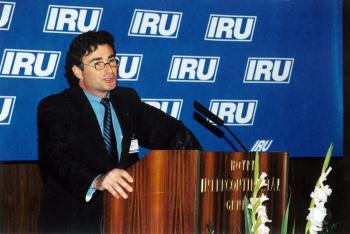
Umberto de Pretto did not arrive at IRU in 1995 as a road transport insider.
At the time, he had worked mainly on other transport modes as a legislative assistant at the Canadian House of Commons in Ottawa and then as Deputy Director at the International Chamber of Commerce in Paris.
“I went in with a very naive view,” he recalled. “Why would you transport goods over long distances on a truck? Put it on something else.”
That view changed quickly.
What struck him was the door-to-door reach and flexibility of the industry. Road transport was not just one option among many. It was often the only workable option. People depend on trucks, buses, coaches and taxis reaching places that other modes simply cannot.
His early political experience in Canada also brought another lesson to his new job. Policymakers often do not understand the basic economic and operational realities of road transport because the sector has not explained itself clearly enough.
“It’s up to us to tell them, to educate them about the realities of road transport,” he said. “That means speaking in terms that matter to governments: the economy, constituents, money, jobs, safety, sustainability and practical facts that clearly illustrate these. Not just what is right for the industry, but what works for society.”
Paper, paper, paper
The industry has evolved significantly over the past 30 years.
A key but ongoing shift has been digitalisation. In the mid-1990s, road transport was still largely paper-based. “Fewer than 20% of companies had an email. Even IRU didn’t have one in 1995,” Umberto de Pretto noted.
That has changed. Operators now use technology to manage fleets, track vehicles, monitor drivers and improve operations.
But progress has been uneven. The road transport sector is dominated by SMEs. That gives the sector flexibility. It also sometimes makes transformation harder.
“No other transport sector is as fragmented as ours,” said Umberto de Pretto, pointing to the large share of SMEs in the sector.
This fragmentation explains why some changes take longer. Digital consignment notes, electronic signatures and autonomous vehicles have all advanced more slowly than expected. The technology may exist. But the market must adopt it. For many owner-operators, the benefits are not always obvious or immediate – let alone affordable. SME margins of only 1–3% can make capital investment challenging.
eCMR is a good example. Electronic signatures were already being used for air waybills in the early 1990s. Yet the road transport ecosystem – operators, users, suppliers and regulators – is still trying to figure out how to handle digital signatures decades later, despite the eCMR protocol being agreed in 2008.
Deregulation fallout
Deregulation is another key development from the past 30 years, leading to two very different situations in North America and Europe.
In the US, deregulation pushed the industry to consolidate, creating larger trucking companies. In Europe, consolidation has been different. Large players are more often multimodal logistics groups or freight forwarders. Pure road transport companies, generally, remain smaller now than when Umberto de Pretto first started at IRU.
“In the EU, it is actually easy to become a small road transport operator without the business experience or knowledge needed to survive,” said Umberto de Pretto.
“Just because you can use the tool doesn’t mean that you’re a good businessperson. If knowing how to use the tool was sufficient most of us, as car drivers, should be able to start a taxi company tomorrow! Get my point?”
This matters. Poor business knowledge can push prices down to unsustainable levels, increase risk and, over time, make the profession less attractive.
“People can enter the market with little capital, leased vehicles and limited business knowledge. But the business environment is tough, not least with regulations and technology changing constantly. We must be careful that operators – of all sizes – have the skills to run a business as well as run vehicles,” he added.
For him, there is still opportunity in road transport. But it depends on knowledge, geography and strategy. Asked what he would tell his own sons if they wanted to enter the sector, he said he would advise them to look for a specialist niche, use technology, or take their expertise to regions where it could drive development.
Lingering challenges
Several problems have improved, at least politically. Secure truck parking was once a huge concern with little recognition.
“Today, the problem is far from being solved. But at least it is recognised,” highlighted Umberto de Pretto. “Governments understand that drivers need safe places to rest if they are expected to comply with social rules and stay safe on the road.”
Driver shortage is another familiar challenge. It is more visible today – but it is not new. “Attracting people to the industry has always been a problem,” he said.
What has changed is the pressure around the profession. Documentation requirements, smart tachographs, rest time rules. One former truck driver, turned politician, once told him that driving had become less enjoyable because the EU had over-regulated the profession after entry, while keeping access to the profession relatively easy.
Old foes
The relationship between road and rail has finally matured. Thirty years ago, the debate was often hostile. “Every conference was about road versus rail,” he recalled.
That has softened. Road and rail are increasingly seen as complementary. The remaining competition is mostly for infrastructure funding. The practical challenge is no longer whether one mode should defeat the other. It is how to make the overall system work better.
For Umberto de Pretto, the key is smarter investment. Rail can work better with road if terminals and transshipment facilities improve. Faster loading, unloading and intermodal connections matter more than slogans. And digitalisation will greatly facilitate the ability to seamlessly move from one mode to another.
Ear to the ground
Passenger transport has followed its own path. Umberto de Pretto sees one of the most important changes in the rapid uptake of battery-electric buses. For passengers, the experience is quieter. For cities, electrification has made an already efficient, safe and clean collective transport mode even more attractive.
He also sees a difference in mindset.
Bus and coach operators are very close to the customer because passengers are physically on board. They see the service, experience it and react to it.
How we’re seen
Thirty years ago, people often viewed the sector negatively. Today, there is more recognition that road transport, including its drivers, is essential. That we are an imperative part of the solution, not just seen as the problem.
In North America, he notes, truck drivers have long had a different image: closer to “modern-day cowboys”. In Europe, the perception has often been less positive. But even that has improved.
The pandemic accelerated the shift.
“I think Covid-19 got people to wake up and smell the coffee,” said Umberto de Pretto. “They realised that ‘these people are keeping things moving’.”
For him, the industry’s response to crises is one of its defining strengths.
“During the pandemic, natural disasters and wars, we get people out and essentials in. Many operators often do these heroic actions voluntarily. There’s a problem. ‘I have a truck. I have a bus. How can I help?’ That’s the most amazing part about this industry.”
After 30 years, road transport is more digital, more recognised, and more central to resilience. Yet it is still fighting familiar battles: borders, driver shortage, safety, fragmentation and regulation.
“The industry has changed in many ways. But its basic role has not: it still delivers – and always will,” concluded Umberto de Pretto.
Part 2 is on IRU: from European TIR body to global road transport voice.