How has IRU changed over the past 30 years? This was the question we put to IRU Secretary General Umberto de Pretto as he prepares to hand over to his successor.
When Umberto de Pretto looks back at IRU over the past 30 years, one contrast stands out. The organisation he joined in the mid-1990s was paper-based, European-focused and identified almost entirely with TIR. The organisation he later led became broader, more global and, very importantly, more member-driven.
The change did not happen overnight.
“In 1995, IRU had no email. No website. No real digital infrastructure. Documents were sent by post. They were printed on different coloured paper depending on the language. Members received large stacks of paper every week,” recalled Umberto de Pretto.
Even in 1999, IRU had one shared mobile phone and one shared email address. Credit cards were not standard. Basic office tools that now seem normal were still controversial.
Umberto de Pretto pushed for change. Staff needed mobile phones and emails: the new tools to work faster and more professionally.
The shift was practical and cultural. IRU had to move from paper distribution to targeted communication. It had to stop sending everything to everyone. Members needed easier access to what mattered to them.
That led to new digital systems and new ways of working. It also reflected a wider change in the industry itself, as operators slowly moved from paper to digital tools.
But the biggest transformation was not technological. It was strategic.
The ‘TIR guys’
Thirty years ago, IRU was seen above all as the “TIR organisation”.
“The moment you walked in the room, ‘the TIR guys were here’,” Umberto de Pretto recalled.
That made sense. TIR was – and is – central to IRU’s work. He recalled that most of his early speeches were about TIR, with sustainable development taking a smaller share.
Over time, that balance changed.
IRU has remained the guardian and promoter of TIR. But it also became active on a much wider agenda: trade facilitation, road safety, professionalisation, resilience, driver shortage, digitalisation and decarbonisation.
TIR itself also evolved in ambition.
For Umberto de Pretto, TIR was never just a customs tool. It was designed to give road transport operators more independence and to make international transport more efficient, predictable and secure.
Truly global
In the 1990s, IRU was still overwhelmingly European in outlook. Its maps, its mindset and its priorities were centred on Europe. TIR was used mainly in that space, and there was little proactive effort to expand it.
That changed. IRU pushed TIR into major markets and strategic geographies: Central Asia, the Middle East, China, India, and now South America. For Umberto de Pretto, these were essential steps. “If you want to expand it, you need China, you need India, you need Saudi Arabia, and you need Brazil,” he said.
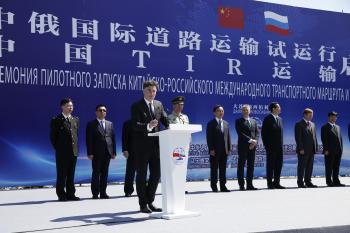
The logic was geographic and economic. Saudi Arabia is essential for the Middle East. China, with its many neighbours, could change the dynamics of trade across Asia. Brazil is central to any serious discussion of TIR in South America.
Africa remains his biggest frustration. He sees it as the continent that needs TIR most. Border delays and weak trade links continue to hold back regional commerce. The potential is enormous. But political will has been difficult to secure.
For Umberto de Pretto, this is not an abstract issue. He points to an analysis conducted by the African Union which concluded that TIR could double trade overnight within Africa. Intra-African trade remains low, while border crossings can take days or even weeks. Goods that could move inland quickly often remain delayed at ports and borders.
“Nobody in the entire world needs TIR more than the African continent,” he said.
Sustainable = profitable
Road transport has also become more sustainable.
IRU was the first global transport organisation to launch a sustainable development charter, which was then enshrined into IRU’s Constitution, in 1996.
But for Umberto de Pretto, sustainability is not just about image. It is about business. Cleaner, safer and more efficient operations are also more profitable.
The industry now turned its attention to carbon dioxide.
To address the decarbonisation challenge, IRU launched the Green Compact, a global commitment adopted by IRU members in 2021 to identify solutions and develop pragmatic roadmaps for the industry to reach carbon neutrality by 2050.
Fully digital?
Digitalisation of TIR is another unfinished task.
Umberto de Pretto is proud of the progress made but frustrated by the pace. He recalls the first digital TIR movement in 2016 between Türkiye and Iran, when both customs and transport operators saw great benefits. Yet years later, the full transition to eTIR is still not complete, but we’re getting there.
Behind TIR sits another issue that is often overlooked: financial responsibility. IRU does not only promote a system. It carries significant risk. Umberto de Pretto points to the scale of guarantees issued through the TIR system, worth tens of billions of euros per year.
For him, that responsibility needs to be much better understood by our public partners. TIR is not only paperwork or procedure. It is a tried, tested and trusted system built on guarantees, risk management and confidence between customs authorities and operators.
Listen, listen, listen
When Umberto de Pretto became Secretary General in 2013, he wanted members to have a stronger voice. His message was simple: “I will listen, listen, listen!”
He wanted the board and members to shape decisions. Strategy, investments and priorities had to be approved through proper governance, not dictated from the top.
“I want to hear what you really think. That way, collectively, we will come up with the best decisions for IRU, for our members, and for the industry we so proudly represent,” he told them.
For him, this is one of the biggest changes. Members now feel heard. They feel valued. They feel responsible. They help shape the direction of their organisation.
IRU also changed how it works with others. In the past, relationships with international organisations were often antagonistic. Today, Umberto de Pretto sees IRU as a credible partner to the UN, the World Bank, regional bodies and governments.
The organisation is more collaborative. More pragmatic. More focused on public-private partnerships. It has also strengthened its presence. Umberto de Pretto pointed to a stronger Brussels office, a stronger China office, more lobbying results and more global activities, even with fewer staff. “Our activities have gone from European to truly global. Truly, truly global.”
He also sees a stronger internal culture. Staff take more responsibility. They show more leadership. They deliver more across a broader agenda.
This matters deeply to him. IRU has become a stronger organisation, a strong team, not one dependent on a single person.
After three decades, IRU is still rooted in TIR. But it is no longer defined only by TIR.
It is now truly the global voice of the road transport industry.
And, as Umberto de Pretto sees it, its strength now lies in being trusted to deliver.
In part 1, Umberto de Pretto reflects on how the industry has evolved over the past 30 years.