
IRU brought together policymakers and the industry to clarify how EU driving and rest time rules apply as electric fleets scale up.
The EU’s transition to battery-electric heavy-duty vehicles is creating new questions, including how existing driving and rest time rules work in practice. Charging cycles, grid constraints and operational planning are beginning to influence how drivers’ working hours are organised across long-haul and regional transport.
IRU’s hybrid workshop (webinar replay), which took place in the framework of IRU's Commission on Social Affairs, brought together over 100 participants from the European Commission, vehicle manufacturers, energy providers, logistics operators, and charging infrastructure companies to examine how current legislation can be interpreted and applied consistently.
Participants warned that divergent national interpretations risk creating legal uncertainty for operators investing in electric fleets and could undermine the Single Market just as large-scale deployment begins.
The workshop examined how existing legislation can be applied consistently to new use cases such as depot charging, overnight charging at safe and secure parking areas, and opportunity charging during mandatory breaks, with the possibility of reopening the legislative framework itself. The focus was on clarification, common understanding, and workable solutions for both operators and enforcement authorities.
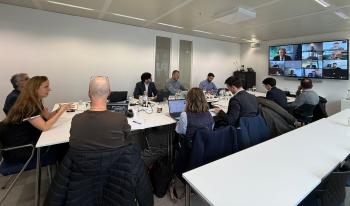
European Commission Director for Land Transport Kristian Schmidt said, “We need transparency and clarity, but also pragmatic solutions. Rest and break periods must remain real, social standards must be preserved, and a level playing field between operators ensured as electric trucks scale up.”
“The Commission is here to explain how the current rules apply, but also to listen and learn from real-life experience and assess whether further clarification may be needed,” he added.
Beyond regulatory interpretation, the debate also addressed the wider human impact of electrification, including on drivers’ working conditions, operational planning, skills, and workforce preparedness.

IRU EU Advocacy Director Raluca Marian said, “Much of the decarbonisation debate has focused on infrastructure and enabling conditions. This workshop showed that the successful deployment of electric fleets requires greater attention to the human component and daily operational realities.
“Driving and rest time rules must be applied in a way that preserves social standards while remaining workable for electric fleet operations.
“The workshop was the first step in IRU’s broader effort to place drivers, skills and workforce preparedness at the centre of Europe’s green and digital transition.”
The discussion will continue at IRU’s EU flagship conference in Brussels on 3 March, where policymakers and industry leaders will focus on skills, technology and the future of the transport workforce in the context of the green and digital transition.