Never miss a story!
Subscribe to our newsletter


IRU and EMTA call for workable Buy European rules for electric buses
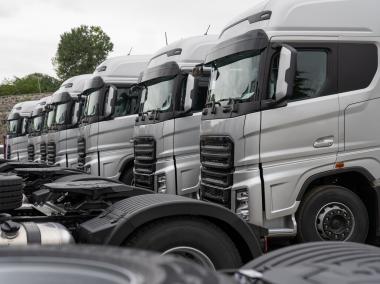
IRU and the European Metropolitan Transport Authorities (EMTA) are urging the Irish Presidency and Members of the European Parliament (MEPs) to fix key provisions in the Industrial Accelerator Act's proposed “Buy European” rules for electric vehicles. They warn that the current approach risks forcing working electric buses off the road and penalising public transport operators and authorities that bought them in good faith.

IRU welcomes EU move towards simpler digital fair labour mobility rules
IRU welcomes the European Commission’s Fair Labour Mobility Package published today, in particular its drive to digitalise social security and qualification procedures, improve interoperability between EU systems, and reduce the recurring administrative burden of cross-border labour mobility which falls disproportionately on small and medium sized firms, of which the vast majority of road transport operators are.

IRU welcomes EU procurement reform, calls for further improvements
The European Commission’s proposal for a new Public Procurement Regulation is a significant step towards quality-based competition, but further improvements are needed to ensure fair and competitive public procurement for road transport.
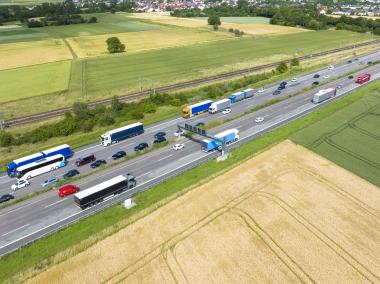
EU heavy-duty vehicle transition needs renewed political momentum
IRU and T&E are calling on European Commission President Ursula von der Leyen to launch a strategic dialogue on heavy-duty vehicle decarbonisation, as key EU rules head for review and rising energy and cost pressures add urgency to getting the transition right.

European contract and spot rates accelerate as fuel costs are passed on
The IRU x Upply x Ti Q2 2026 report shows that European contract and spot markets have accelerated sharply, breaking with the softer conditions seen through late 2025 and in Q1 2026. Contract rates rose to 148 index points, up 7.9 points quarter on quarter (QoQ) and 15.2 points year on year (YoY). Spot rates climbed even more steeply, reaching 146.8 index points, up 14.6 points QoQ and 13.9 points YoY, nearly double contract rate's quarterly pace. After three quarters of divergence, both markets
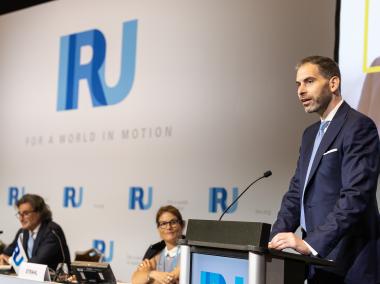
New IRU Secretary General Habib Turki takes the helm
Habib Turki has officially assumed office as IRU’s new Secretary General.

EU electrification plan strengthens support for heavy-duty decarbonisation
IRU welcomes the Commission’s recognition of road transport as one of the key sectors in its Electrification Action Plan, which is an important step towards creating the conditions needed for operators to invest in electric vehicles.


Eurovignette deal brings greater clarity on road charging for HDVs
IRU welcomes the provisional agreement reached by the European Parliament and the Council on targeted amendments to the Eurovignette Directive as an important step towards greater legal clarity on CO₂-based road charging for heavy-duty vehicles across the EU.

Cross-border vans enter new regulatory era under EU transport rules
A major regulatory shift began on 1 July for Europe’s van sector: cross-border light commercial vehicles (LCVs) above 2.5 tonnes must now comply with EU rules on driving and rest times, mandatory smart tachographs and driver posting. This means equipping vehicles with tachographs and adapting to entirely new compliance requirements affecting drivers and day-to-day operations.
Stronger EU grids can power road transport electrification
IRU takes note of the Council’s agreed negotiating position on the grids package as an important step towards strengthening the EU’s energy infrastructure to support electrification and decarbonisation.

2026 Connecting Europe Facility call delivers on key road transport asks
IRU welcomes the launch of the European Commission’s final Connecting Europe Facility (CEF) Transport call under the current 2021–2027 EU budget, which provides dedicated funding for three long-standing priorities of the commercial road transport sector: alternative fuels infrastructure, external border efficiency and digital innovation. The package includes EUR 130 million for alternative fuels infrastructure, EUR 20 million for external border-crossing improvements, and EUR 20 million for digi
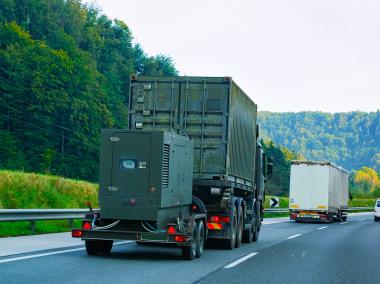
EU military mobility: trust and legal certainty key for civilian operators
IRU welcomes the progress made by the Council and the European Parliament on new EU rules to facilitate military mobility, while calling for stronger safeguards to ensure civilian road transport operators can effectively support defence logistics and mobility in times of crisis.

IRU calls for practical improvements to EU Industrial Accelerator Act
IRU’s new position paper on the European Commission’s proposed Industrial Accelerator Act (IAA) calls for practical adjustments to ensure the framework strengthens industrial competitiveness and decarbonisation without undermining the road transport sector.

EU urged to reach agreement on zero-emission heavy-duty proposal
IRU and T&E call for urgent political support to secure a pragmatic compromise in the ongoing trilogue negotiations on the Weights and Dimensions Directive in coordinated letters to the European Commissioner for Sustainable Transport and Tourism, Apostolos Tzitzikostas, the Cypriot Presidency of the Council of the EU, and the European Parliament’s lead negotiator, Rosa Serrano Sierra.

Parliament backs more proportionate EU vehicle checks and pragmatic tolls
IRU welcomes the European Parliament’s Committee on Transport and Tourism’s (TRAN) support for key positions on the Roadworthiness Package and the revision of Eurovignette rules on CO₂ emission classes for heavy-duty vehicles with trailers.

European road freight contract rates climb as fuel prices surge
The IRU x Upply x Ti report on European road freight rates in Q1 2026 reveals a divergence between contract and spot markets. Contract rates reached 140.1 index points, a solid 3.2-point increase quarter on quarter (q-o-q) and an 8.9-point increase year on year (y-o-y). Meanwhile, spot rates edged down slightly to 132.3 index points, falling by 2.8 points q-o-q and ending the period 2.0 points lower y-o-y.
EU crisis aid framework offers support, but national implementation is key
IRU welcomes the European Commission’s new Temporary Crisis Framework targeting several sectors most affected by the energy crisis, particularly the explicit recognition of the exceptional pressures facing road transport operators. However, Member State action remains key to turning the opportunities created by the framework into real support for the sector.
IRU and GPCA join forces to drive safety in dangerous goods transport
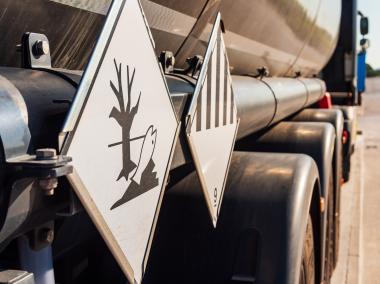
IRU, the world road transport organisation, and the Gulf Petrochemicals and Chemicals Association (GPCA), the voice of the chemical industry in the Arabian Gulf, have signed a memorandum of understanding (MoU) to advance safer dangerous goods transport.

EU adopts clear and proportionate rules for transport emissions accounting
IRU welcomes the European Parliament’s adoption of the agreement reached with the Council on the CountEmissionsEU regulation, establishing a common EU approach to emissions calculation for road transport. This marks the effective conclusion of the legislative process.

Fuel crisis: EU takes useful first steps, but plans must go further
IRU welcomes the targeted transport measures, calls for clearer contingency planning should supply conditions deteriorate, and expects broader financial support through a separate State aid framework.
EU transport ministers act on fuel crisis
EU transport ministers convened today in an informal video conference to assess the impact of developments in the Middle East on the transport sector, marking an important step towards a coordinated EU response to rising fuel costs and market volatility.

EU adopts updated package travel rules impacting coach operators
The revised Package Travel Directive updates the definition of package travel and clarifies travellers’ rights while introducing changes that will directly affect how coach services are organised, contracted and reimbursed within package tours.
Fuel crisis: IRU calls for urgent EU transport minister action
As the fuel market crisis intensifies across the EU, IRU has urged its transport ministers to take immediate and coordinated EU-level action to keep supply chains moving and protect people’s mobility.
Fuel market shock: IRU urges EU action to keep logistics moving
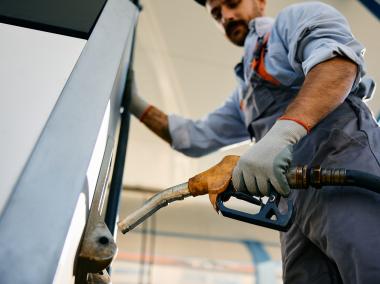
Surging diesel prices and tightening fuel supply are putting EU transport operators under immediate pressure and risk disrupting logistics chains. IRU is calling on the European Commission to urgently coordinate an EU-wide response to stabilise fuel markets and ensure the continued flow of goods.
EU industrial accelerator act must reinforce transport backbone
IRU welcomes the European Commission’s proposal for a regulation on the Industrial Decarbonisation Accelerator Act but warns that the transport dimension, the backbone of EU mobility and industrial supply chains, remains underrepresented.