
The war is entering its fifth week. A fragile diplomatic window has opened, but with no ceasefire in sight, energy markets remain tense. Here is the latest overview for the road transport sector.
This week’s dominant story has been the emergence of a tentative diplomatic opening, which has introduced some temporary downward pressure on oil prices, without reversing the underlying upward trend. However, despite Iran-US talks mediated by Pakistan, the situation remains deeply uncertain.
Impacts on local energy systems are likely to be felt at least through to the end of this year, as repairing and restarting production sites and realigning tanker capacity will take months, even if the war would stop tomorrow.
Prices at the pump
Prices have increased in all regions around the world this week.
In the US, diesel prices rose again this week. They are now 39% higher than at the start of the war. Even though the country is almost self-sufficient in oil, global crude oil prices still affect US operators, leaving them among those facing the steepest increases worldwide, although prices at the pump remain lower than in Europe due to lower excise tax levels.
In the EU, governments are beginning to take measures to mitigate price increases, support transport operators financially, and ensure adequate supply.
On price mitigation, Croatia, Hungary, Slovakia and Slovenia have introduced temporary price caps. Excise taxes have been slightly reduced in Croatia, Hungary, Ireland, Italy, and Portugal, but with limited effects for operators. This is the case notably in Portugal, where the reduction also triggered a reduction in the partial refund of excise taxes to operators.
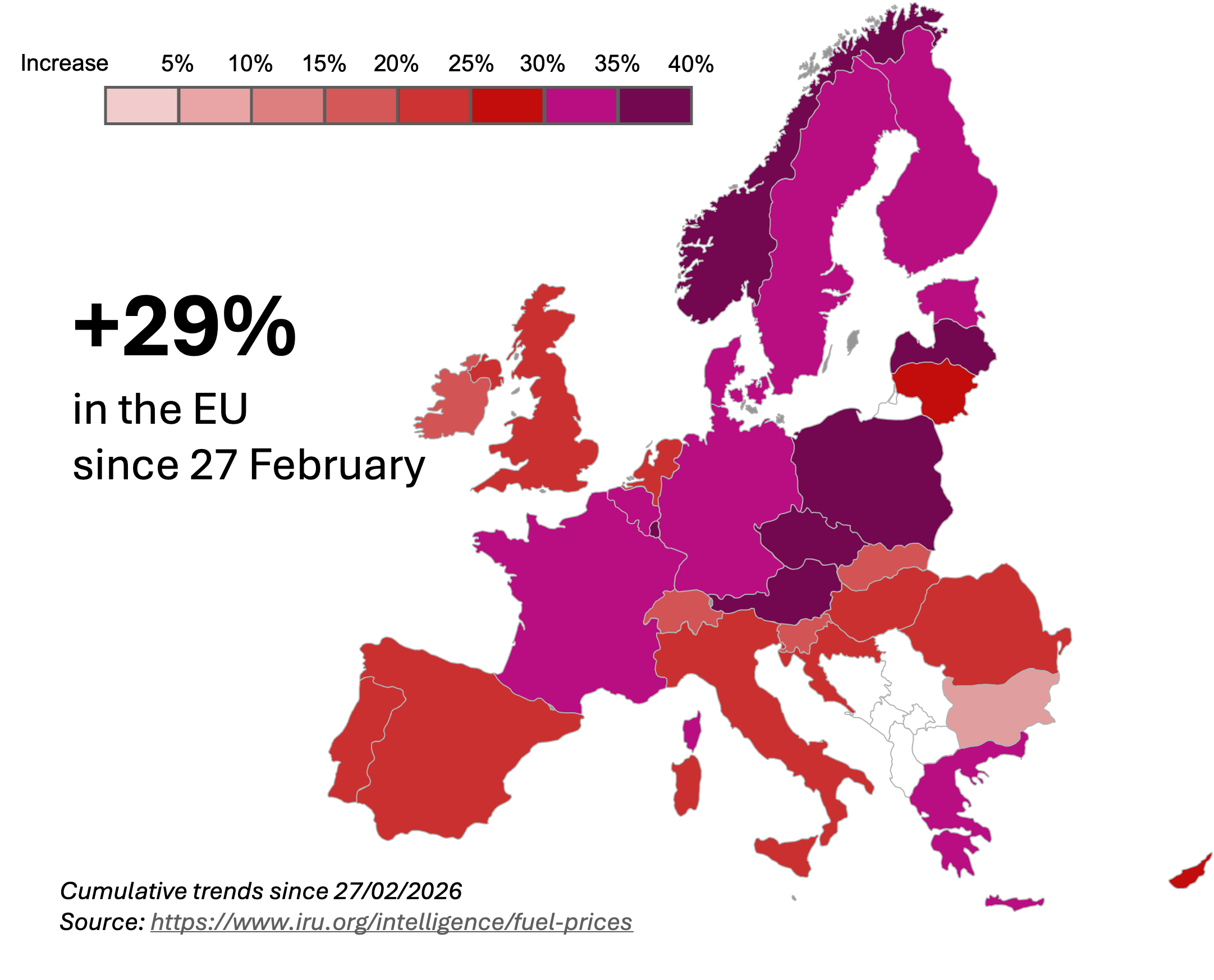
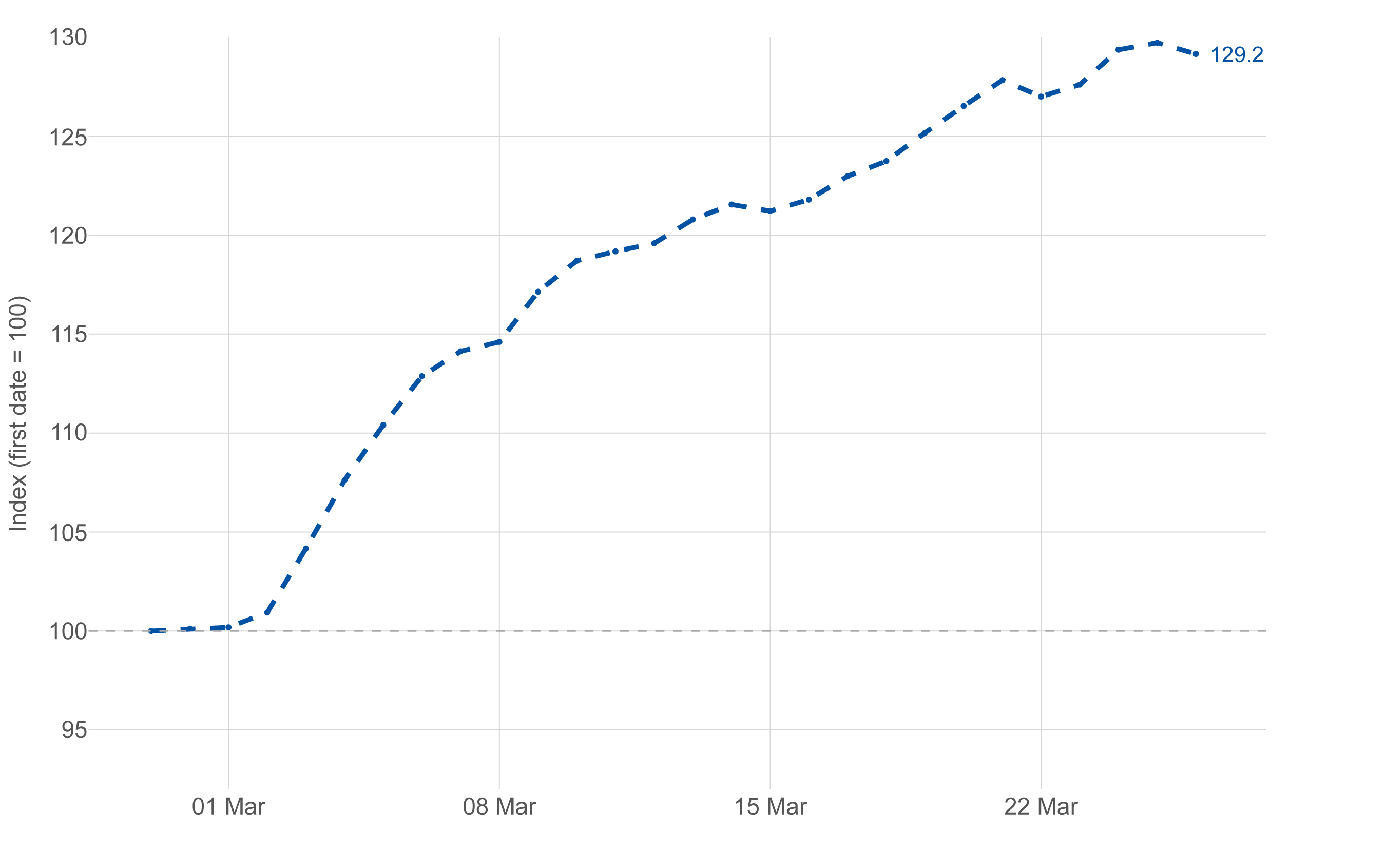
Despite these measures, the average weighted diesel price across the EU-27 stood at EUR 2.12 per litre as of 26 March, a 29% increase since the beginning of the war.
In other measures, Italy is allocating EUR 100 million to support the industry in 2026, while Greece is considering a multi-million-euro support package. And Spain reduced VAT to ease transport operator cash flow.
On the supply side, Slovakia and Slovenia have introduced rationing at the pump, and France is removing its winter diesel requirements, hoping to increase national diesel production to avoid shortages.
EU Average Diesel Price since 27 March
A growing concern for EU fleet operators is the supply of diesel additive AdBlue.
Polish media is reporting AdBlue supply disruption warnings that recall 2022 when prices surged from €0.35 to over €2.00 per litre and threatened the operating capacity of the Euro 6 truck fleet across Central Europe. As then, war in the Middle East is affecting natural gas supply chains, which in turn affects the supply of urea, AdBlue's primary ingredient, as it is produced from natural gas.
In China, average diesel prices rose again this week. Despite tankers successfully crossing the Strait bound for China and the government introducing a cap on price hikes on Monday 23 March, prices are now 25% higher than at the start of the war. Chinese authorities also committed to guiding refiners and distributors to coordinate production and transport of refined products to ensure adequate domestic supply.
Chinese authorities have also committed to guiding refiners and distributors to coordinate production and transport of refined products to ensure adequate domestic supply.
In Brazil, diesel prices have now risen by more than 20% since the start of the war; in Türkiye by 30%.
On 12 March, the Brazilian Government announced a package that reduces federal (social contribution) taxes on diesel, establishing anti-speculation oversight measures, creating a temporary BRL 0.32/L economic subsidy, and raising export taxes on crude oil and diesel.
The combined Brazilian tax cut and subsidy are designed to reduce diesel prices by BRL 0.64/L in total, conditional on proof that the amount was passed through to end consumers. The day following the announcement, energy providers raised diesel prices, cancelling any relief for transport operators.
In Türkiye, the government has activated the sliding scale on the ÖTV consumption tax, similar to a reduction of excise duty, absorbing a large element of the price increase at the pump. However, the measure is reaching its limit, and concerns are mounting on prices movements over the coming weeks.
Fuel prices and freight rates dynamics
Fuel prices account for about a third of truck total cost of ownership (TCO) and are the most important performance measure for transport operators. TCO goes hand in hand with freight rates: one is the price paid by operators, and the other is the price paid by their customers.
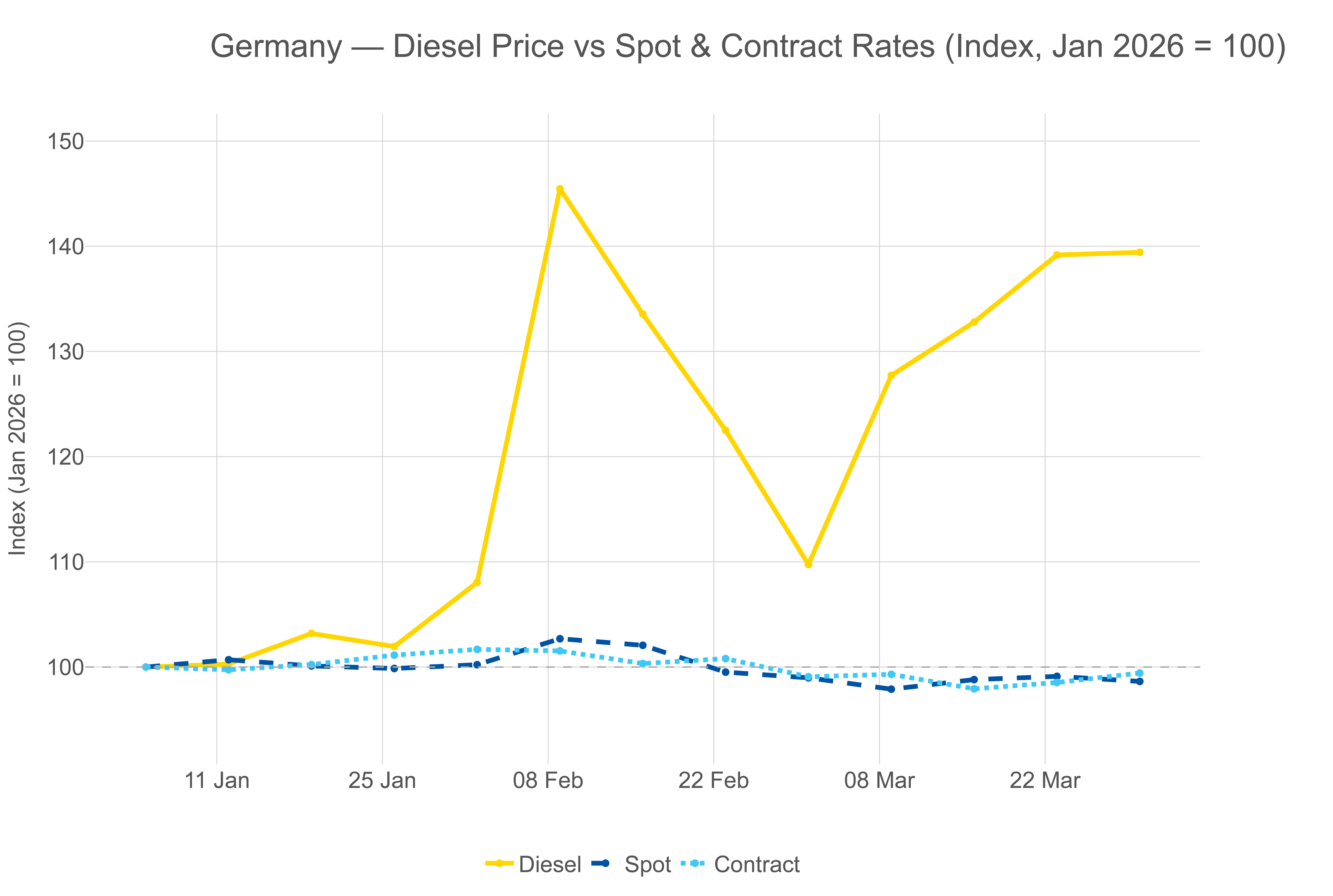
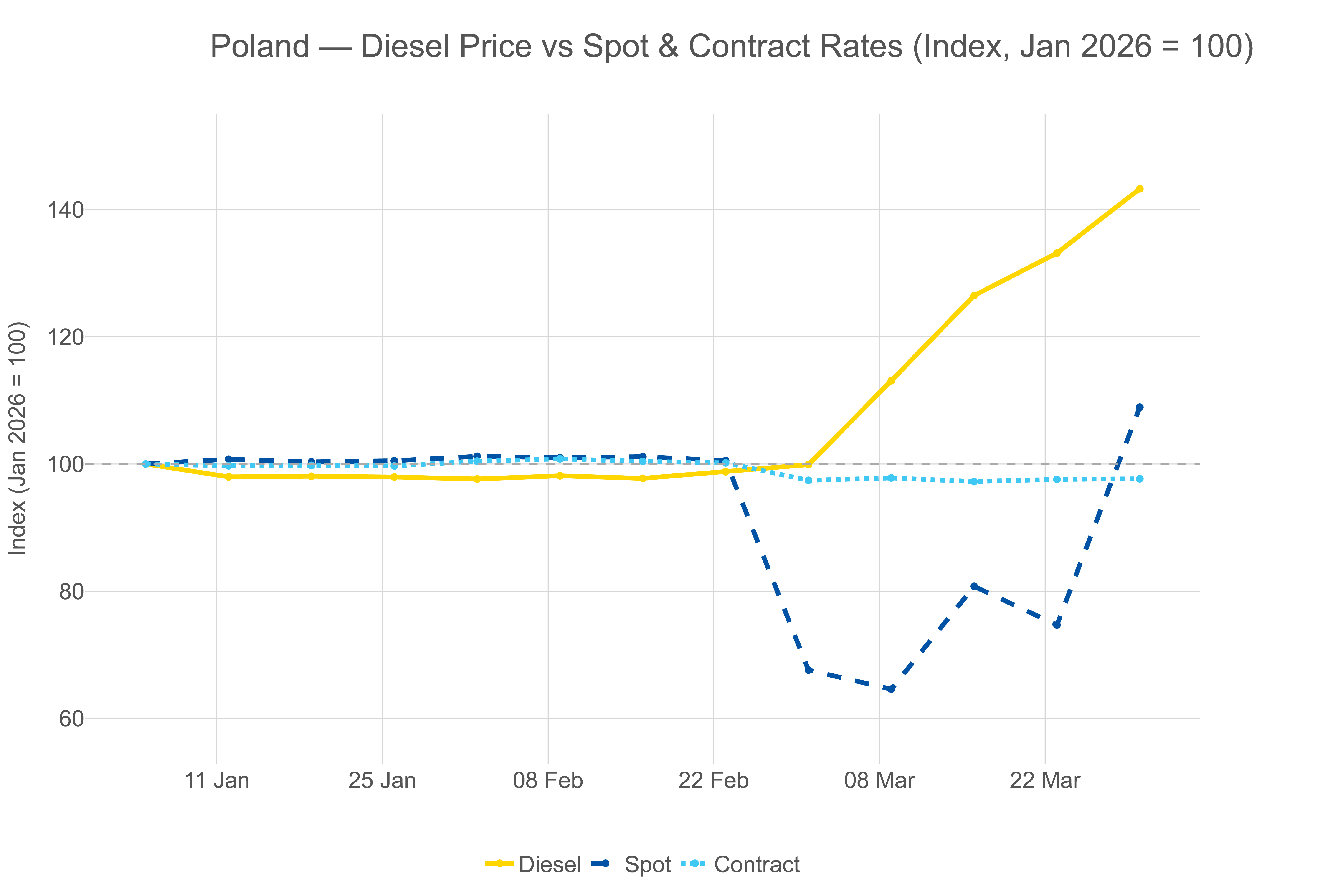
To date, freight rates are generally not indexed to fuel price movements, making it challenging for operators to pass current diesel price increases on to shippers. Even in countries with official indices, such as France and Spain, the update frequency is too low to keep pace with these increases.
Against the latest fuel price and freight rate indices, the data shows a dire situation for operators, with two examples below for Germany and Poland. It should be noted that indices cannot be compared between countries, as the baselines differ.
Brent price dynamics
This week, Brent oscillated within a narrower corridor than in previous weeks.
It rose nearly 2% on Thursday alone. But as of Friday, Brent is back in USD 110 per barrel territory.
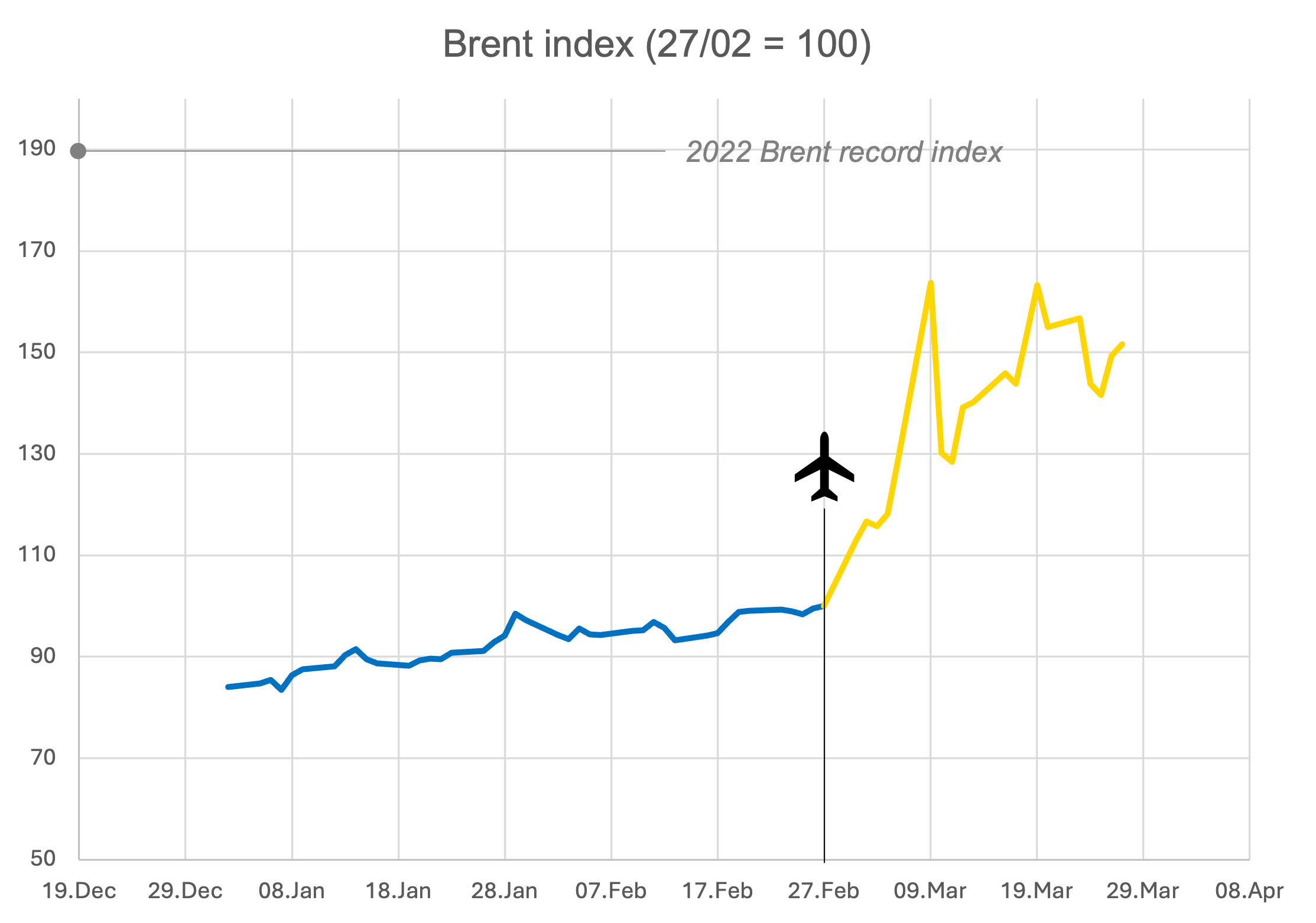
Unlike the 2022 shock related to war in Ukraine, driven by sanctions and rerouting, the 2026 disruption centres on a physical chokepoint that cannot be offset through diversification or substitution.
The longer the Strait of Hormuz remains disrupted, the longer prices will stay elevated, and the longer it will take to restore energy production sites to normal.
There were limited signs of easing. Some eight oil tankers were apparently able to pass through the Strait this week. And tanker attacks appear to have largely stopped since 19 March, according to UK Maritime Trade Operations, though the Strait remains effectively closed to most international traffic.
Natural gas price dynamics
To date, CNG and LNG prices for trucks and buses in the EU have been less affected than diesel, despite higher natural gas prices. However, persistently high natural gas prices are increasingly jeopardising future road freight volumes, as European industries rely on it to power factories.
Moreover, diesel additive AdBlue is made from natural gas, and its price has been climbing since the beginning of the conflict. However, German AdBlue prices decreased this week compared to the sharp increase seen last week (now only up 7% compared to pre-war prices).
Dutch TTF gas prices, Europe’s benchmark gas hub, have been strongly affected, mainly due to LNG supply risks, shipping chokepoints, and tightening storage dynamics.
This week, attacks on gas production sites in Qatar and Iran sent TTF prices soaring, exceeding EUR 55 per MWh for the first time since the beginning of 2023.
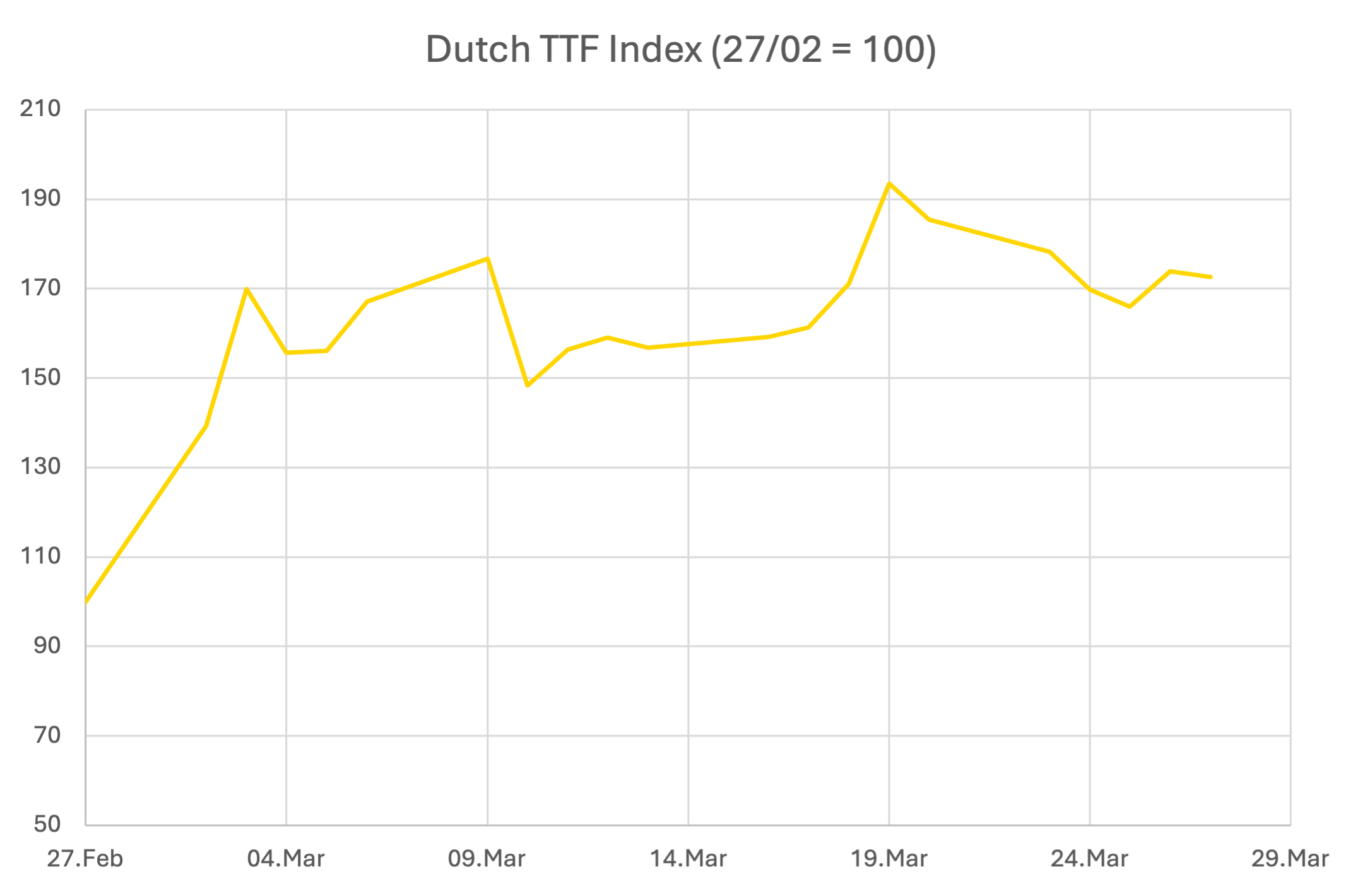
Stockpiles remain well below seasonal norms in the EU, averaging 28%. The Netherlands stands at 6% (2% less than last week) and Germany at 22%, with both countries at their lowest levels on record.
A similar trend is seen in Spain, although stocks are in better shape at 56%. France is also below its usual level at 22%, although this is not a record low, at 22%.
After winter, stockpiles will need to be replenished, likely at higher prices given current market conditions, which could impact economic output and, in turn, freight activity.
Recent attacks on GCC crude oil and gas installations and Iranian military assets on Kharg Island have pushed Brent higher.
What to watch next week
Key variables to monitor for the road transport sector are:
- Whether Pakistan-mediated talks produce any tangible progress
- Whether tanker traffic through the Strait of Hormuz continues to climb, or reverses
- Whether EU gas stockpile withdrawals accelerate, which could sharpen the AdBlue and industrial demand risks into the next quarter
IRU fuel prices: Get daily updates for EU countries and weekly updates for 40+ countries, with a one-week forecast to help you plan confidently.