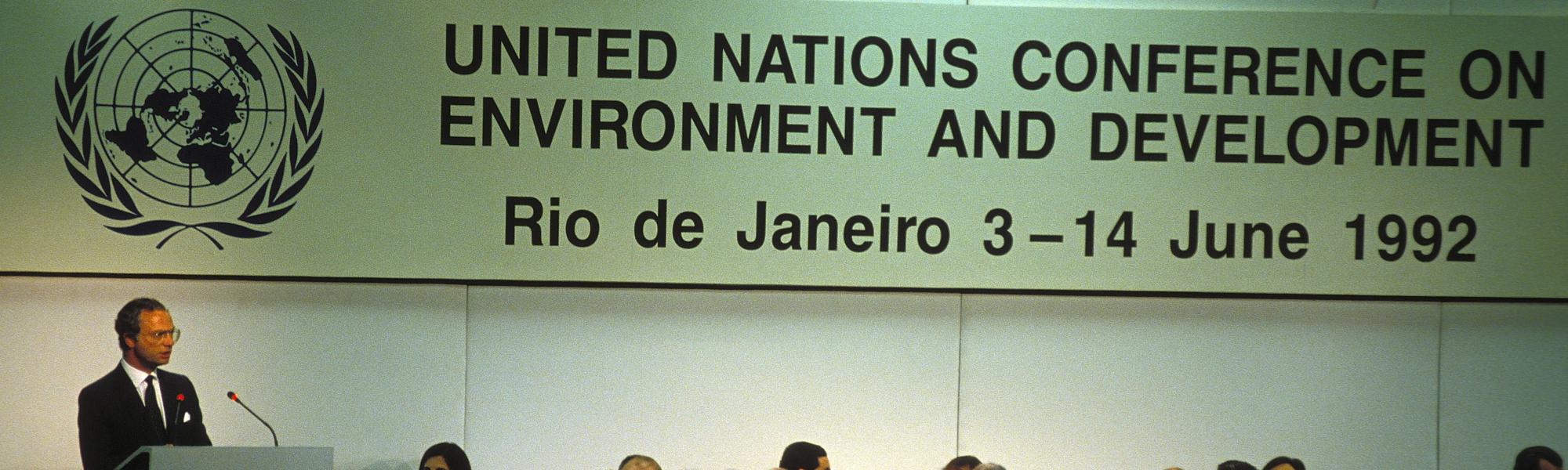
With the new UN sustainable transport decade under way, it’s now time to make it happen. In this two-part series, IRU’s Secretary General – who led efforts 30 years ago to establish the first sustainable development charter by a global transport organisation – reflects on the significance of sustainable transport and joint IRU–UN efforts since the historic 1992 Earth Summit.
The UN Decade of Sustainable Transport (2026-2035) is an opportunity to raise awareness on road transport’s crucial role in achieving the 2030 Agenda and its 17 Sustainable Development Goals. It helps focus on driving solutions, resources and partnerships to advance sustainable transport globally.
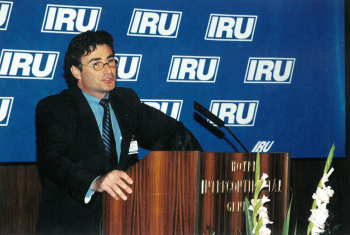
We asked IRU Secretary General Umberto de Pretto to give us a historic perspective on sustainable development efforts in transport going back 30 years.
In the second part of this two-part series, he looks forward to the coming years and how to deliver a successful UN Decade.
Why have a sustainable transport decade?
Transport, and road transport in particular, is indispensable to the everyday lives of people around the world.
Buses, coaches, taxis, vans and trucks are the lifeline of society, keeping us fed, healthy and supplied with life’s essentials. Road transport gets us to school and work and connects us with our loved ones.
Commercial road transport is also the glue that links all transport modes together, making mobility networks and supply chains function. It’s the mode that delivers first- and last-mile connectivity.
In short, all eight billion people who share this planet depend on road transport.
It is imperative to have a decade that not only recognises road transport’s critical role in society but also pushes solutions that improve how people move, how goods flow, and how societies connect.
With road transport at the heart of global mobility and logistics, IRU is at the heart of these solutions.
What do people often get wrong about sustainable transport?
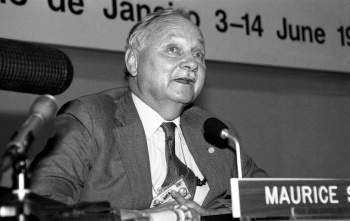
Sustainable development as a concept has deep historical roots, but the term was first outlined in a formal global context in the 1987 Brundtland Report, Our Common Future, commissioned by the UN and led by former Norwegian Prime Minister Gro Harlem Brundtland. This led to the UN Earth Summit in Rio de Janeiro, Brazil, in 1992, chaired by Maurice Strong, Canadian business and sustainability leader and the first Executive Director of the UN Environment Programme – that’s when the term sustainable development entered common usage.
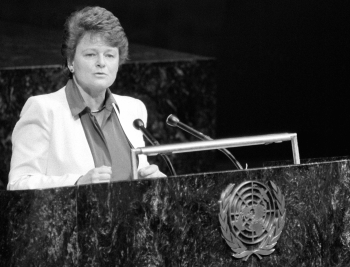
The Brundtland Report defined sustainable development as “development that meets the needs of the present without compromising the ability of future generations to meet their own needs.”
It outlined three interconnected pillars that need to be balanced to achieve this: economic, environmental and social – while recognising that without economic development we will not have social equity or environmental protection.
Similarly, transport that supports sustainable development must be, in equal measure, economically, socially and environmentally sound.
You cannot have one without the other two. Green transport must also be efficient, cost-effective, safe and inclusive.
What role does collective mobility play in sustainable transport?
While goods transport and logistics are largely driven by commercial operators, passenger transport can be private – generally a person’s own private vehicle – or collective – by bus, coach or taxi.
Buses and coaches are not only economically efficient and inclusive – especially for those who cannot afford or are unable to run a private vehicle, they are instrumental to achieving environmental objectives.
Just one coach can replace over 30 private cars and emit 80% less CO₂ per passenger-kilometre than a car. Moreover, buses and coaches are the safest mode of transport in most regions.
The key question is how best to implement and drive collective mobility solutions. New or revamped bus and coach services are quick, flexible and cost-effective to launch, requiring low infrastructure and running costs – and therefore less pressure on public investment.
What sustainable transport initiatives has IRU led?
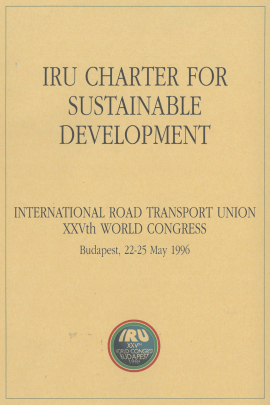
In 1996, IRU was the first global transport organisation to launch a sustainable development charter, signed by Maurice Strong, which was then enshrined into IRU’s Constitution. Inspired by the 1992 Earth Summit, I led this work in my first IRU role after joining the organisation in 1995.
A year later, IRU was at the RIO+5 Earth Summit in 1997, where we enthusiastically shared our vision for sustainable development to political and business leaders, explaining that we harnessed our industry’s support by demonstrating that sustainability equals profitability.
We have since worked with the UN on many sustainable transport initiatives around the world.
One of our biggest joint achievements was the creation of World Sustainable Transport Day in 2023.
The United Nations General Assembly adopted the resolution to designate a UN World Sustainable Transport Day at its 77th session in May 2023. The resolution, put forward by the government of Turkmenistan, followed IRU’s initial proposal for a dedicated World Transport Day.
Celebrated every year on 26 November, World Sustainable Transport Day is now a special occasion to reflect and make transport safer, more efficient, more sustainable and greener.
We now look forward to working together and making the Decade of Sustainable Transport a tangible success.
In part two, Umberto de Pretto explores the specific actions that must be taken for a successful sustainable transport decade.