IRU’s President and Secretary General participated in the 48th BSEC-URTA General Assembly in Istanbul, marking 25 years of cooperation and calling for stronger regional connectivity, faster border crossings and practical solutions to today’s challenges.
The Black Sea Economic Cooperation–Union of Road Transport Associations (BSEC-URTA) has celebrated its 25th anniversary during its General Assembly in Istanbul.
Since BSEC-URTA’s establishment in 2001, IRU and BSEC-URTA have worked together to expand TIR, improve border crossings and strengthen connectivity.
The Black Sea region has experienced major geopolitical and economic changes over the past 25 years. As new trade corridors emerge and supply chains adapt to growing uncertainty, the partnership between IRU and BSEC-URTA remains crucial to supporting efficient, secure and resilient road transport.
Building on 25 years of partnership
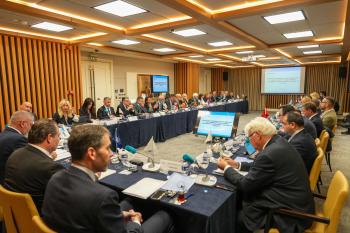
Opening the General Assembly, IRU President Radu Dinescu congratulated BSEC-URTA on its anniversary and reflected on the organisations’ shared achievements.
“Through all of it, IRU and BSEC-URTA have stood side by side,” he said.
He also addressed the impact of geopolitical developments on regional trade, driver shortages and mobility, and the growing importance of decarbonisation.
Looking ahead to COP31 in Antalya, he highlighted IRU’s commitment to a practical and inclusive green transition through the IRU Green Compact.
Turning challenges into opportunities
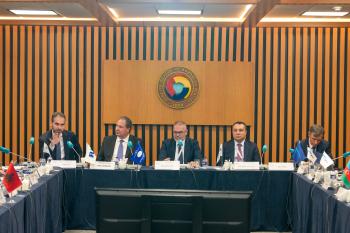
Addressing the General Assembly for the first time as IRU's Secretary General, Habib Turki stressed the strategic importance of the Black Sea region in connecting Europe, Central Asia and the Middle East.
“Trucks should spend more time moving goods and less time waiting at borders,” he said.
Habib Turki outlined four priorities for closer cooperation: border crossing facilitation and transport corridors, digitalisation, professional driver visas, and driving and rest time rules.
He highlighted the growing importance of corridors through Iraq and Syria, which are opening new opportunities for operators in the Black Sea region to access markets across the Middle East.
On digitalisation, Habib Turki called for wider implementation of eTIR, eCMR and digital transport permits, alongside better interoperability between national systems.
He also focused on the need to address visa restrictions affecting professional drivers, particular for the Schengen area, including through simplified procedures and multiple-entry visas with longer validity periods.
Another priority is addressing challenges related to the AETR Agreement, which harmonises driving and rest-time rules for international road transport.
“Success will depend on our ability to remove barriers, accelerate digitalisation, and support professional drivers,” said Habib Turki. “IRU stands ready to strengthen cooperation with BSEC-URTA, governments and regional bodies to turn these opportunities into reality.”
Strengthening cooperation for the future
The General Assembly illustrated the importance of cooperation between IRU, BSEC-URTA and their members in addressing shared challenges, facilitating trade and strengthening transport connectivity. To mark the anniversary, IRU presented BSEC-URTA with a commemorative plaque.
As trade routes evolve and the industry faces growing uncertainty, IRU and BSEC-URTA will continue working together to advance digitalisation, support professional drivers and strengthen the competitiveness and resilience of road transport across the Black Sea region and beyond.