
At the 39th session of the UNECE Working Party on Transport Trends and Economics, IRU highlighted how TIR trucks can turn international transport corridors from lines on a map into resilient operational trade routes.
The UN Economic Commission for Europe (UNECE) meeting focused on extending transport corridors in the geographic area covered by UNECE towards the Middle East, the Gulf Cooperation Council (GCC) region, Africa and Asia-Pacific.
A recurring question was how to make existing corridors genuinely operational.
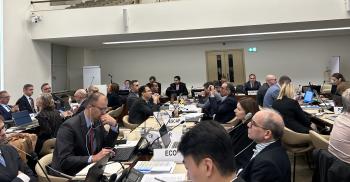
“Road transport is the connective tissue holding corridors together,” said IRU Policy Adviser Clara Sanchez Lopez. “It connects all other modes of transport together and carries goods from source through to final destination.”
“When disruptions such as those affecting the Strait of Hormuz occur, trucks provide supply chain flexibility. They don’t need new infrastructure to respond; they can be redeployed immediately,” she added.
From corridors to operations
The challenge is less about creating new corridors than coordinating existing systems.
A good example is the TIR Convention. Road-rail and road-maritime operations have been successfully tested under a single TIR framework, illustrating how one international legal instrument can bridge different modes across an end-to-end journey.
The next step is scale.
IRU called for proven models to be replicated on concrete timelines, with greater recognition that many remaining barriers are regulatory and procedural rather than related to infrastructure.
TIR’s Middle East expansion
Rami Karout, IRU’s Senior TIR and Transit Manager, highlighted TIR’s rapid expansion across the Middle East.
TIR is operational in the UAE, Saudi Arabia, Qatar, Jordan and Oman, with Iraq joining in 2025 and Egypt expected to follow suit in 2027.
“TIR has grown into the go-to solution for the Middle East’s leading transport and logistics companies,” said Rami Karout. “At a time of acute pressure across the region, this UN convention has shown its real value: opening up new trade routes that link Europe and Türkiye to the GCC through Iraq, Syria and Jordan.”
The region is increasingly strengthening its resilience by developing multiple routes and combining modes rather than relying on a single corridor or chokepoint.
That is where trucks and TIR’s core strengths – speed, reliability and adaptability – become most valuable.
For IRU, the direction is clear: international corridors can only deliver their full potential when transport modes, regulatory frameworks and border procedures work together in practice.