
Brent crude slipped below USD 90 a barrel after a pause in attacks this week, but European forecourt prices moved the other way.
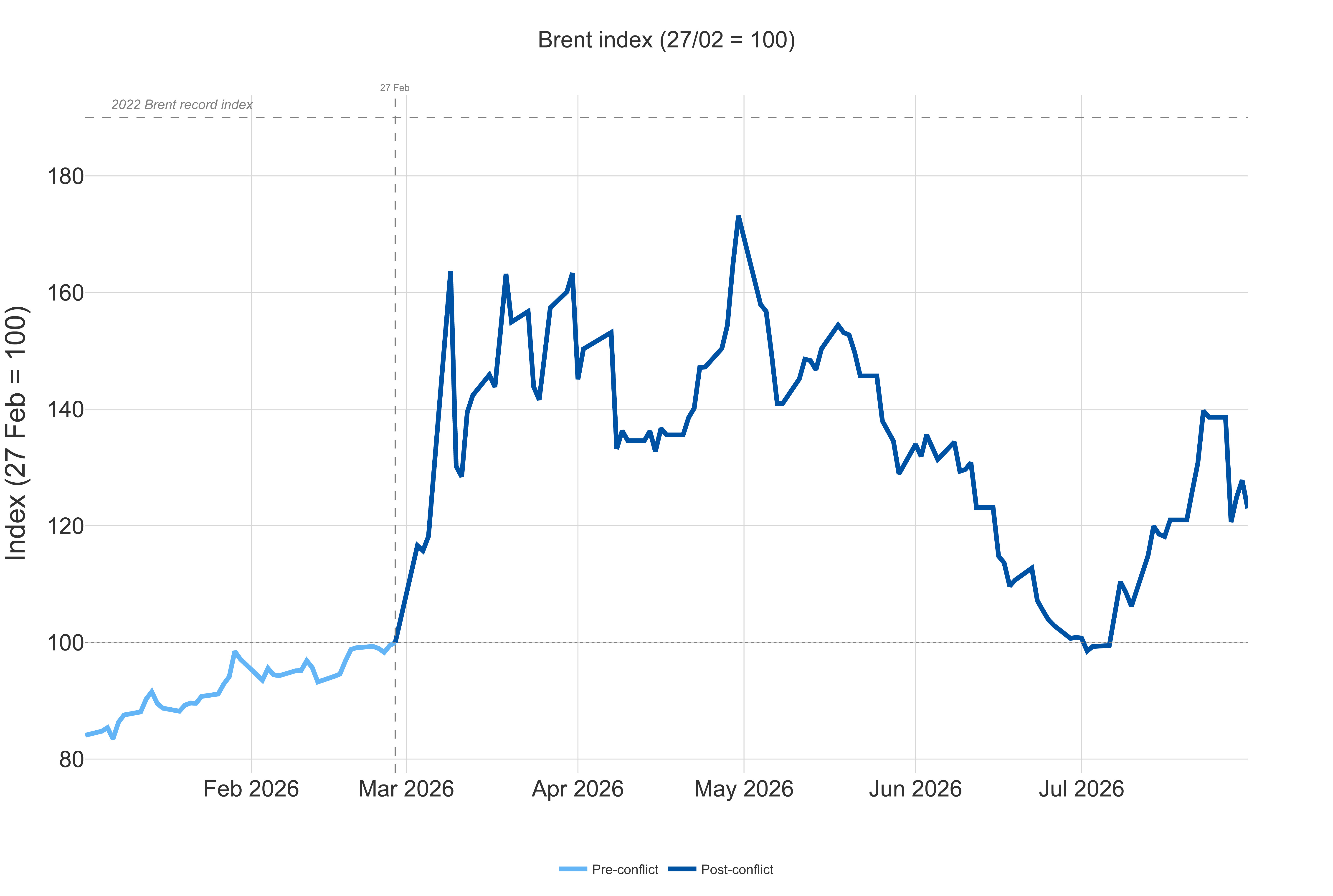
Following a pause in hostilities, Brent reached USD 89.79 a barrel on 31 July, down 11.3% in the week and 23% above the 27 February pre-war baseline.
West Texas Intermediate (WTI) reached USD 84.12 a barrel, down 9.3% in the week and 24.1% above baseline, leaving a narrow Brent-WTI spread of roughly USD 5.7 a barrel. The broader Goldman Sachs Commodity Index stands at 683.74, still well inside its war-era range.
Physical oil flows through the Strait of Hormuz have not yet recovered. Tanker transits through the strait fell on 21 July to ten, down from 16 the day before, against a pre-conflict average of 178 vessels a day. Eight ships were attacked between 13 and 20 July according to the International Maritime Organization.
On supply policy, seven OPEC+ producers agreed on 5 July to add 188,000 barrels a day from August, the group's latest monthly unwinding of earlier voluntary restraint.
Goldman Sachs maintained its Brent forecast of USD 80 a barrel for the fourth quarter of 2026 on 23 July. It expects Brent and WTI to average USD 75 and USD 70 in 2027 provided the Strait of Hormuz stays open, but flags Brent above USD 120 by the fourth quarter should the strait remain disrupted. JP Morgan forecasts that Brent will average USD 86 a barrel in the third quarter, USD 80 in the fourth and USD 64 in 2027.
Prices at the pumps
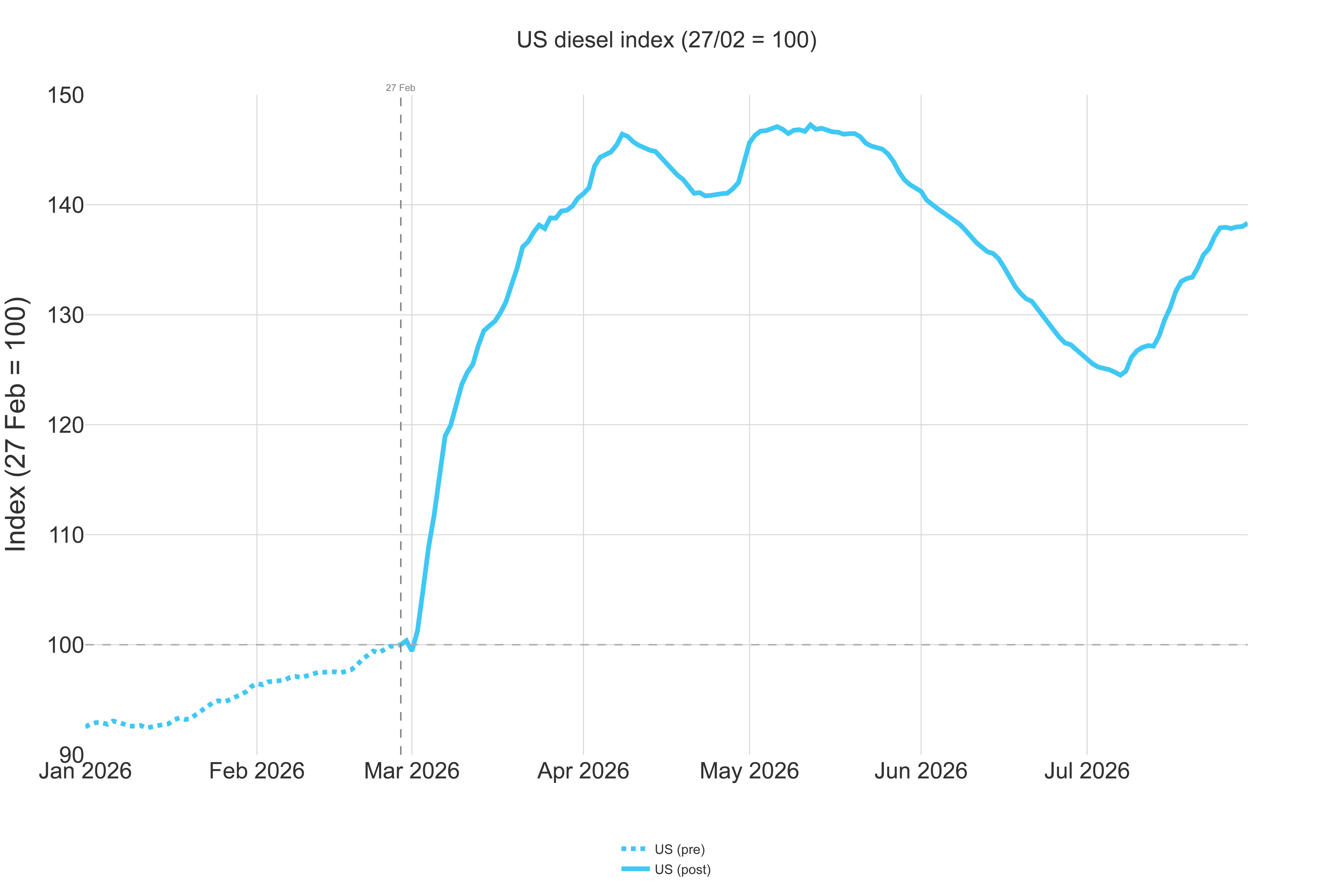
In the United States, average diesel prices stand at USD 1.413 per litre, up 38.3% since the 27 February baseline. The gap between crude and product remains key: WTI is 24.1% above baseline, yet diesel prices at the pump have risen by more than half as much again, reflecting refining capacity lost to the conflict.
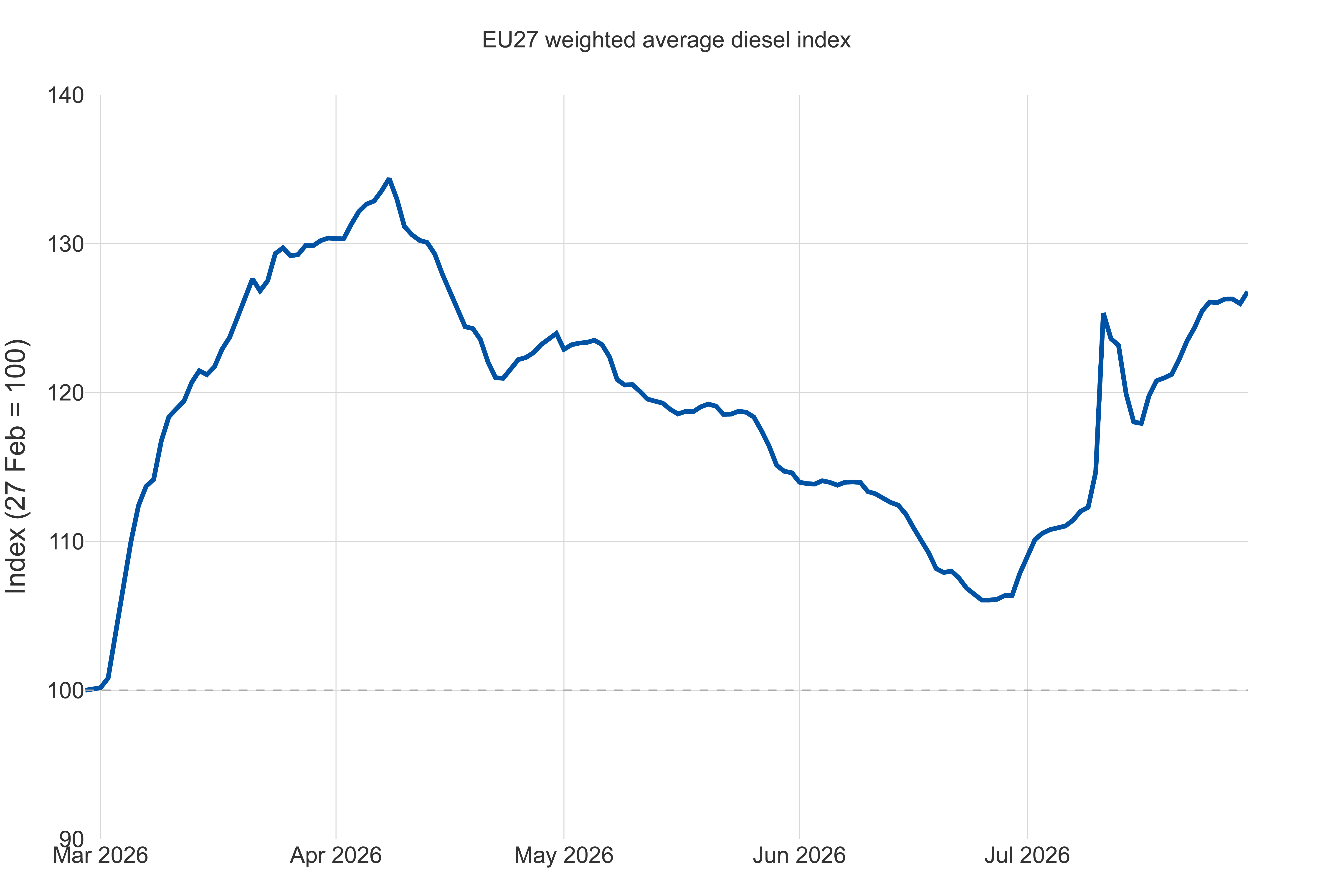
In the EU, average diesel prices stand at EUR 2.062 per litre, up 26% since the war began and up a further 1.9% over the past week. Pump prices rose as crude fell 11.3% because forecourts are still passing through the mid-July escalation and national fiscal cushions have thinned. The most expensive pump prices are in the Netherlands at EUR 2.42 per litre (up 24.1%), Denmark at EUR 2.34 (up 25.2%), Germany at EUR 2.256 (up 29.4%), Finland at EUR 2.233 (up 27.4%) and Belgium at EUR 2.232 (up 31.0%).
At the other end of the spectrum, the lowest EU pump prices are in Cyprus at EUR 1.662 per litre (up 18.0%) and Bulgaria at EUR 1.724 (up 33.7%).
Outside the EU, UK diesel has risen 26% since baseline to GBP 1.78 per litre.
Government support
The policy map is now moving in both directions at once.
Italy’s temporary diesel-excise rate is EUR 532.90 per 1,000 litres from 30 July to 6 August, a EUR 0.14-per-litre reduction.
Czechia went the other way, letting its margin cap and reduced diesel excise expire on 19 July. Germany's EUR 0.14 per litre energy-tax cut and Spain's diesel VAT reduction and EUR 0.20 per litre professional fuel-card support all expired on 30 June and have not been reinstated.
Where support measures survive, they are unevenly distributed.
France has extended targeted support for affected professional sectors, including road transport, agriculture and fishing, to the end of August; Norway’s fuel-tax suspension, worth NOK 3.53-4.26 per litre, also runs to 31 August; Romania is refunding RON 0.85 per litre after purchase until 31 December; Hungary is capping diesel at HUF 128.28 per litre; and Slovakia has a fixed EUR 1.905 per litre price for international customers.
Sweden is the clearest outlier on the supportive side, with a SEK 0.82 per litre energy-tax cut running to 30 September and a carbon-dioxide tax reduction from 1 July to 30 November. The Netherlands has extended its reduced excise rate to 1 January 2027.
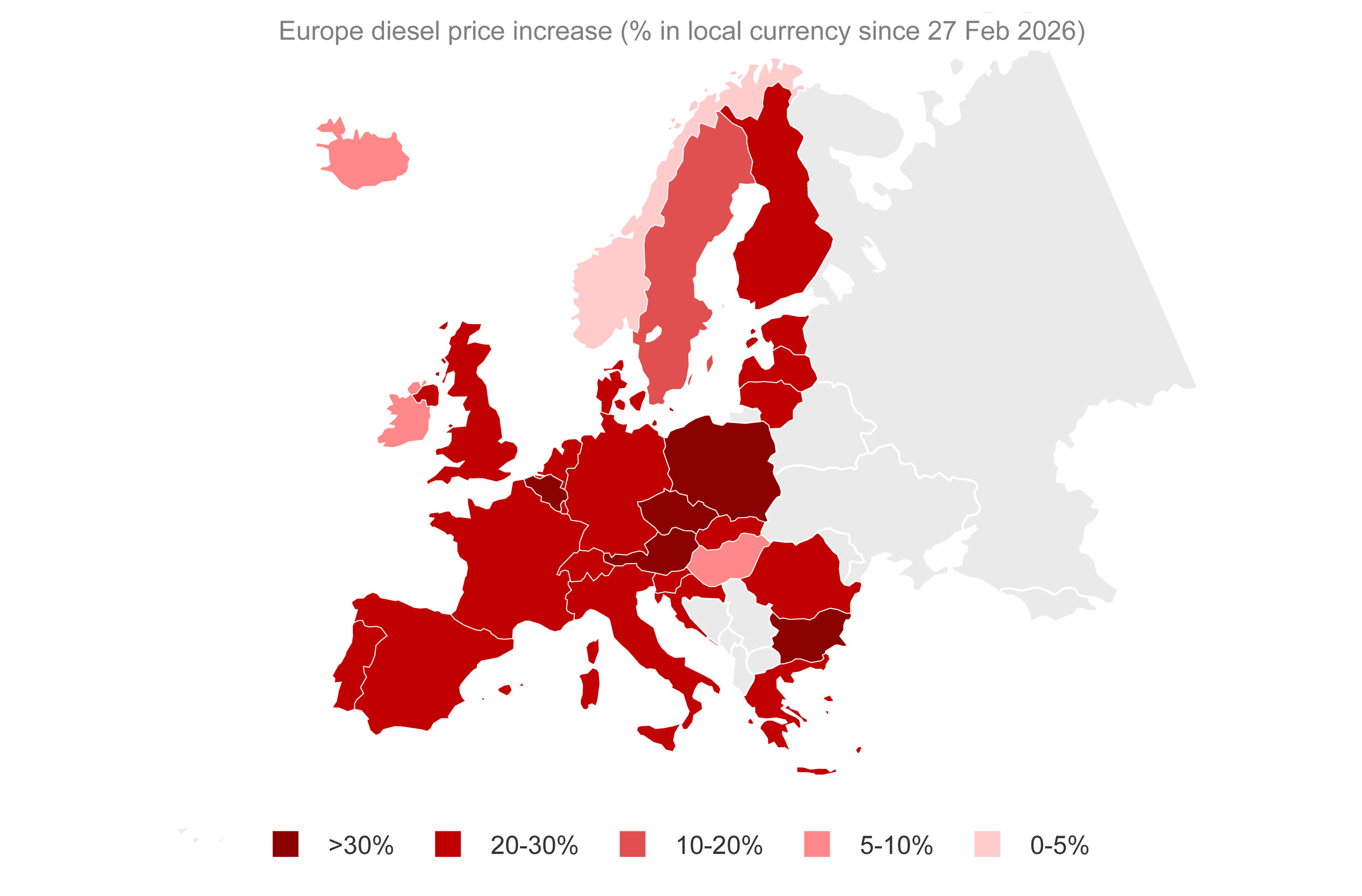
Türkiye's average diesel price is 27% higher in Turkish lira terms since baseline, at TRY 78.81 per litre, a sharp acceleration from the 16% recorded a fortnight ago. The sliding-scale ÖTV mechanism continues to adjust excise in response to wholesale and currency moves, but a 27% rise indicates the buffer is absorbing rather than neutralising the shock, at a fiscal cost that grows weekly.
China's average diesel price is 8% higher in renminbi terms since baseline, at CNY 7.07 per litre, the most contained increase among large economies. The government continues to set retail ceilings for refined products, lowering them for a third consecutive time from 4 July, cutting diesel by CNY 915 a tonne, the largest reduction in nearly six years.
In India, average diesel prices are 8% higher in rupee terms since baseline, at INR 98.1 per litre, another contained outcome achieved fiscally rather than by market forces. The government cut excise on 27 March, reducing petrol duty from INR 13 to INR 3 per litre and diesel duty to zero. It also raised the export duty on diesel from INR 8.5 to INR 15.5 per litre to keep refined product in the country.
Brazil's diesel price is 9% higher in real terms since baseline, at BRL 6.59 per litre. The government continues to subsidise diesel for road transport by BRL 1.12 per litre, in place since 1 June and continuing to 31 December 2026, reimbursed to producers and importers that pass the discount on in full. Mexico again shows the smallest rise of the group, up 3% in peso terms to MXN 26.88 per litre.
Wholesale price dynamics
The past week divided cleanly in two. Brent reached USD 102.0 a barrel on 23 July and USD 101.19 on 24 July, holding the escalation premium built after mid-July strikes. It touched USD 101.19 again on 27 July before the pause broke the move intraday, and by 28 July the daily high had dropped to USD 88.06, down 13.7% from the 23 July peak in four sessions. Prices then steadied rather than fell further: highs of USD 91.17 on 29 July and USD 93.31 on 30 July, easing to USD 89.79 on 31 July.
Two features of these movements should be noted. The collapse was concentrated in a single session driven by media headlines reporting the pause in hostilities. The partial recovery to USD 93.31 on 30 July however shows the market pricing the pause as conditional.
For fuel buyers the range, not the level, is the risk: Brent traded a USD 14 band inside one week while remaining 23% above its pre-war baseline.
Road transport operators with fuel clauses indexed to crude rather than to pump diesel prices should expect surcharges to fall faster than actual costs in the coming settlement period, an unfavourable asymmetry while pump prices are still rising.
Natural gas
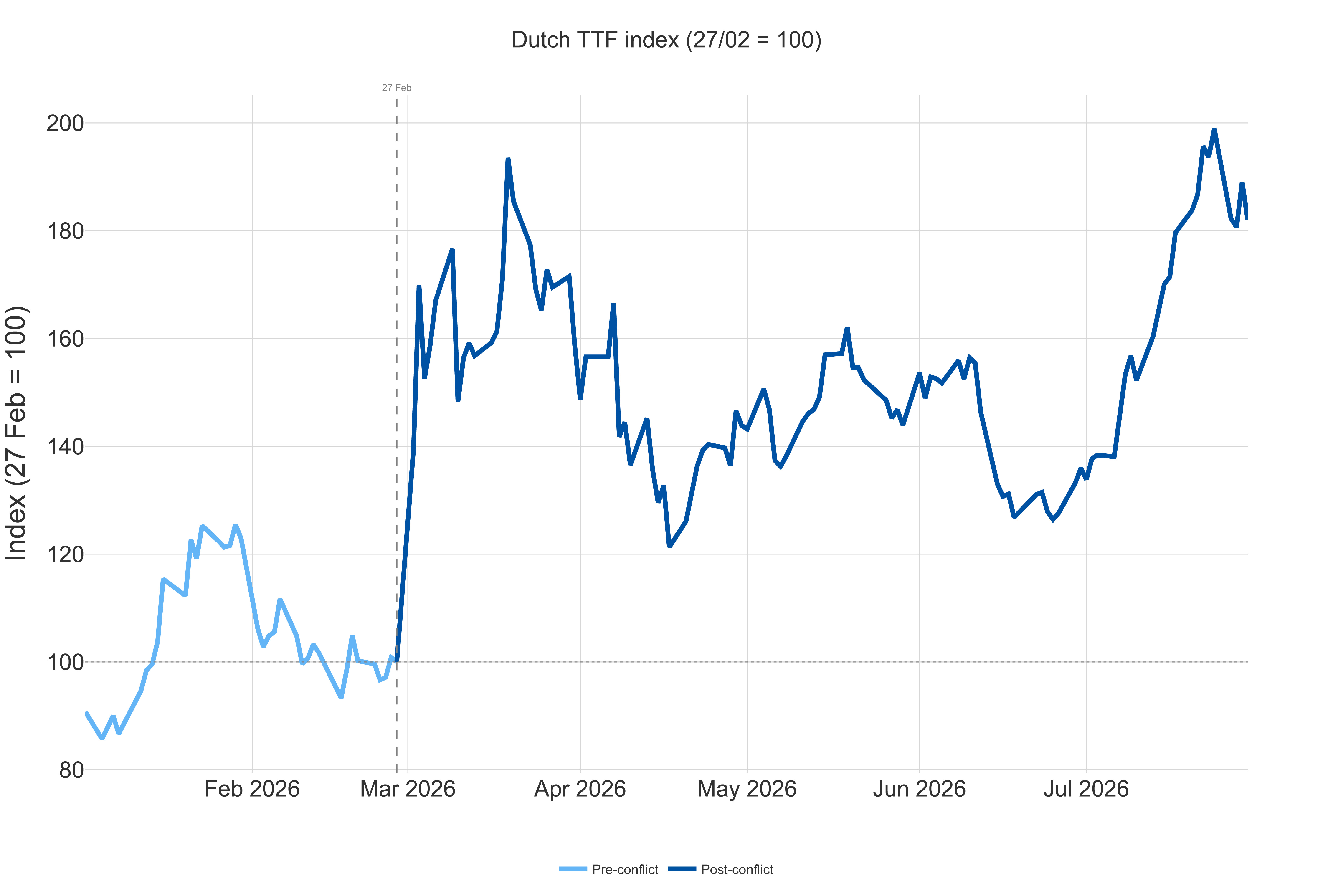
Dutch TTF gas reached EUR 58.18 per MWh on 30 July, down 6.0% in the week but still 82% above its 27 February baseline. The weekly path tracked crude closely: EUR 62.54 per MWh on 22 July, EUR 61.90 on 23 July and EUR 63.58 on 24 July, then a drop to EUR 58.25 on 27 July and EUR 57.74 on 28 July as the hostilities pause landed, followed by EUR 60.42 on 29 July.
Storage is the structural problem that price relief does not solve. The official European aggregate stood at 56.4% full on 29 July, holding 637.4 TWh against 1,130.2 TWh of capacity, equivalent to about 66.1 days of average annual demand.
Fill rates are uneven: Sweden at 11.5%, Belgium at 33.3%, the Netherlands at 36.4%, Bulgaria at 42.2% and Slovakia at 43.4% all sit below the aggregate, though these are proportions of national capacity rather than volumes.
The binding constraint is the EU’s 90% storage-filling target, which may be met between 1 October and 1 December under the current flexibility rule. The EU Agency for the Cooperation of Energy Regulators calculates that liquefied natural gas (LNG) imports would need to rise by roughly 13% on 2025 levels to reach 90%, while an 80% outcome could be achievable on unchanged LNG volumes.
The Oxford Institute for Energy Studies reaches a similar conclusion, citing unfavourable winter-to-summer price spreads alongside conflict-driven supply interruptions.
Impacts on operators
The EUR 0.76-per-litre spread between the cheapest and most expensive EU markets makes tank-location planning important for managing operator margins.
Operator cost recovery remains partial at best. IRU's most recent quarterly reading put European contract rates at 140.1 index points, up 3.2 points on the quarter, while spot rates fell 2.8 points to 132.3. This means that operators cannot absorb fuel increases of this scale without passing them on to clients. Contract-indexed operators are recovering slowly; spot-exposed operators are not recovering at all.
AdBlue is the second cost line to watch. There is no confirmed Europe-wide shortage, and prices have been broadly stable at roughly 65-90 cents per litre in intermediate bulk containers and 90 cents to EUR 1.20 at the pump. But urea synthesis depends on natural gas and Middle East production, so supply risk is materially higher than before the war.
Outlook: what to watch
2 August – OPEC+ producers meet again after agreeing a 188,000 barrels a day increase for August. A further unwinding would reinforce current softness; a pause would signal the group reads demand as weak.
6 August – Italy’s temporary diesel-excise cut expires; operators refueling in Italy could see pump prices rise by about EUR 0.17 per litre unless the measure is extended.
31 August – France's targeted subsidies and Norway's fuel-tax suspension both end potentially widening the EU spread further.
30 September – Sweden's SEK 0.82 per litre energy-tax cut ends, with its carbon-dioxide tax reduction following on 30 November.
1 December – The EU’s 90% gas-storage target must be met within the permitted 1 October-1 December window. A shortfall would increase winter gas-price risk and could add pressure to urea and AdBlue costs.
31 December – Romania's RON 0.85 per litre excise refund and Brazil's BRL 1.12 per litre diesel subvention both end.
1 January 2027 – The Netherlands' reduced excise rate expires in the EU's most expensive diesel market.
IRU fuel prices: Get daily updates for EU countries and weekly updates for 40+ countries, with a one-week forecast to help you plan confidently.
IRU members, strategic partners an Intelligence subscribers already have full access to the IRU fuel prices service.