
As the Middle Corridor gains strategic importance for Europe–Asia trade, attention is shifting from political coordination to practical implementation. At a high-level roundtable in Brussels, IRU highlighted the concrete measures needed to make the route faster, more predictable and ready for investment.
- Facilitation and cooperation, not infrastructure alone, determine corridor performance
- Reducing time lost at borders is key to unlocking competitiveness
- Tools such as the TIR system, eTIR and eCMR offer immediate efficiency gains
- Coordinated political action is needed to translate strategy into bankable projects
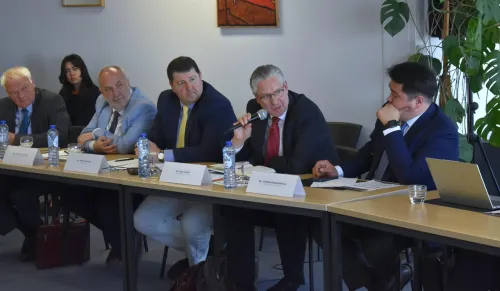
The Brussels discussions on “Sustainable Middle Corridor – from strategic coordination to bankable implementation”, organised by the Kazakhstan–EU Gateway in collaboration with FERRMED and the European Institute of Asian Studies, brought together government, financial and industry representatives.
The participants examined concrete initiatives to strengthen the competitiveness and resilience of the Middle Corridor as a growing Europe–Asia trade route. The corridor is increasingly seen as a driver of regional trade, connectivity and economic development across the countries along the route.
The Middle Corridor, also known as the Trans-Caspian route, is a multimodal transport corridor linking China to Europe via Central Asia, the Caspian Sea and the South Caucasus. Combining rail and maritime segments, it connects key logistics hubs across Kazakhstan, the Caspian ports, Azerbaijan and Georgia before reaching the European Union. Its growing relevance reflects efforts to diversify trade routes and strengthen supply chain resilience between Europe and Asia.
IRU EU Goods Transport Associate Director Marc Billiet stressed that connectivity along the route goes beyond infrastructure. The performance of the corridor depends equally on facilitation, predictability and cooperation across countries, particularly given its multimodal nature and multiple border crossings.
Marc Billiet discussed infrastructure and operational challenges for sustainable and green logistics, including bottlenecks at border crossings and modal transfer points. He also presented IRU’s work in support of the corridor’s development through the deployment of facilitation tools, including TIR Green Lanes and digital solutions that reduce delays and improve the efficiency of transport operations.
IRU further pointed to its engagement in piloting eCMR under the EU’s Global Gateway strategy, supporting the digitalisation of transport documents and processes along the corridor.
Combining political commitment with the full deployment of facilitation and incentive tools can significantly reduce time lost at borders and strengthen the competitiveness of the Middle Corridor.
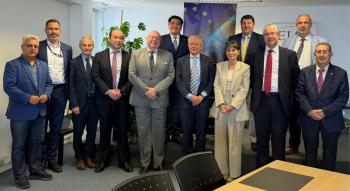
Discussions in Brussels confirmed broad alignment among policymakers, financial institutions and industry stakeholders on the strategic importance of the Middle Corridor. While challenges remain, participants underlined that ongoing investments, regulatory improvements and digital integration efforts are strengthening the corridor’s competitiveness and reliability.
If sustained and coordinated effectively, these efforts can help transform the Middle Corridor into a core pillar of Eurasian connectivity, offering a more resilient, efficient and competitive trade route between Europe and Asia