Together with its member the Irish Road Haulage Association (IRHA), IRU held high-level talks with Sean Canney, Ireland’s Minister of State for Transport, on how the Irish Presidency of the Council of the European Union and the road transport sector can work together to deliver practical progress for operators.
The discussion with Minister Canney focused on the sector’s priorities, including financial pressures on operators. With fuel costs still high after the disruption around the Strait of Hormuz, and margins of only 1–2% for many, IRU stressed the need to maintain the support granted to operators during the crisis.
“The discussion showed that there are practical ways to move forward on issues that directly affect operators’ competitiveness, from payment certainty to payload capacity and driver recruitment,” said IRU EU Director Raluca Marian.
“We look forward to working with Minister Canney and his team to turn this dialogue into progress,” she added.
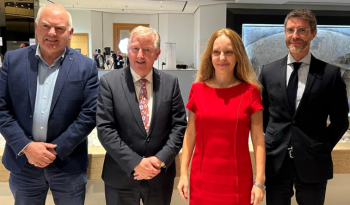
On late payments, IRU raised the issue of a dedicated EU regulation requiring payment within 30 calendar days, without exceptions or extensions. Minister Canney acknowledged the impact of late payments on operators and expressed interest in discussing the issue with fellow ministers and the sector.
On weights and dimensions, IRU sees an important opportunity to encourage the uptake of zero-emission vehicles and strengthen cross-border transport in Europe, and welcomes the Presidency’s willingness to find solutions.
The meeting also covered combined transport and emissions trading. Both are particularly relevant to Ireland as an island nation, where the efficiency and cost of connections between road and other transport modes have direct implications for operators.
Driver recruitment and training concluded the discussion. Minister Canney recognised the potential to attract younger people to the profession and the importance of modernising the Certificate of Professional Competence. Making training more accessible and relevant to today’s operating environment is a critical part of addressing the shortage of professional drivers.
“Modernising driver training and attracting more young people to the profession are essential to securing the workforce that goods and passenger transport services depend on,” said Raluca Marian. “Training pathways need to prepare new drivers for the realities of the job and help bring more people into the sector.”
“We were delighted to help organise such an important meeting, which was both collaborative and positive,” said Paul Jackman, Deputy Vice President of IRHA. “We thank Minister Canney and his team for engaging on matters so important to the EU road transport industry. We look forward to continued progress.”
IRU will continue working with the Irish Presidency, the European Commission, the European Parliament and Member States, alongside IRHA and other national road transport associations, to advance practical EU policies that strengthen operators’ competitiveness and support efficient, reliable transport services.