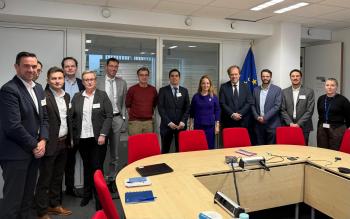
IRU brought a cross-section of transport operators, including members, directly to the European Commission for an exchange with Kurt Vandenberghe, Director-General for Climate Action (DG CLIMA), to discuss how EU climate policies can better reflect the realities of road transport.
IRU’s meeting with DG CLIMA brought together passenger and goods transport companies of various sizes and business models from across Europe, including IRU members. Their diverse experiences informed a constructive exchange with Kurt Vandenberghe and his team at DG CLIMA, alongside Matthieu Moulonguet from the Cabinet of Commissioner Wopke Hoekstra.
Discussions focused on the practical conditions needed to accelerate decarbonisation, including the ongoing review of the Alternative Fuels Infrastructure Regulation (AFIR), access to finance and the revision of the EU’s CO₂ emission standards for heavy-duty vehicles.
“Road transport operators are not waiting for the transition to happen. They are already investing in electric vehicles, adapting their depots and developing innovative energy solutions,” said IRU General Delegate to the EU Raluca Marian said. “But ambition alone will only deliver decarbonisation at scale if investments make operational and economic sense.”
“We greatly appreciate Kurt Vandenberghe’s openness to dialogue and his willingness to listen directly to operators’ experiences and concerns, particularly ahead of important EU policy developments that will shape the future of road transport decarbonisation,” she added.
One transition, different operational realities
Operators shared concrete examples of investments in zero-emission trucks, buses and coaches, depot charging infrastructure and solar energy generation, highlighting both their commitment to decarbonisation and their diverse operational realities.
While challenges such as high vehicle costs, access to financing and charging infrastructure are common across the sector, their impact varies depending on business models, transport segments and geographical location.
Freight and passenger transport operators need the right conditions to accelerate investment in decarbonisation.
AFIR revision
The ongoing AFIR review offers an important opportunity to better align EU infrastructure policy with operators’ needs.
While public charging infrastructure along major transport corridors remains essential, operators stressed that depot and semi-public charging must be recognised as integral parts of the charging ecosystem, rather than secondary solutions.
For freight transport, this means combining public infrastructure with private depot charging and semi-public facilities that operators may voluntarily make available to other businesses.
For buses and coaches, infrastructure deployment must also account for depots, terminals, tourist destinations and other operational locations, where charging needs are determined by service schedules and passenger transport requirements.
A more comprehensive approach to infrastructure planning would help optimise investments, make better use of existing facilities, and ensure that charging infrastructure develops in line with actual transport demand.
Financing the transition
Operators highlighted the need for more accessible financing, clearer guidance on available EU and national support, and simpler administrative procedures to facilitate investments in zero-emission vehicles and charging infrastructure, particularly for small and medium-sized enterprises.
However, they also stressed that subsidies alone cannot deliver the transition at scale. Operators need the financial capacity to invest, a viable total cost of ownership and vehicles suited to their specific operational needs.
Financial capacity also depends on predictable cash flow. Late payments tie up resources that could otherwise be invested in fleet renewal, charging infrastructure and new technologies, further limiting operators’ ability to finance the transition.
CO₂ standards
The ongoing revision of the EU’s CO₂ emission standards for heavy-duty vehicles was another key topic.
Regulatory requirements must reflect market realities, including the availability and affordability of zero-emission vehicles, the deployment of adequate charging and refuelling infrastructure, and companies’ operational needs.
“We will continue to advocate for an ambitious but pragmatic approach to decarbonisation, one that safeguards competitiveness and technology openness, and ensures that regulatory ambitions keep pace with the conditions needed to deliver real emissions reductions on the ground,” said Raluca Marian.