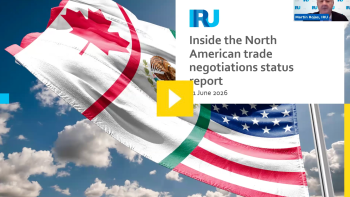
Protect the North American trade deal, modernise borders and keep goods flowing. That was the message from IRU’s recent North American Transportation Forum webinar. The discussion focused on the future of the United States-Mexico-Canada Agreement (USMCA), also known as CUSMA in Canada and T-MEC in Mexico, as the three countries move through the agreement’s six-year review process.
The stakes are high for the trucking sector. Trucks move around 70% of the value of North American trade. They also feel the impact first when border crossings slow, rules change or uncertainty increases.
IRU Senior Adviser for the Americas Martin Rojas opened the webinar by stressing that North American trade integration has been a major success story over more than three decades.
The agreement helped lock in regional trade. But several of its practical promises – from digitalisation to border harmonisation – remain unfinished.
“A long time ago, we sat in a room discussing a single window for North America,” he said. “We don’t have that system yet in place.”
“The USMCA review is no longer just a technical trade exercise. For North American trucking, it raises a bigger question: will the region continue to function as an integrated market, or shift towards a more fragmented bilateral model?” he asked
The discussion then turned to three experts on North American trade, borders and logistics.
Keep North America working

Christopher Sands, Director of the Center for U.S.-Canada Relations Johns Hopkins School of Advanced International Studies, said the USMCA review is new territory for all three countries.
“This review process is an innovation,” he said. “We haven’t seen something like this before.”
He expects the most likely outcome to be neither immediate renewal nor withdrawal, but continued negotiation. Canada and Mexico have signalled support for a 16-year renewal. The open question is the US.
Christopher Sands said recent signals suggest some difficult issues are being moved onto separate tracks, which could make a future renewal more possible. Perhaps not immediately. But potentially in the coming year.
He also pointed to a strong signal from industry. USMCA compliance has risen sharply as companies seek protection from tariff uncertainty.
For Christopher Sands, North America has a powerful advantage: it moves much of its trade by road. In a world of maritime choke points, disrupted canals and geopolitical shocks, the region’s trucking sector provides resilience.
He warned that younger generations may not understand what is at risk. They grew up after NAFTA and may not remember what trade looked like before regional integration.
“We have to have a conversation about North America’s economy and why its effective functioning is crucial for all three countries,” he said.
Mexico wants USMCA to survive and thrive

Antonio Ortiz-Mena, CEO and Founder of AOM Advisors, said Mexico is politically divided on many issues. But not on USMCA.
“We agree on two things,” he said. “We want Mexico to win the World Cup. And we agree on the relevance of USMCA.”
For Mexico, he said, preserving and strengthening the agreement is the country’s top foreign economic policy priority. That consensus cuts across political parties, regions and age groups.
Still, Mexico faces several pressure points. One is the US trade deficit with Mexico. Another is the push for higher rules of origin, especially in autos, auto parts and other intermediate goods moved by truck.
Antonio Ortiz-Mena argued that major reshoring cannot happen by simply moving one factory.
“You can’t move an ecosystem,” he said.
That means North American production will remain deeply integrated. It may change. It may become more regional. But it will still depend heavily on cross-border transport.
He expects USMCA to survive, though with more bilateral understandings between the US and Canada and between the US and Mexico. Trade may also become more regulated and less market-led.
His key message to the trucking and logistics sector was clear: governments need practical solutions from industry.
New technologies can help trace goods, certify origin and reduce pressure at the border, allowing compliant freight to move faster.
The border cannot become a parking lot

Gerry Schwebel, Executive Vice President for the Corporate International Division at International Bank of Commerce in Laredo, Texas, brought the border perspective.
“I live it. I breathe it,” he said. “My office overlooks I-35 [a major north–south interstate highway that runs from Laredo near the Mexican border to Duluth, Minnesota].”
Laredo is North America’s largest land port. Yet Gerry Schwebel noted that it has seen no major infrastructure improvement in 25 years, despite major growth in trade.
For him, the success of the system has depended on private sector resilience and close cooperation with public authorities. But that is not enough for the future.
Infrastructure matters. So do processes. And both must be designed with input from the people who use the border every day.
“Governments don’t trade. People trade,” he said. “It’s up to the people, the stakeholders, the ones that live it every day, to be engaged.”
Gerry Schwebel also warned that enforcement can create disruption if it is not paired with practical solutions. Best practices developed over years may suddenly clash with stricter interpretations of the rules. That can stop trucks, delay freight and disrupt entire supply chains.
The goal, he said, should be secure, compliant and efficient trade.
“We don’t want our ports of entry to become parking lots,” he said. “We want commerce to flow efficiently and securely.”
One theme stood out throughout the webinar: USMCA remains essential, but it needs practical modernisation. The region needs better data systems, smarter border processes, more consistent enforcement and stronger cooperation between governments and industry.
As the review continues, the trucking sector’s message is simple: preserve North American trade, fix what slows it down, and let compliant freight move.