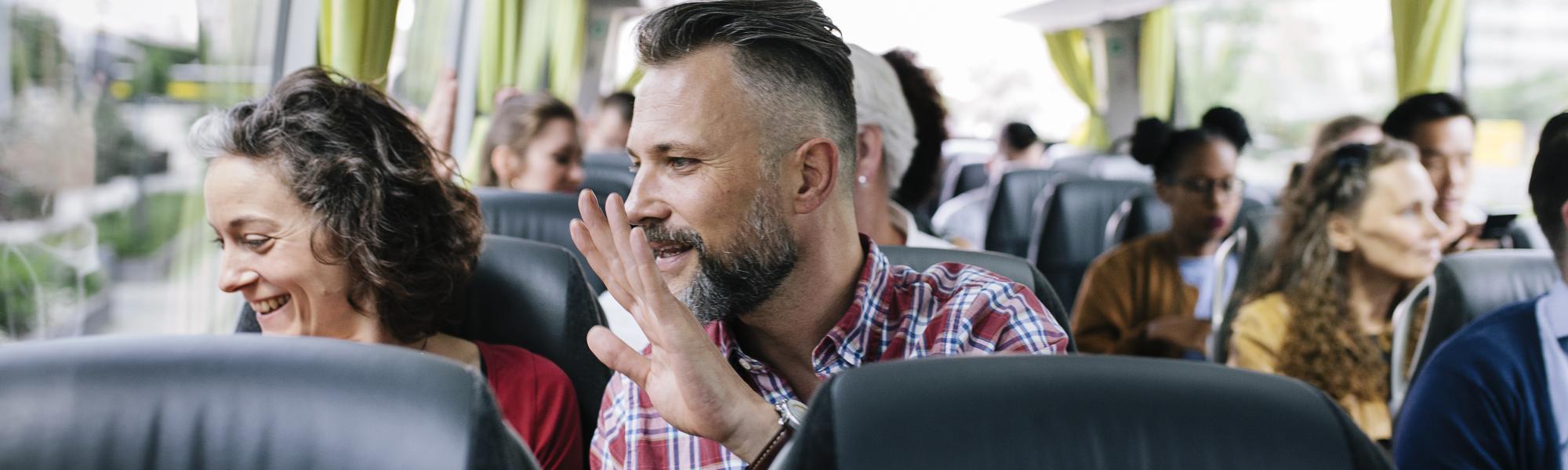
From airports to UNESCO sites and cruise terminals to congress halls, buses and coaches are the invisible infrastructure keeping Europe’s tourism moving. Their contribution – millions of passengers carried, billions in economic impact, and essential support to sustainability and cohesion – makes them irreplaceable. As the EU shapes the future of tourism policy, one truth is clear: there is no sustainable tourism without buses and coaches, argues CONFEBUS Director Jaime Rodríguez in this guest article.
European tourism has entered a decisive moment.
Visitor numbers are fully recovered, mobility demands are changing, and the European Commission is preparing its “European strategy on sustainable tourism” for 2026.
In this context, buses and coaches quietly sustain the movement of millions of travellers each year. They connect airports, ports, hotels, cultural destinations, congress centres and rural areas. Without them, Europe’s tourism ecosystem could not function.
Cruise tourism: moving millions on wheels
Europe remains the world’s second largest cruise market, welcoming more than seven million passengers annually.
Organised shore excursions – one of the core spending items in cruise tourism – depend largely on buses and coaches.
At major ports such as Barcelona, Civitavecchia, Hamburg or Piraeus, tens of thousands of cruise passengers rely on coaches to reach museums, monuments and cultural attractions.
More efficient and lower‑emission than other modes, coaches are essential for port‑city connectivity.
Airports: reliable first‑ and last‑mile mobility
The EU had nearly one billion air passengers in 2024, according to Eurostat.
Mobility studies from major hubs such as Paris‑CDG, Frankfurt, Munich, Rome‑Fiumicino, Madrid‑Barajas, Barcelona‑El Prat and Amsterdam‑Schiphol consistently show that buses and coaches act as key mass‑transit links between airports and urban centres. They also provide essential access to regions without rail services.
For millions of tourists, the first and last mile of their trip relies on buses and coaches.
Tour operators and group travel: a core tourism segment
Coach‑based tourism remains one of Europe’s strongest organised travel segments. Hundreds of thousands of coaches operate across the continent, carrying millions of travellers on cultural circuits, multi‑day trips, excursions and cross‑border tours.
In 2024, group travel – particularly cultural and intercity sightseeing tours – registered double‑digit growth. Tour operators rely on coaches for safety, flexibility, sustainability and capacity, making them the dominant mode for organised tourism.
MICE tourism: supporting Europe’s global leadership
Europe hosts more international congresses than any other region. The International Congress and Convention Association (ICCA) rankings consistently include Paris, Barcelona, Lisbon, Vienna and Madrid among the world’s top ten cities for meetings and conventions.
Moving thousands of delegates between hotels, congress venues and airports requires scalable solutions – and only buses and coaches can offer that capacity. During large events, European cities deploy hundreds of coaches to ensure efficient flows and prevent congestion. Without a strong coach sector, Europe’s leadership in Meetings, Incentives, Conferences and Exhibitions tourism (MICE tourism) would be compromised.
Leisure and cultural tourism: access for millions
Leisure tourism generated more than EUR 800 billion in Europe in 2024 (WTTC).
A significant share of this activity depends on buses and coaches: concerts and festivals rely on shuttle operations; stadium events require large‑capacity transport; and rural tourism – historic villages, national parks, pilgrimage routes – depends on coaches for safe and sustainable access. Buses and coaches provide access to culture and entertainment, particularly for younger, older and lower‑income travellers.
A strategic mode for the EU’s 2030 Tourism Agenda
Eurostat data show that transport accounts for nearly 29% of all tourism expenditure by European residents – an even higher share for international trips.
As the European Commission prepares the 2026 sustainable tourism initiative, buses and coaches align directly with its priorities:
- Sustainability: Among the lowest‑emission passenger modes in Europe
- Accessibility: Reaching destinations beyond rail networks and reducing regional imbalances
- Affordability: Essential for families, youth, seniors and travellers on a budget
- Resilience: Quickly deployable, reliable during peak flows and flexible during disruptions
Europe’s tourism cannot decarbonise without shifting a significant part of mobility to collective transport modes. Buses and coaches are the most effective tool to achieve this.
About CONFEBUS
IRU member CONFEBUS is the Spanish Confederation of Transport by Bus & Coach, an organisation that represents and defends the interests of the Spanish bus & coach undertakings providing a wide range of services (regular, urban, occasional, school, tourism, management of terminals, etc).