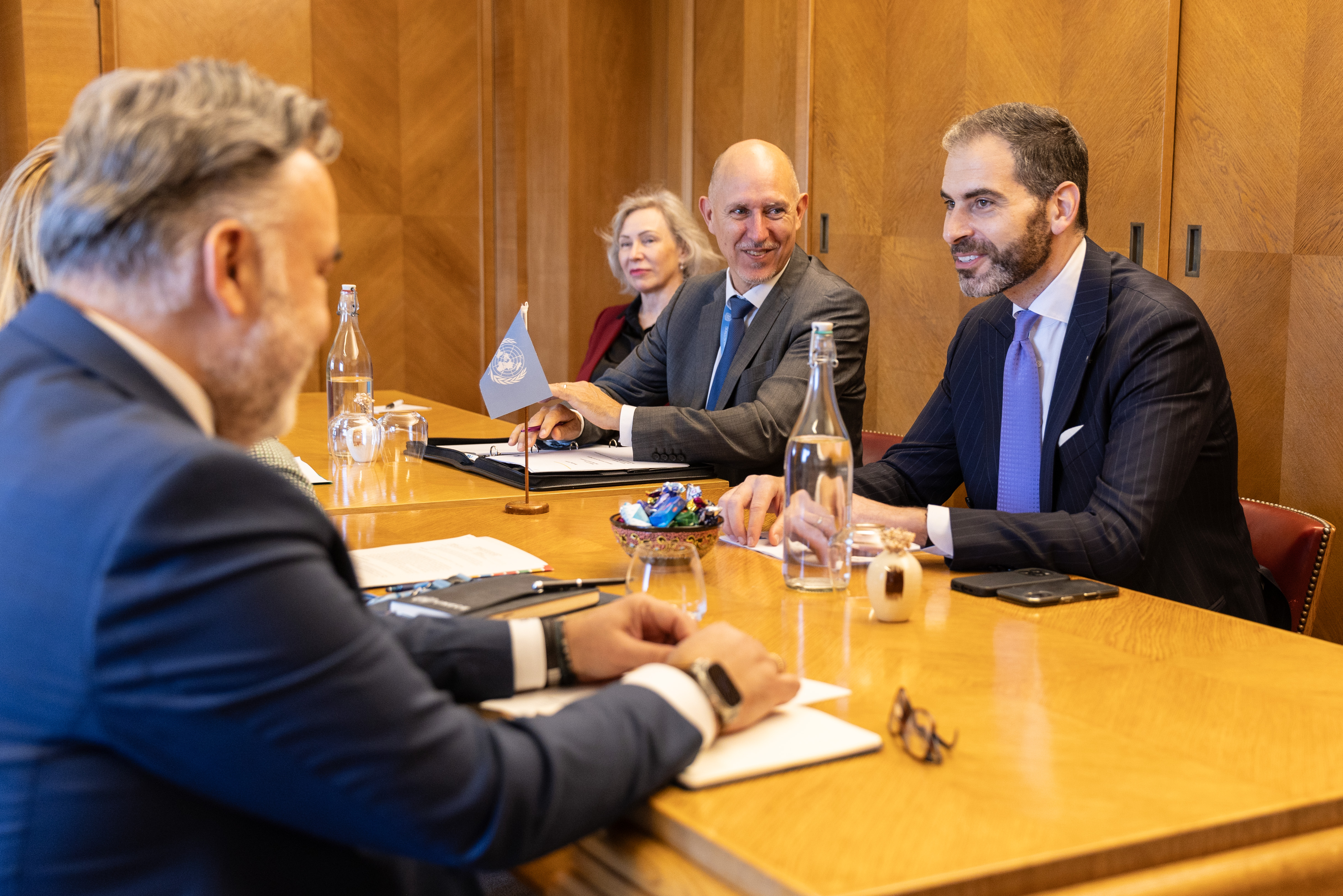
New IRU Secretary General Habib Turki and UNECE Executive Secretary Tatiana Molcean have held their first bilateral meeting, setting out priorities to strengthen their longstanding partnership, accelerate digitalisation and expand the reach of international road transport conventions.
Meeting at the United Nations in Geneva, Habib Turki and Tatiana Molcean reaffirmed the importance of close cooperation between IRU and UNECE in addressing the evolving challenges facing international road transport.
The discussion focused on strengthening the implementation and geographical expansion of key UN transport conventions, particularly TIR and CMR, while accelerating joint efforts to advance their digitalisation through eTIR and eCMR.
Particular attention was given to the AETR Agreement, including the pressing challenges surrounding its implementation and the need to ensure a coherent, practical and internationally coordinated approach that supports operators and drivers.
The two leaders also exchanged views on broader opportunities to facilitate international road transport, including the application of existing UN instruments governing the temporary importation of commercial road vehicles, notably the 1956 Convention.
Other issues included the persistent difficulties professional drivers face in obtaining visas, as well as the impact of geopolitical developments and shifting trade patterns on road transport.
Looking ahead, both organisations shared opportunities to contribute to the objectives of the United Nations Decade of Sustainable Transport, including ways to measure progress and translate global commitments into practical results for the sector.
The discussion identified several opportunities for closer cooperation, which will be followed up through expert-level exchanges between IRU and UNECE.
IRU and UNECE have cooperated for nearly eight decades in developing and implementing international road transport standards and instruments, including TIR, CMR and ADR. Their public-private partnership continues to play a central role in facilitating trade, improving road safety and advancing sustainable transport worldwide.