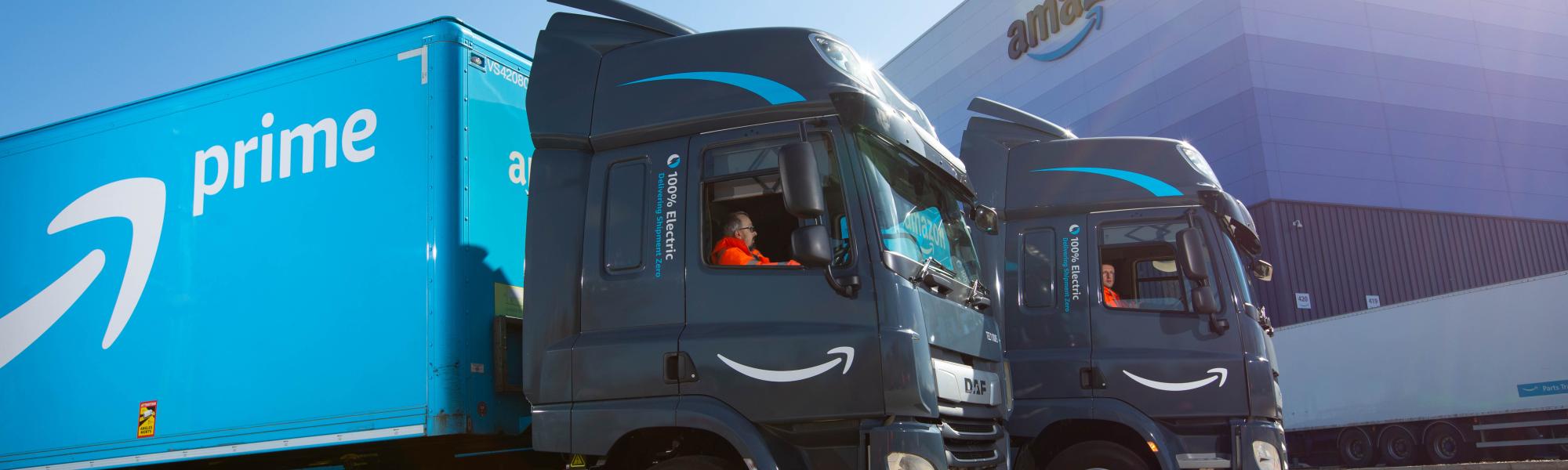
Battery-electric vehicle adoption remains concentrated among larger operators and on shorter routes. But large-scale deployment can also help create the conditions for others to follow, Amazon’s Andreas Marschner told us.
The road transport industry’s shift to alternative fuel vehicles is gaining momentum. But the transition remains uneven.
IRU’s 2026 Green Compact survey found that planned investment in battery-electric vehicles is heavily concentrated among larger companies. In Western Europe, 87% of operators with annual turnover above EUR 100 million plan to invest, compared with 26% of smaller companies.
IRU member Amazon offers an example of what deployment at scale can look like.
In 2022, Amazon committed EUR 1 billion over five years to further electrify and decarbonise its European transport network. At the end of 2025, Amazon and its delivery partners had more than 10,000 electric delivery vans in Europe.
Amazon is also electrifying heavier transport and has more than 200 electric heavy trucks operating across its European network.
“Our investments in Europe are helping drive the region’s transition to a low-carbon economy, while also supporting economic growth, competitiveness and long-term resilience,” said Andreas Marschner, Amazon’s Vice-President of Worldwide Sustainable Operations.
Using scale to bring others along
For Andreas Marschner, the value of scale extends far beyond reducing emissions within Amazon’s own network.
“Scale gives manufacturers and infrastructure providers confidence that demand will be there,” he said. “Large and sustained orders can help reduce investment risk and accelerate the deployment of both vehicles and charging infrastructure.”
The Green Compact survey shows why this matters.
Vehicle prices have become a leading barrier to alternative fuel vehicle adoption, cited by 66% of operators in Western Europe and 78% in Eastern Europe. Smaller operators have less capital to invest, greater difficulty accessing finance and less capacity to absorb unsuccessful trials or operational disruptions.
Amazon has sought to reduce that barrier for some of the third-party companies operating within its network.
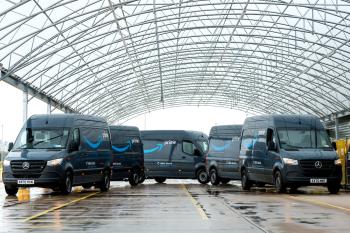
In certain cases, Amazon works with fleet management companies to specify electric vehicle requirements. Those companies then purchase and lease the vehicles to operators serving Amazon routes. This reduces operators' upfront capital requirements and allows the broader network to benefit from operational experience gained through Amazon's wider transport network.
The underlying principle extends beyond vehicles.
Through long-term power purchase agreements, Amazon provides revenue certainty that can help large-scale renewable energy projects reach deployment. This reduces financial risk for developers and encourages investment in new renewable capacity.
The resulting energy supports Amazon’s own operations, while also contributing to the decarbonisation of electricity grids that serve households, public services and industry.
In transport, large vehicle orders and predictable freight demand can play a similar role by giving manufacturers and infrastructure providers clearer signals about where the market is heading.
Beyond the vehicle
The vehicle, however, is only one part of the transition. Charging infrastructure remains a major challenge, particularly for heavy-duty transport.
Amazon has installed thousands of electric vehicle charge points in Germany and the UK, as well as hundreds more in France, Italy and Spain. It is also working on the wider infrastructure challenge beyond its own sites.
One example is CHALET, an open-source planning tool that aggregates and anonymises operator data to help identify where public commercial vehicle charging infrastructure is most needed on European highways.
Amazon is also supporting the development of an electric freight corridor in Poland. The pilot, scheduled for 2027, aims to aggregate demand for zero-tailpipe-emission freight transport along major logistics routes, allowing electric trucks and high-capacity charging infrastructure to be deployed in parallel.
The approach reframes one of electrification's core challenges: instead of waiting for infrastructure before deploying vehicles, aggregated demand can help show infrastructure providers where investment is needed.
“Electrifying transport means recognising how investments in vehicles, charging infrastructure and power grids need to enable each other,” said Andreas Marschner. “We need to confidently invest across the whole electric logistics ecosystem to accelerate the sector's transformation.”
“That requires coordination across operators, infrastructure providers, energy companies and policymakers,” he added.
Amazon has applied the same principle of collective demand more broadly. It co-founded the Sustainable Freight Buyers Alliance, which brings freight buyers together to coordinate demand for battery-electric vehicles and charging infrastructure.
That reflects a wider lesson from the transition.
Amazon may have the scale to move early, but even the largest companies cannot decarbonise road logistics alone. Grid capacity, charging networks, vehicle availability and supportive policy frameworks all need to develop alongside demand.
Transport decarbonisation forms part of Amazon’s commitment under The Climate Pledge to reach net-zero carbon emissions across its operations by 2040.
“Our investments are not only reducing our own environmental footprint. They are also helping to de-risk investment in the technologies and infrastructure that will underpin Europe’s green transition and long-term industrial competitiveness,” said Andreas Marschner.
Amazon’s experience shows what can happen when large-scale demand is mobilised to support decarbonisation. The wider challenge is creating the conditions that allow more operators – particularly smaller companies which make up most of the road logistics sector – to follow.
About Amazon
Since its inception as an online retailer in 1995, Amazon has been relentlessly focused on being Earth’s most customer-centric company, where people can find and discover anything they want to buy online. Amazon also enables other retailers to sell through the Amazon.
Since 2021, Amazon has invested EUR 17 billion in European companies pioneering low-carbon technologies across the energy, transportation and packaging sectors. According to a report by Frontier Economics commissioned by Amazon, these investments have supported up to 144,000 jobs and generated as much as EUR 11 billion in gross value added across the EU and the UK.