
While Brent is still below its spring peak, the other cost components of diesel are on the rise. National measures are still in place in most of the EU, but they are being tapered rather than deepened, with limited impact on prices at the pump. Here’s the latest overview for the road transport sector.
Brent crude futures moved back above USD 100 per barrel on 9 September as renewed attacks on oil product shipping intensified concerns over Middle Eastern supplies.
Traffic through the Strait of Hormuz remains severely constrained, while the shutdown of Saudi Arabia's East-West pipeline has further restricted export options. The pipeline, with a total capacity of 7 million barrels per day but carrying an estimated 4–5 million barrels per day since the war began, links Saudi Arabia oil fields to the Red Sea port of Yanbu, a crucial alternative to the Strait of Hormuz.
Attacks and threats against Saudi-linked shipping had already sharply reduced Saudi crude flows through the Bab el-Mandeb Strait since late July, prompting shipments from Yanbu to be redirected north through the Suez Canal and Egypt's SUMED pipeline, the southern route being considered unsafe. The Saudi pipeline shutdown now threatens the supply feeding those alternative routes, with Yanbu holding only five to seven days of export stocks.
The disruption is already affecting European buyers: according to Argus and Reuters, at least three European refiners had late-September crude cargoes cancelled or pushed back to November by Saudi Aramco, with Poland's Orlen turning to North Sea grades and US WTI as replacements.
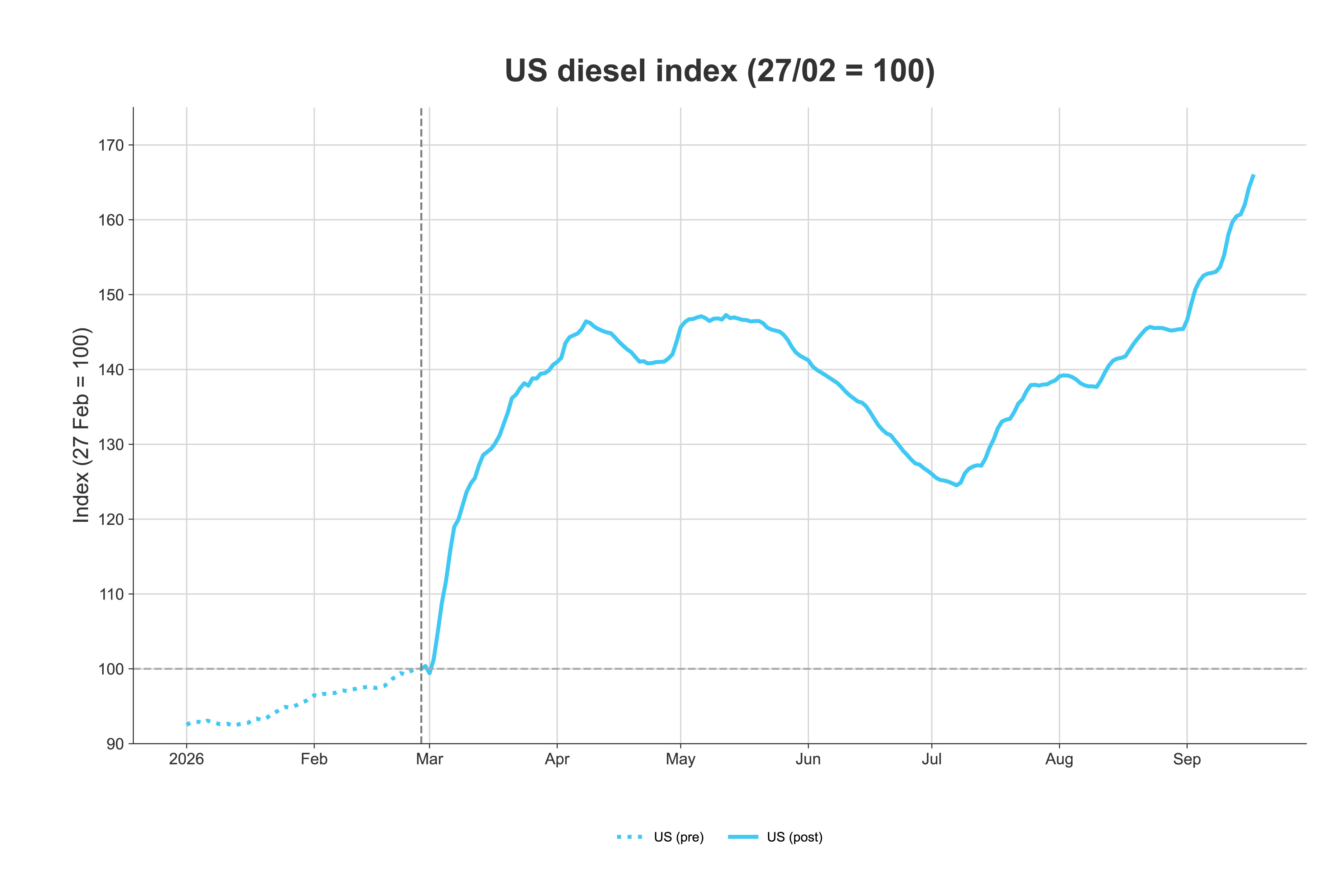
Over the same week, the EU’s average diesel price rose by 4%. This decoupling between crude and diesel is the defining feature of September: according to the IEA, diesel refining margins in North-West Europe exceeded USD 100 per barrel in early September, and US diesel traded above USD 200 per barrel, 94% above pre-war levels, while Brent was up 45%.
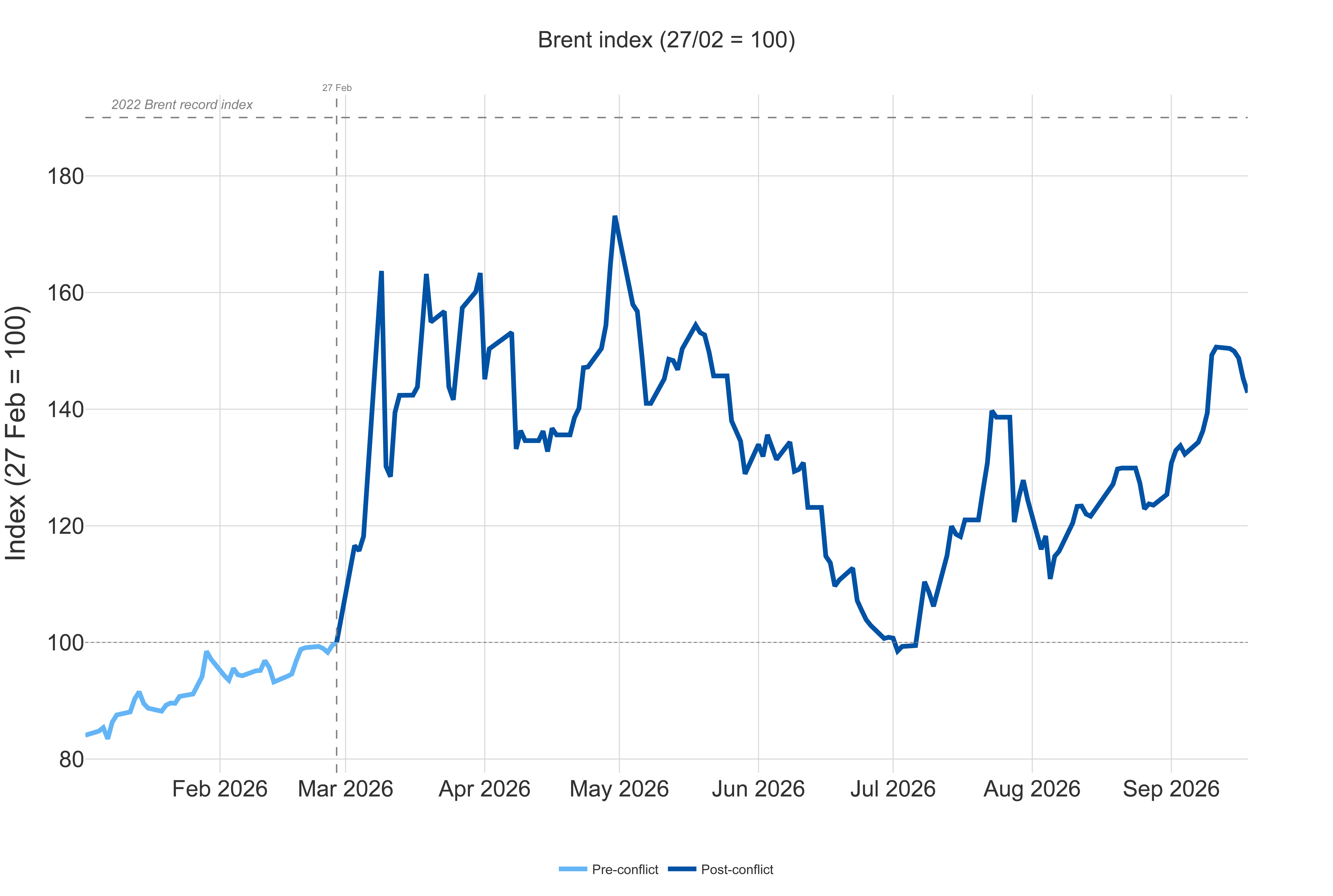
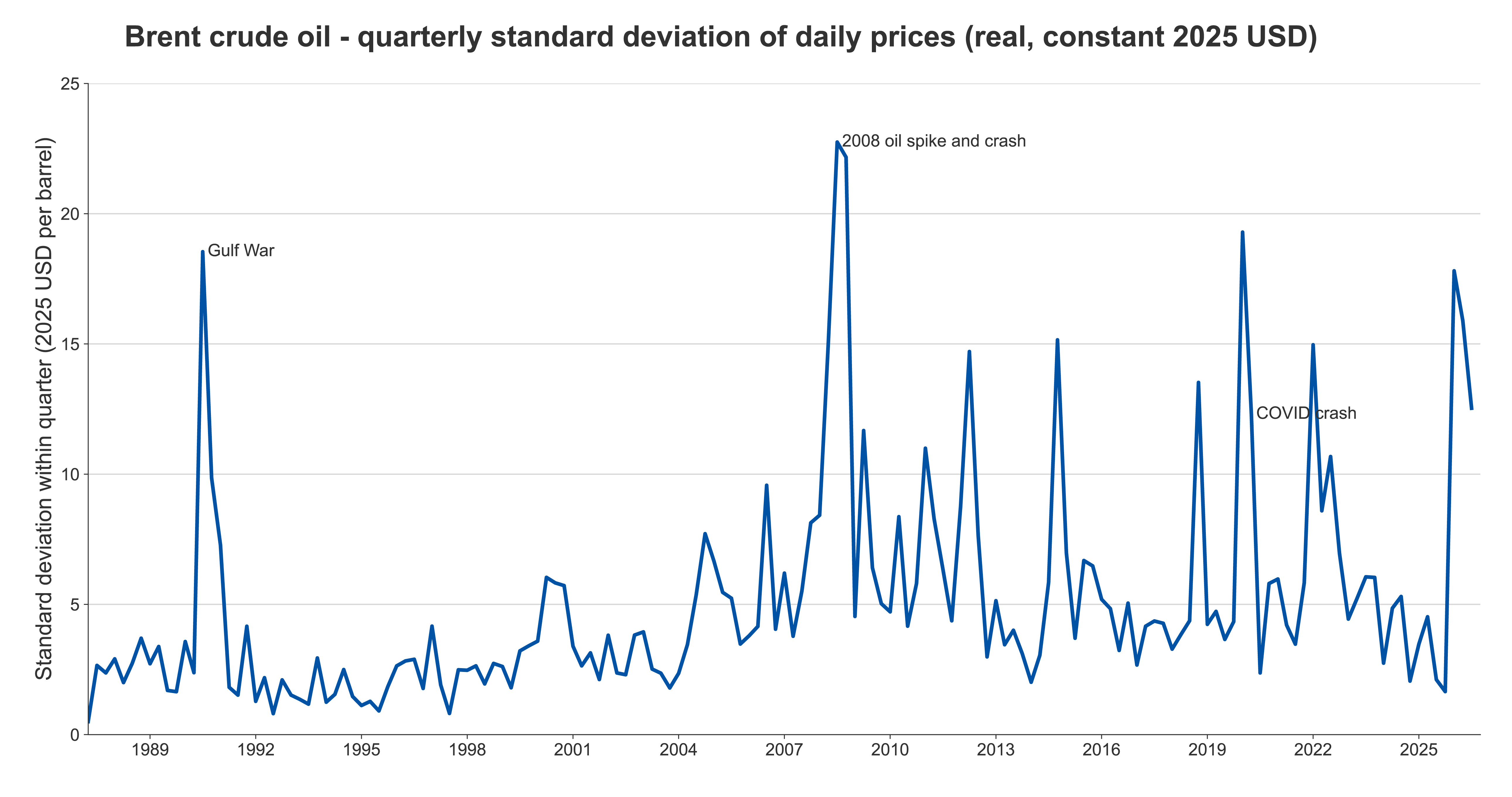
While the Brent value is high, once adjusted for inflation, the world has already faced higher Brent prices in relative terms. The long-term issue though is the Brent dynamics, which remain in crisis territory, with the volatility indicator still in high territory for 2026 despite summer’s short relief. This could mean that the higher diesel prices are just the tip of the crisis that economies will experience in the coming months, once the ripple effects will be more visible.
Refining and stocks
The immediate effect of the current crisis is nevertheless on diesel prices at the pump, reaching figures never seen before due to issues with refining and available stocks.
For the EU, the diesel supply chain involves refining crude with regional capacity and importing finished diesel from other regions. Before the war, the Middle East was the largest external supplier of diesel to the EU, ahead of the US and India.
Since then, diesel exports have collapsed: the IEA puts net diesel exports from Middle East countries at 390,000 barrels per day in August, just over a quarter of pre-war levels, and the United States has become Europe's main external supplier, providing about half of Europe's seaborne diesel imports in August, according to Vortexa. September marks overheating on both supply routes.
The IEA notes that with operating rates already very high in the US and Europe, and Asian refiners constrained by crude availability, the global refining system is bottlenecked in meeting product demand.
EU refineries could produce roughly 4.5–5 million barrels per day of diesel and gasoil at full operation, based on a typical European product mix.
According to Argus, planned September maintenance could temporarily remove 450,000–550,000 barrels per day of northern European crude-processing capacity (roughly 4% of wider European capacity). Maintenance pressure extends beyond northern Europe, with planned work at Motor Oil Hellas's Corinth refinery in Greece and Galp's Sines refinery in Portugal also affecting secondary processing units this autumn. These programmes could further constrain fuel production, although their impact cannot be measured by treating the entire refineries as offline.
US diesel supplies are tightening despite refineries operating at exceptionally high rates.
Atlantic coast distillate inventories fell to 19.3 million barrels in the final week of August, their lowest level since weekly records began in 1990, according to the EIA. They have since recovered slightly to 21.6 million barrels in the week ending 11 September, still far below any previous year. Higher exports have contributed to the drawdown: US distillate exports reached a record 1.88 million barrels per day in late July, as European buyers outbid domestic demand.
Autumn maintenance could add further pressure. Canada's 320,000 barrels per day Saint John refinery, a major supplier of ultra-low-sulphur diesel to the northeastern US, is undergoing a 75-day maintenance programme from early September to mid-November. Its shutdown coincides with rising agricultural demand during the harvest and the approach of the winter heating season.
US refinery utilisation reached 98% in the week ending 28 August, the highest since 2018, and stood at 96.8% in the week ending 11 September, leaving limited scope to compensate via higher operating rates. National distillate inventories stood at 107.9 million barrels on 11 September, 13% below the five-year average. Some refiners have postponed maintenance until 2027, but in its September outlook the EIA nevertheless expects national distillate inventories to fall below 100 million barrels in September and to remain below the five-year low through most of 2027.
Higher energy prices experienced to date are not only the result of the conflict in the Middle East but also of the war in Ukraine, with Russian refining capacity being targeted and damaged, further limiting the supply of diesel on the global market.
Russia has banned exports of diesel and gasoil since 8 July, with the ban formally expiring on 30 September. An extension to 31 October was decided on 14 September but had not yet been published by mid-week. The reason is the state of the refineries: according to Reuters, three of the six largest diesel-producing plants, which together account for about half of Russia's diesel output, are now shut (Kirishi) or running at about a quarter of their design capacity (NORSI and Volgograd), two further Rosneft refineries at Syzran and Saratov halted after strikes on 16 September, and the Yaroslavl refinery was hit on 17 September. The IEA estimates Russian crude runs at around 3.6–4 million barrels per day against a seasonal norm of 5.3–5.6 million, the lowest level since 2004, and now assumes they will stay at that level through 2027.
Diesel prices at the pump
September is seeing the energy crisis getting back to full steam, with diesel prices surpassing their previous 2026 records. While Brent is still below the peak of about USD 125 a barrel reached last April, tensions on refining capacity, stocks and international diesel flows have pushed pump prices to unprecedented levels.
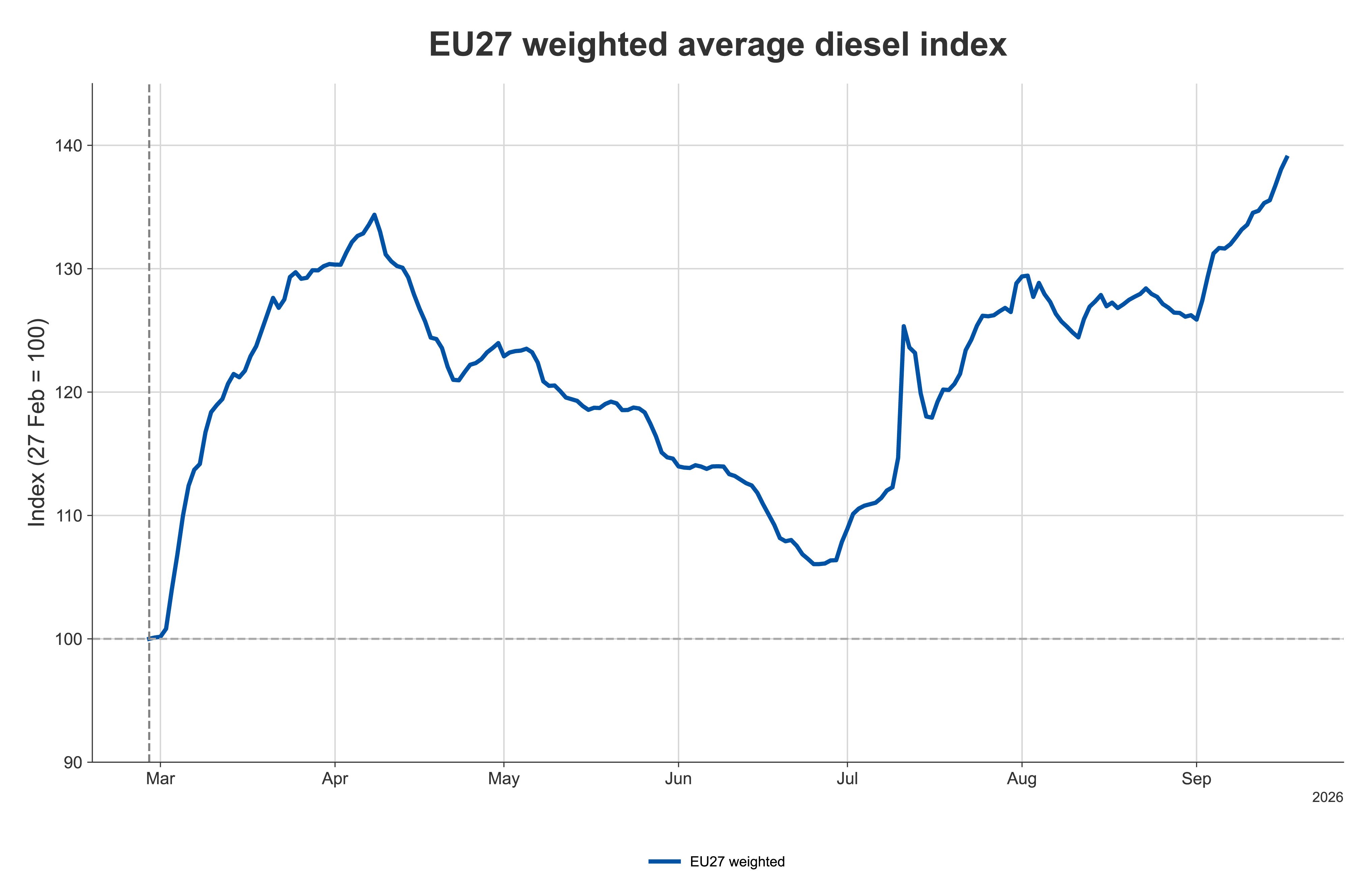
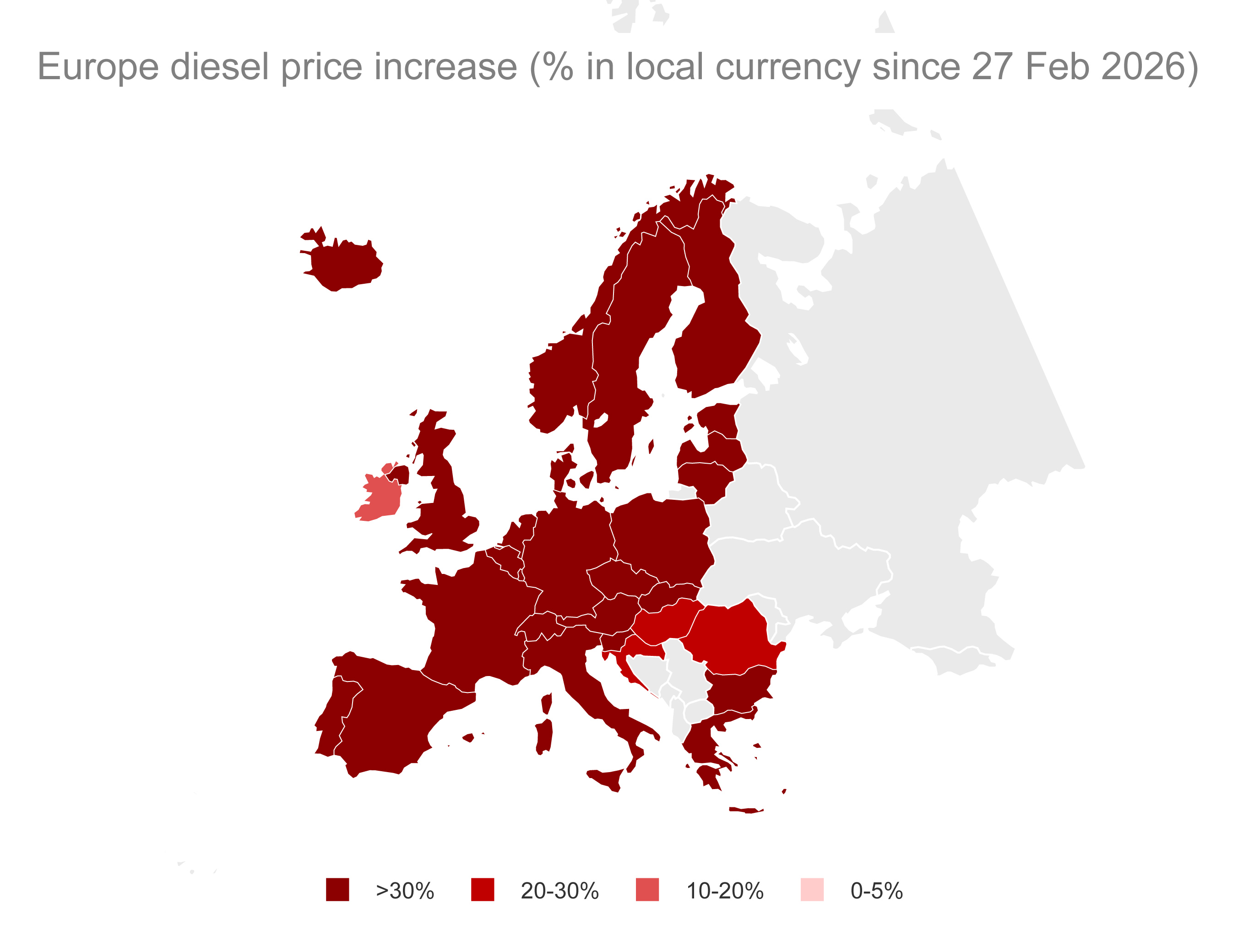
In the EU, the weighted average price reached EUR 2.26 per litre on 17 September, a 38% increase since 27 February, beating the previous record of a 34% increase set on 8 April. The 4-point difference matters as in April, most EU countries had just introduced excise cuts, price caps or rebates. On the other hand, today's record prices are being handled with less fiscal support in the largest EU markets: for example, Germany's fuel discount lapsed on 30 June and the latest Polish measures ended on 31 August. The current price level also exceeds the previous all-time high of June 2022.
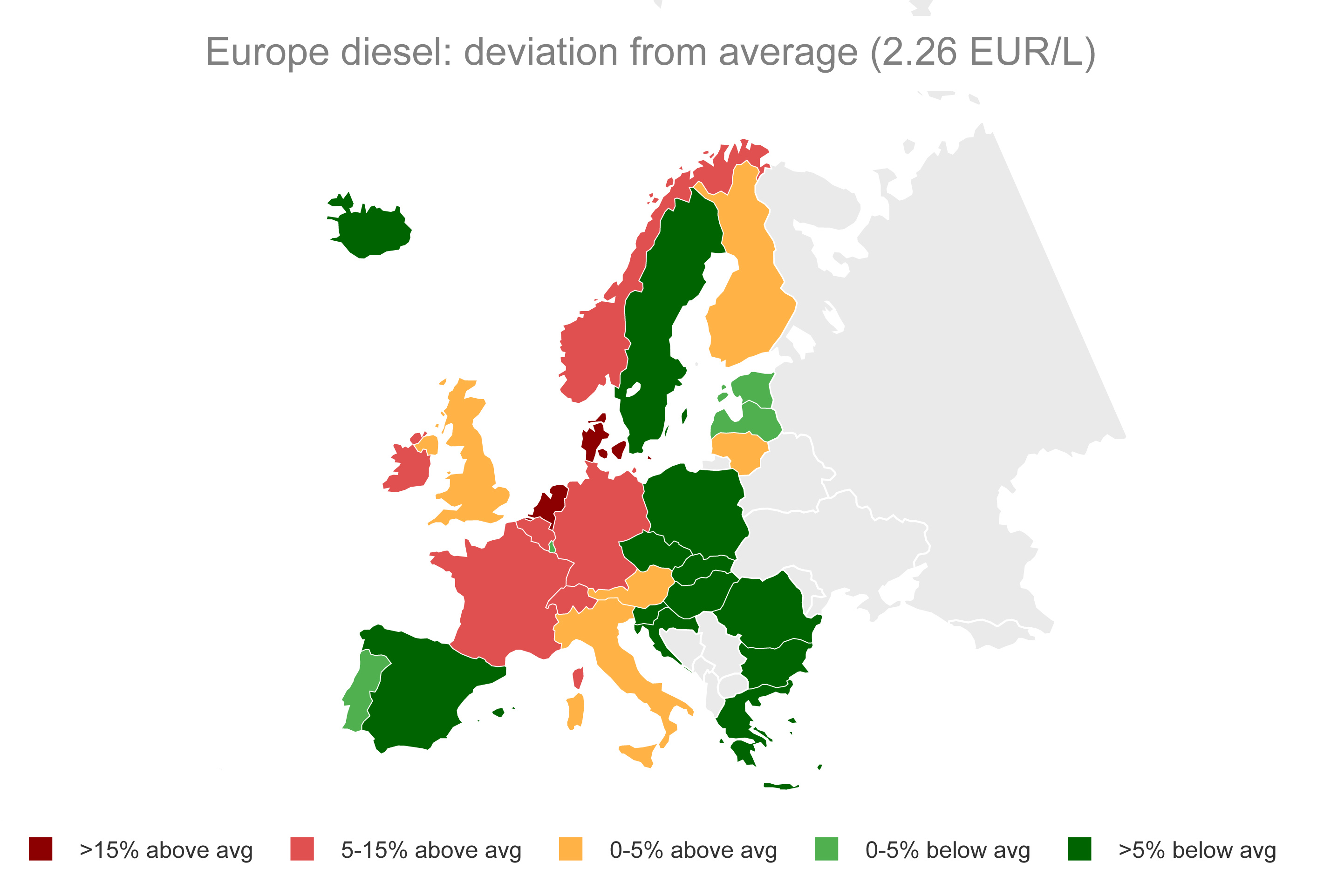
Diesel is most expensive in Denmark and the Netherlands, averaging EUR 2.62 per litre at public fuel stations, followed by Germany at EUR 2.50 per litre, while the biggest increases since the beginning of the crisis are in Poland, Bulgaria and Czechia, all close to 50%.
Malta being an exception with a frozen administered price, the cheapest diesel is found in Croatia, at EUR 1.85 per litre, followed by Spain at EUR 1.89 per litre, both the result of national measures. Croatia sets a weekly maximum price, without which diesel would sell at about EUR 2.16 per litre; Spain has cut its excise duty to EUR 179 per 1,000 litres in September, on top of a EUR 200 per 1,000 litres refund on professional diesel. Both Spanish measures expire on 30 September and the automatic clause that deepened the cut cannot be triggered again for October.
Outside the EU, Turkish operators are experiencing a greater price hike, with diesel up 61% in lira since February.
The September jump is largely fiscal: the special consumption tax on diesel, zero-rated in August, was reinstated on 1 September, pushing the Istanbul price above TRY 100 per litre on 17 September, and a further tax step is due in October.
Chinese operators have seen prices rise by 17% since their mid-July low, and by 21% since February, although the price remains below its April peak: the government raised diesel prices by CNY 250 per tonne on 13 September, deliberately below the CNY 420 implied by its pricing formula, and China entered the crisis with ample oil and diesel reserves.
In the US, prices have reached an all-time nominal record: retail diesel is up 66% since February at USD 1.69 per litre, and the official on-highway price of USD 6.29 per gallon on 14 September exceeds the June 2022 record of USD 5.81.
National measures to support transport operators
Most EU governments have kept their fuel price shields in place through September, but the pattern is to phase out measures rather than deepening them.
Out of the 27 countries, 16 still have measures in place, and 5 of them are supposed to remove them at the beginning of next month.
- Italy has extended its excise cut for a tenth time but reduced the discount from about EUR 0.17 per litre to EUR 0.12 on 18 September and to EUR 0.6 from 26 September, after which an automatic mechanism recycling surplus VAT receipts takes over from 5 October.
- Romania has renewed its 25% cut in diesel excise for the second half of September, alongside a margin cap and a once-a-day price rise rule running to 31 October.
- Cyprus has extended its excise reduction to 30 November.
- France has extended its targeted per litre aid to fishermen, farmers and construction to 31 December, while still excluding road freight.
- The Netherlands has cut its truck toll by 22% and zeroed the vehicle tax on trucks of 12 tonnes and over until the end of the year.
- Slovenia has passed an act under which the state covers up to 70% of road hauliers' additional diesel costs above a reference price.
- Hungary's new package gives private diesel car owners a monthly allowance and farmers a full duty refund, but nothing for road transport operators.
The next critical date is 30 September, when a series of measures expire at once: Spain's excise cut and professional diesel refund, Austria's monthly excise reduction (October to be decided at the end of the month), Greece's state diesel subsidy of about EUR 0.10 per litre, Romania's excise cut and Sweden's energy-tax cut. Germany, the EU's largest diesel market, has had no price measure since its fuel discount lapsed on 30 June, which is why it now posts the third-highest price in the EU at EUR 2.50 per litre, up 43% since February.
Detailed national measures are available here.
Natural gas
Europe's tightening natural gas market is raising concerns ahead of winter.
Dutch TTF prices stood at about EUR 76 per MWh on 17 September after peaking at EUR 83 per MWh on 14 September, compared with an average of around EUR 34 per MWh in January.
The direct impact on transport operators' costs has so far been limited, with the European CNG and LNG fuel prices monitored remaining relatively stable and urea, the key raw material used in AdBlue, recording more moderate price movements.
The greater risk may come through freight demand: sustained high gas prices could force energy-intensive manufacturers to reduce production, weakening demand for transport, while at the same time lowering the purchasing power of EU citizens. Fertiliser producers in Czechia and Poland have already said they are considering curtailing ammonia output.
The 2022 energy crisis illustrates this vulnerability. Surging gas prices pushed production costs to unsustainable levels for many European manufacturers, prompting output cuts and shutdowns. EU road freight activity subsequently declined by 3.2% in 2023, measured in tonne-kilometres. Although that decline cannot be attributed to gas prices alone, it highlights the sector's exposure to weaker industrial activity.
With EU gas storage at 68.8% of capacity on 16 September and replenishment progressing slowly, the region has a smaller buffer against winter supply pressures.
Higher September prices are also making refilling more expensive. The EU retains a headline storage target of 90%, although current rules allow it to be met between 1 October and 1 December and permit deviations under difficult market conditions. Low inventories nevertheless leave Europe more exposed to further price increases if the coming winter is colder than usual, with potential consequences for both industrial production and road freight demand.
What to watch in the coming month
On the export of crude oil from the Arabian Peninsula, the situation could remain very dire as the Strait of Hormuz is still very difficult to cross for tankers and the East-West pipeline will run at reduced capacity for weeks. Moreover, the recent attacks and related damage highlight the pipeline's risk exposure, and repair will not make it less exposed to drones.
In its September Oil Market Report, IEA stated that global oil demand is now expected to fall by 2.5 million barrels per day in 2026, and observed oil inventories have dropped by 507 million barrels since the start of the war.
Combined diesel exports from the Middle East and Russia in August were 1.6 million barrels per day below February, when they accounted for almost 45% of global seaborne diesel trade. Covering that shortfall would require an additional 1.5–2 million barrels per day of refinery runs, and the IEA states that "it remains uncertain where additional production could come from".
On the demand side, the seasonal rise in middle distillate demand between August and November is expected to reach almost 1.2 million barrels per day, double the usual rate, as households replenish heating-oil tanks delayed by the crisis. The IEA's conclusion is that diesel markets "will remain undersupplied in the coming months, unless demand softens rapidly".
With the colder season about to start in the Northern Hemisphere, tensions in the balance between oil supply and demand therefore have little room to ease and are likely to intensify. US refiners share this view: Valero indicated in July that global inventories could remain below the five-year average through 2027 even if the conflicts ended immediately, and Phillips 66 expects tight margins to last into 2027 because of infrastructure damage and low inventories.
For transport operators, it means that a sustained decrease in diesel prices is highly unlikely in the short term, and measures need to be taken to solve the paradox of securing diesel supply and preserving cash flows.
IRU fuel prices: Get daily updates for EU countries and weekly updates for 40+ countries, with a one-week forecast to help you plan confidently.
IRU members, strategic partners an Intelligence subscribers already have full access to the IRU fuel prices service.