
In the second part of this series on the UN Decade of Sustainable Transport (2026–2035), IRU Secretary General Umberto de Pretto outlines clear actions to materialise tangible results.
For a historical overview of sustainable road transport and joint IRU-UN initiatives, see the first part of this series.
How can we ensure the Decade is a success?
Looking back on the 80-year history of the UN and transport, change comes most effectively when the UN works closely with the private sector, notably in public-private partnerships.
From IRU’s work as the global voice of commercial road transport, we have dozens of examples of successful collaborations spanning our own 78-year partnership with the UN, historically the first public-private partnership of the UN.
As the private sector side of the equation, we offer not only an operational perspective of transport networks and services that helps the UN propose, draft and implement robust international standards, but we offer innovation and practical tools to make change happen on the ground.
With this in mind, we have a key role to play in making the UN Decade a success, especially in helping mobilise and scale up existing proven and pragmatic tools.
Examples include:
- Building capacity and mobilising evidence-based tools and resources, such as with IRU’s Green Compact, to accelerate the adoption of sustainable road transport solutions
- Ratifying and implementing key UN transport conventions, including the global TIR transit system and the eCMR protocol to the CMR convention
- Fostering technology neutrality, sustainable innovation and digitalisation as drivers of efficiency and transparency in transport management and operations
What is the role of TIR in sustainable transport?
The TIR system is the mother of all UN public-private partnerships and has demonstrated, over many decades, that efficiency equals sustainability, in this case for trucks moving essentials across borders.
TIR has been shown to slash CO₂ emissions at border crossings by 90% by ensuring that trucks can cross borders efficiently and swiftly.
Drivers stuck at borders for hours or days on end – and sometimes even weeks – idling away are a clear impediment to the economic, social and environmental pillars of sustainable transport.
How else can we make road transport more sustainable?
One of our biggest concrete achievements has been to work with governments to reduce noxious emissions by up to 98% since 1990.
We have now turned our attention to carbon dioxide.
To address the decarbonisation challenge, we launched the IRU Green Compact, a global commitment adopted by IRU members in 2021, to investigate solutions and design and implement pragmatic roadmaps for the industry to reach carbon neutrality by 2050.
The rapid pace of change with decarbonisation technology and innovation means that clarity, robustness and pragmatism are crucial to meet commercial road transport operator needs in enabling them to change over time – both economically and operationally – as they continue to serve mobility and logistics demand.
The Green Compact is grounded in a scientific, evidence-based approach – applied to the analysis of transport operations, the investigation of decarbonisation levers, and the forecasting of market potential – with a focus on economic as well as social and environmental sustainability.
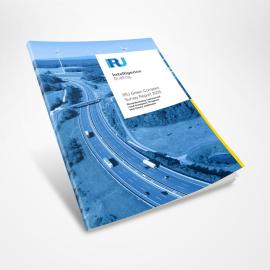
Importantly, the Green Compact builds in regional and country flexibility in driving the right approaches in the right places – based on transport and energy landscapes. It targets the longer-term scaling up of solutions across the more than 3.5 million companies, many of which are SMEs, that operate commercial road transport services globally.
Based on the Green Compact, what is the way forward?
A key finding of research conducted under the Green Compact is that the road transport sector can already reduce its carbon footprint by 50% with available efficiency measures.
For example, eco-truck combinations (two trailers instead of one) can reduce a truck’s CO₂ emissions by 30%.
The steady transition to alternative fuels covers the remaining 50%, allowing the industry to reach carbon neutrality.
We can take significant steps right now, instead of putting all our focus on alternative fuel trucks when the enabling conditions are simply not there yet.
How can the public and private sectors use the Green Compact to decarbonise transport?
We have developed two Green Compact modelling tools specifically for companies and governments to decarbonise operations and plan policies while continuing to meet transport demand.
The Alternative Fuels and Efficiency Model (AFEM) is a cutting-edge calculation tool for operators and shippers. It combines regulatory reporting, emission reduction strategies, and total cost of ownership analysis.
Using telematics data, AFEM calculates energy consumption, emissions and costs for both completed and future trips, factoring in eco-driving efficiency, payload and vehicle parameters.
The Decarbonisation Roadmap Maker (DRM) simulates the effectiveness of new technologies, practices and policies.
DRM enables governments and companies to develop pragmatic, data-driven decarbonisation roadmaps, while monitoring costs.
Any final words?
We must focus on pragmatic solutions.
At the end of the UN Decade, we must be able to look back and see clear, tangible and measurable change in the sustainability of transport around the world.
To make this happen, the public and private sectors must work hand in hand to achieve what is already possible today.
At IRU, we are gearing up for this great challenge.
Instead of talking about the decade of sustainable transport, let’s stop talking about it and start acting.