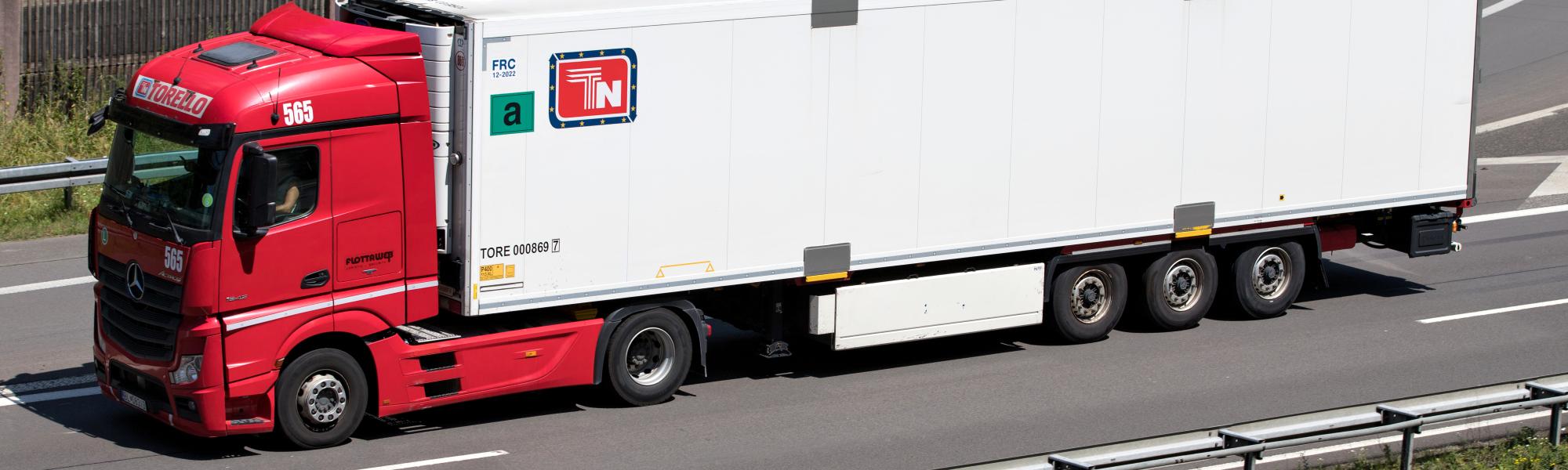
For Torello, driver shortage is not only a labour market issue. It is also a question of bureaucracy, certification and integration, especially for drivers from outside the EU. The company can identify, recruit and train drivers. But making them fully qualified and ready to work takes far too long.
Italy’s driver shortage has not disappeared. For companies such as IRU member Torello, one of the main barriers remains the time required to bring new professional drivers into the workforce, particularly when candidates come from third countries.
According to Vincenzo Loria, HR Generalist at Torello, the current process is too slow and often too complex. Under Italy’s Decreto Flussi system, companies must declare their annual staffing needs and then take part in a “click day” (a system to allocate work permits for non-EU nationals) to request foreign workers.
Even when a quota is obtained, several months may still pass before the driver receives a visa and is able to enter Italy. And arrival in Italy does not mean that the driver can immediately become operational.
“We can bring people to Italy, but then we have the problem of the driving licence and the CPC,” said Vincenzo Loria, HR Generalist at Torello.
Once in Italy, the first obstacle is the Certificate of Professional Competence, known in Italy as CQC. Without it, a driver cannot work professionally. This is already a major bottleneck, especially because the qualification must be obtained in Italian.
But the CPC is not the only obstacle after arrival. For non-EU drivers, the residence permit can become an additional bottleneck. In many cases, it is issued more than one year after the driver has arrived in Italy.
In practice, delays in the residence permit can also delay the driver attestation required for international road transport. This means that, even after being recruited, brought to Italy and trained, non-EU drivers may still be unavailable for international routes.
For a company such as Torello, this is a major operational constraint. The full process can already take many months before a driver enters the country, followed by another six months to a year before that person becomes fully qualified and operational.
These delays create direct costs, hidden costs and lost productivity. The issue is not the training itself. Torello can develop a candidate into a professional driver in three to six months. The real challenge is the documentation process.
“People should arrive in Italy already qualified in terms of documents,” said Vincenzo Loria. “Not in terms of training, because we can train them.”
The language barrier makes the process even harder.
In Italy, the CPC must be completed in Italian. This means that drivers arriving from countries such as Kyrgyzstan, India, Tunisia or Morocco first need to learn Italian, then Italian regulations, and then Italian driving rules. For many candidates, one year is therefore the shortest realistic timeline before they can become fully operational.
Torello tries to use the waiting period productively. The company trains drivers while they wait for their documents, offering practical driving courses, Italian language training and courses on regulations.
However, as candidates are not yet fully licensed to work, practical training can only take place in Torello’s own parking areas, not on public roads. The company covers these costs directly, without public incentives.
This is why harmonisation matters. Vincenzo Loria pointed to significant differences within the EU. A CPC may be obtained much faster in one country than in another, yet drivers must qualify in the country where they work and in that country’s language. This remains one of the biggest obstacles to faster recruitment.
The recently established Piano Mattei cooperation framework between Italy and Tunisia has helped make it easier to identify and train drivers before they come to Italy. It is a useful step, but it does not solve the core problem. Drivers still need to complete the CPC qualification in Italy and in Italian, and the wider administrative process remains lengthy.
“It can help, but it does not solve the problem,” said Vincenzo Loria.
International workforce
Torello’s workforce shows how international the profession has become. Around 60% of the company’s drivers are foreign nationals. Of those foreign drivers, about 60% come from other European countries, while 40% come from the Middle East and North Africa. Across the company, 15 nationalities and five to six languages are represented.
That diversity requires practical support. Torello hires office staff who speak the languages of its driver workforce. When many drivers came from Romania, the company hired Romanian-speaking staff. As more drivers now come from Tunisia and Morocco, it is looking for Arabic-speaking staff. For Vincenzo Loria, this is not just translation. It is integration.
“We are always talking about people,” he said. “It is a relationship. It is a colleague.”
The whole family
Working conditions are another major part of the solution. Torello’s average driver age is between 40 and 45. Attracting younger people means making the job more appealing, especially for those who do not want to spend weeks away from home.
Some drivers prefer last-mile or national work because they can return home more often. International drivers, by contrast, may spend two or three weeks on the road. For drivers from India or Kyrgyzstan, returning home may only be possible every three months. This makes working and living conditions away from home essential.
Torello has invested in secure parking at its Piacenza headquarters, with hostel-style facilities, including beds, showers, a kitchen and washing machines. The site is mainly used by Torello drivers, although it is also open to others. The company is planning a similar investment at its Montoro headquarters.
When drivers are abroad, Torello requires them to use safe and secure parking areas. This protects cargo, but it also protects people.
Retention, Vincenzo Loria said, does not depend on complicated incentive schemes. It starts with respect. “There is no special formula. It is about respect, listening and making drivers feel part of the company.”
That approach has helped drivers stay with Torello for 10, 12 or even 18 years. In one case, an entire family now works for the company after the father joined, followed by his wife and children. The message is clear: companies can invest in training, facilities and integration. But faster progress will also require simpler, more predictable and more harmonised qualification and documentation systems.
Drivers are needed now. Waiting one or two years to make them fully operational is no longer sustainable.
About Torello
Founded in 1975 in Italy, Torello is a family-run logistics company operating nationally and internationally.
It provides road transport, contract logistics, and supply chain solutions, offering customised warehousing and last-mile delivery services with a fleet of over 3,200 vehicles.