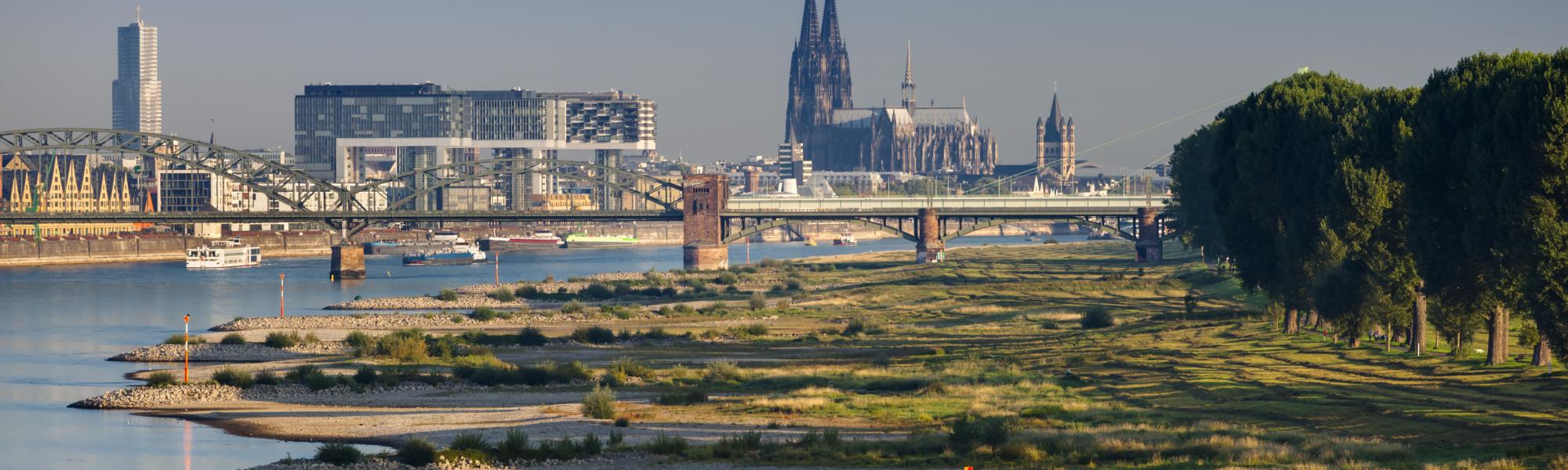
The Rhine’s historically low water levels highlight the importance of resilient, flexible and multimodal transport networks.
Persistently low water levels on the Rhine are disrupting freight flows, reducing vessel capacity and sharply increasing transport costs.
As water levels fall, barges have had to reduce their loads significantly. Some vessels are operating at only a fraction of their normal capacity.
Businesses are in turn looking to other modes where possible.
Rail can absorb some volumes, while road transport offers flexibility to reroute goods quickly, connect different parts of the logistics chain, and serve destinations without direct waterway or rail access.
“The drying Rhine reminds us of a simple reality: no single mode of transport can secure the supply of our economy on its own,” said Fabien Produit, Member of the Executive Board and Head of the Knowledge Division at IRU member ASTAG.
Several German states have temporarily relaxed restrictions on heavy goods vehicle movements to provide additional room for the road freight sector to respond. IRU’s Flash Info alert system has been updating operators on these changes.
“Germany already faces a severe driver shortage. And driving and rest time rules remain unchanged even where Sunday driving restrictions have been relaxed,” said Prof. Dr. Dirk Engelhardt, Spokesman of the Executive Board of IRU member BGL.
“Whenever established transport chains come under pressure, road freight is expected to step in because of its flexibility. But road transport cannot create unlimited capacity overnight,” he added.
Transport resilience
The current disruption illustrates the different strengths of each transport mode.
Road transport provides the flexibility to connect origins, terminals and destinations, reroute freight and respond rapidly when established logistics patterns are disrupted. At the same time, the scale of the volumes normally carried on inland waterways demonstrates the limits of replacing one mode with another at short notice.
“When one link in the logistics chain is weakened, the others must be able to step in quickly. Road transport provides this essential flexibility, but it too has its limits,” said Fabien Produit.
The Rhine’s historically low water levels therefore illustrate why transport policy cannot rely on modal shift alone.
“The situation on the Rhine shows once again that resilient logistics needs strong infrastructure and sufficient capacity across all modes, with road, rail and waterways working together,” said Prof. Dr. Dirk Engelhardt.
The lesson from the Rhine is therefore broader than the immediate shift of some cargo from vessels to trains and trucks: resilient logistics requires strong capacity across modes, the ability to combine them efficiently, and enough regulatory flexibility to allow each mode to support the others when circumstances change.