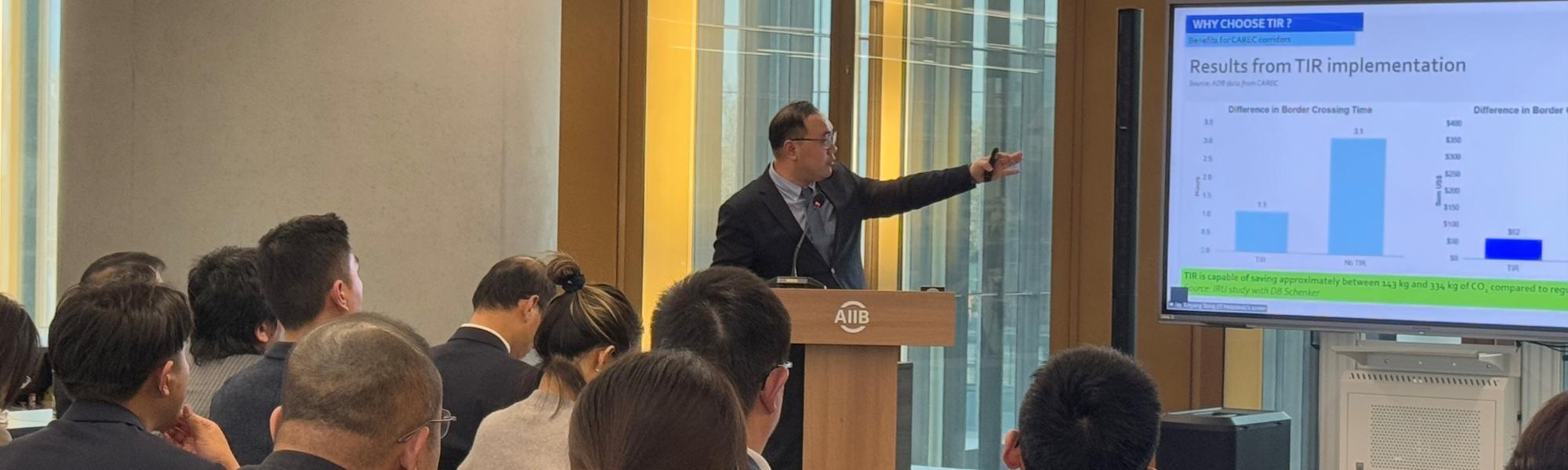
IRU highlighted how the global TIR system is bolstering China–Central Asia transport links at a regional workshop in Beijing.
The Asian Infrastructure Investment Bank – in partnership with IRU member the Global Sustainable Transport Innovation and Knowledge Center (GSTIKC) – recently hosted a workshop on logistics connectivity between China and Central Asia. It brought together governments, international organisations, financial institutions and industry stakeholders to exchange views on transport infrastructure, cross-border facilitation and regional investment priorities.
Speaking at the event, Ran Wang, IRU’s Chief Representative for East and Southeast Asia, outlined the latest developments in the use of TIR along China–Central Asia corridors. He showed how TIR is helping landlocked countries become landlinked trade hubs by improving the efficiency and reliability of cross-border transport.
“Uzbekistan, one of only two double-landlocked countries in the world, has become the largest user of the TIR system, demonstrating its effectiveness in overcoming border-crossing challenges and strengthening the country’s economy.”
Ran Wang stressed the importance of combining investment in physical infrastructure with proven facilitation tools such as TIR.
“With digital solutions such as eTIR and the development of TIR Green Lanes at key border crossings, we are making transport faster, more predictable and more resilient across regional corridors.”
Ran Wang also discussed how TIR is enabling the development of new trade routes and corridors.
Examples include efforts by IRU and its partners to facilitate operations along the Middle Corridor. Another example is the recent milestone of the first intermodal TIR pilot from China to Uzbekistan. The goods first travelled by rail from Xi’an, central China, to Kashgar North Station in Xinjiang, northwest China, before continuing by TIR truck from the Irkeshtam border crossing to Jizzakh, Uzbekistan.
Discussions at the workshop also underscored the importance of closer regional cooperation and more coordinated policies in response to evolving global supply chain dynamics.
About TIR in China
The global TIR transit system continues to gain momentum in China.
Between 2024 and 2025, the number of licensed TIR operators rose by nearly 45%, while the number of TIR vehicles almost tripled.
This growth was reflected in the number of TIR movements: TIR operations to and from China have more than doubled.
This continued growth is strengthening public and private sector confidence in the TIR system, resulting in the opening of new routes and an expansion in the range of goods transported.
Over 50 border crossings and inland Chinese cities now facilitate TIR operations for more than 80 cross-border TIR routes, unlocking new destinations along China–Europe corridors.
The types of goods moved under TIR now include e-commerce products, bulky and heavy cargo, dangerous goods, cold-chain products, electronics, bonded cargo, and heavy-duty vehicles.
The expansion of TIR operations in January led to the opening of 200 new customs offices for TIR transport in China. Most are in bonded customs zones and e-commerce distribution centres.