
Diesel pump prices have eased slightly from their late-September record, but they are edging up again. Wholesale market diesel is back where it was a month ago, at around USD 200 a barrel. What has changed is what makes up that price: the refining premium that drove it in September has halved, and higher crude and shipping costs have taken its place. Crude is flowing out of the Middle East again, but diesel is not, and refineries elsewhere are already running close to their limits. The IEA now expects diesel markets to stay tight well into 2027. Here’s the latest overview for the road transport sector.
Brent crude futures have risen by about 13% since the start of September. The December contract settled at USD 106 a barrel on 15 October, about 45% above its 27 February level, after hitting USD 108 in mid-September.
But the physical market has moved much more. North Sea Dated, the price paid for actual cargoes, averaged USD 117 a barrel in September, up USD 26 on August, and reached USD 134 on 12 October.
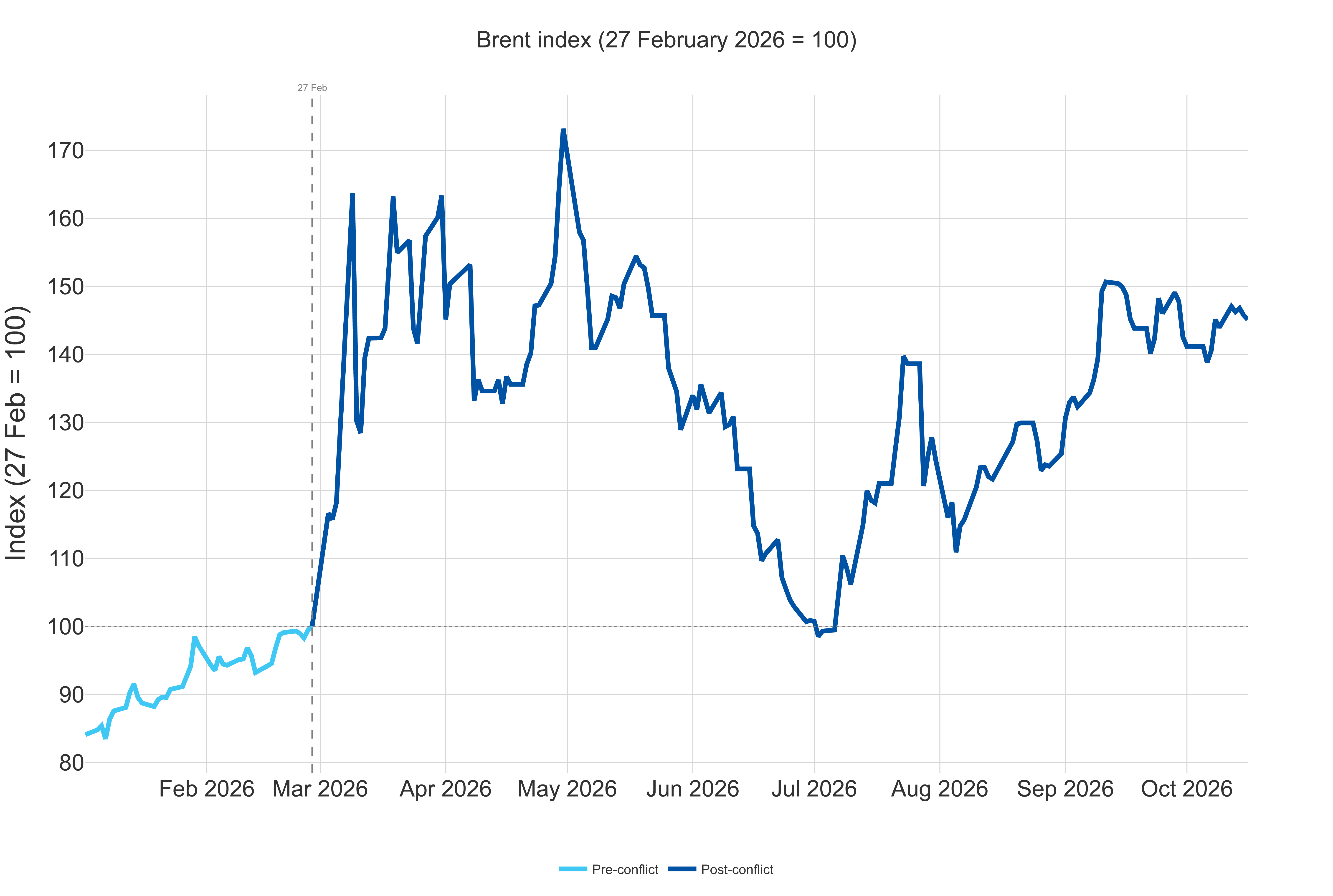
Three events drove the rise: the September attack on Saudi Arabia’s East-West pipeline; Aramco’s cancellation of October cargoes to some European refiners, which sent them chasing North Sea barrels; and renewed attacks in October, including on Aramco’s headquarters in Dhahran on 13 October. By mid-October, Aramco was offering spot cargoes to European refiners again.
Middle East crude supply has nevertheless largely recovered. Its crude exports reached 13.9 million barrels a day in September, 75% of their pre-war level, according to the International Energy Agency (IEA). Saudi Arabia’s East-West pipeline was back at 5.8 million barrels a day on 6 October, more than 80% of its capacity. Vitol’s chief executive puts crude and products leaving through Hormuz at about 14 million barrels a day, against 20 million before the war, with most going to Asia.
Prices have not followed the volumes, because the barrels travel further, on fewer available ships, at record freight rates. A tanker loading at Yanbu for South Korea now sails through the Suez Canal, across the Mediterranean and around Africa to avoid the Bab el-Mandeb Strait: more than 50 days at sea instead of about 23.
Shipping a barrel of crude from the Middle East to East Asia cost about USD 3 before the war and more than USD 30 now, according to the New York Times. From West Africa or the US Gulf Coast to Europe, it cost around USD 25 in early October, more than four times its pre-conflict level, according to the IEA.
For operators, the gap between physical and futures prices matters. Dated traded USD 28 above the front-month Brent future in early October, against less than USD 3 in August, which the IEA says has made hedging with futures “less effective”.
The futures curve also shows what the market expects. On 12 October, Brent for delivery in twelve months traded at USD 86 per barrel, USD 20 below the front month: when prompt prices sit above forward prices – a structure known as backwardation – oil is scarce now. Yet USD 86 is the highest 12-month price since 2022. The market expects relief, but from a higher floor than a year ago.
Refining and stocks
Diesel is the product the war has hit hardest.
Global diesel and gasoil availability was 1.5 million barrels a day lower than a year earlier in Q2 and 1.7 million lower in Q3, according to the IEA.
Refined product exports from the Middle East stood at 1.9 million barrels a day in September, against 4.7 million before the war.
The five main exporters – Saudi Arabia, the UAE, Kuwait, Bahrain and Qatar – shipped 1.5 million barrels a day by sea, the highest since the conflict began but half their pre-war volume.
Kuwait, a major diesel supplier to Europe since 2022 with no pipeline around the Strait of Hormuz, exported 380,000 barrels a day of products in Q3, against almost 1 million before the war.
October has gone backwards. While crude flows through the Strait of Hormuz held up, product flows, LPG included, fell to 1.33 million barrels a day over the first 12 days of the month, from about 2 million in September and 4.8 million before the war, according to Vortexa.
Russia is the second missing supplier. Its diesel exports averaged around 140,000 barrels a day between July and September, against 693,000 a year earlier, according to S&P Global. Russia supplied about 9% of the world’s seaborne diesel trade in 2025. The agreement signed with the US on 9 October would allow 100,000 barrels a day in October, rising to 240,000 in December according to the IEA, at best a quarter of the volume Russia has stopped supplying.
The IEA expects little effect, because the constraint is damaged refineries, not export policy. Analysts quoted by the New York Times estimate that 40-50% of Russian refining capacity is offline, and repairs take months. Russian crude exports have risen instead, but no one has spare refining capacity to turn that crude into diesel.
In total, global diesel exports were 4.7 million barrels a day in September, 700,000 below a year earlier. The Middle East and Russia together exported 820,000 barrels per day, 1.3 million less than a year earlier, a fall of more than 60%. The US and China added 610,000 barrels per day, but their exports were already falling from their August peak.
Europe feels this directly. The OECD imported 673,000 barrels a day of gasoil and diesel from outside the region in July, 37% less than a year earlier, with deliveries from Saudi Arabia and Eurasia down by half or more, according to the IEA.
The US has become Europe’s main external supplier, with around 40% of the region’s imports this year according to Kpler, and US Gulf Coast diesel exports reached 1.41 million barrels a day in September, the highest for any September since 2016. But the US is short at home: its diesel stocks ended September 14% below a year earlier, at a 14-year seasonal low, and 37% lower in New York State and surrounding areas.
European refineries cannot compensate. The diesel crack – the gap between the price of diesel and crude – fell from about USD 100 a barrel in early September to USD 57 in the first week of October. At the same time, the crude refiners actually buy became more expensive. Dated Brent rose by USD 26 a barrel in a month, while North Sea grades traded USD 15–20 above it. European refiners also had to compete with Chinese buyers for the same tankers.
In the week of 5 October, the IEA’s margin for a north-west European refinery running medium sour crude was USD 2.10 a barrel. Its conclusion: “this opens the possibility of economic run cuts for a refining system operating at its upper limits, despite tight product markets and low product stocks”. Governments are pulling the other way. On 2 October, the G7 asked for refinery maintenance to be coordinated, utilisation raised and diesel output maximised.
Jet fuel adds pressure too: in Europe and Asia, with jet cracks back above diesel, refiners that can shift output towards kerosene do so.
Inland logistics make it worse. The Rhine gauge at Kaub fell below zero at the end of September, the lowest on record, and read 12cm on 16 October. Barge deliveries to southern Germany and Switzerland have all but stopped: barge freight to Basel reached EUR 248.50 per tonne on 12 October, about EUR 0.20 cents per litre of diesel, and four German Länder have relaxed the Sunday truck ban for low-water freight until 31 October.
Stocks are the buffer that is missing. Global on-land inventories fell by a further 113 million barrels in September, their lowest level since at least 2016, and total observed stocks are 509 million barrels below their end-February level.
Government stocks in OECD countries fell to 1,030 million barrels at the end of August, the lowest since December 1989.
By the end of September, 331 million barrels of the March emergency release had been delivered, but the pace had collapsed to 8 million barels in the whole of September, and Europe had delivered only 76 million of its 122 million barrels.
The G7’s 100-million-barrel release of 2 October covers the undelivered part of the March commitments rather than a new pledge.
On 15 October, the IEA Governing Board agreed to speed it up, “including over 20 million barrels of diesel as soon as possible”, half of it from France. Spread over four months, that diesel amounts to about 170,000 barrels per day, a tenth of the fall in global diesel availability in Q3.
Diesel prices at the pump
On top of crude and refining, two further costs come before diesel reaches a European depot.
Shipping costs are at record highs: on 14 and 15 October, clean tanker rates out of the Middle East hit their highest levels on all three ship sizes since Argus Media began assessing the route in 2005, as shipowners move product tankers into crude. Capacity goes where the pay is better, and diesel is left with fewer ships. Plus, the euro fell to a 17-month low against the dollar in early October, so the same dollar price buys fewer litres.
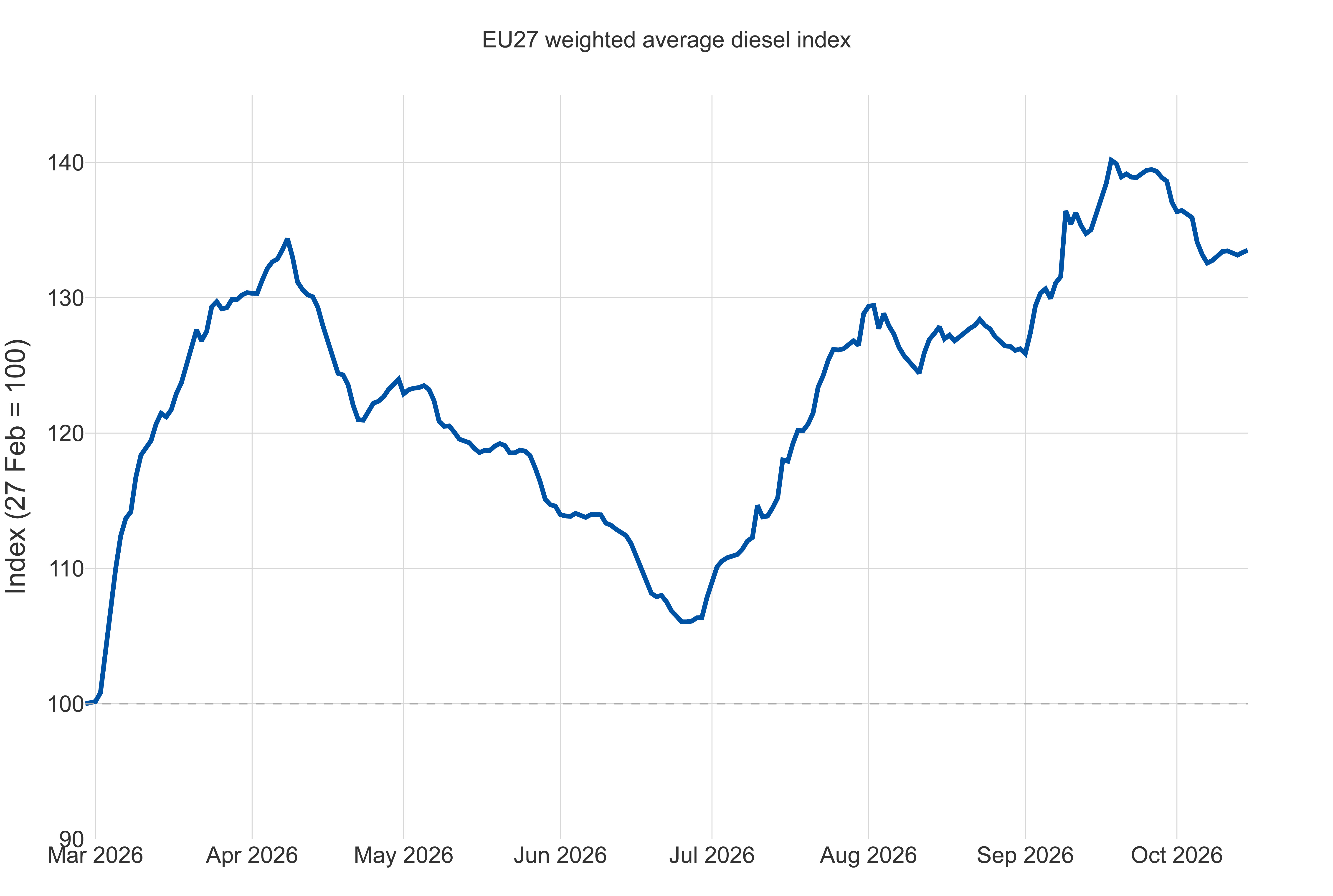
In the EU, IRU’s weighted average diesel price peaked at EUR 2.27 per litre on 27 September – 39% higher than on 27 February and a new record. It fell to EUR 2.15 on 7 October, as Germany’s tax cut and new measures in Poland, Czechia, Austria and Latvia took effect. It has since edged up, reaching EUR 2.17 on 15 October, 33% above February.
Diesel is most expensive in Denmark, at EUR 2.56 per litre, and the Netherlands, at EUR 2.53, followed by France, Belgium and Finland at about EUR 2.35.
The largest increases since February are in Bulgaria (48%), Estonia (45%), Cyprus (43%), Luxembourg (42%) and Czechia (41%).
Malta apart, the cheapest diesel is now in Poland at EUR 1.81 per litre, followed by Croatia at EUR 1.83 and Spain at EUR 1.87. In all three cases, it’s the result of national measures; the Croatian government puts diesel at EUR 2.13 without its caps.
In Germany, HVO100 has traded below B7 diesel at wholesale since mid-August for the first time. At the pump its premium has fallen from more than EUR 0.20 per litre to EUR 0.04 to 0.08 in many places, and some stations already sell it below diesel.
Fleet operators and farmers are buying more, and traders expect German HVO100 demand to roughly double this year. The reasons are partly German. HVO is not made from crude, and the end of double counting for advanced biofuels in Germany’s greenhouse gas quota has raised the value of quota credits, and that revenue can be used to lower HVO prices; low water on the Rhine adds to that value by restricting biofuel deliveries from Amsterdam-Rotterdam-Antwerp.
The volumes remain small: HVO100 is around a quarter of the 2.4 million tonnes of HVO Germany is expected to use this year, the rest being blended into diesel, or about 2% of the country’s diesel market. Brazil shows the same pattern, with biodiesel quoted below fossil diesel during the crisis and fleets testing blends well above the 15% mandate.
In Türkiye, diesel is up 59% in lira since February, at TRY 98.18 per litre on 15 October; the special consumption tax stays at TRY 6 per litre until 31 October and rises to TRY 9 on 1 November and TRY 12 on 1 December.
In the UK, diesel set an all-time record of GBP 0.199 a litre on 28 September, above the June 2022 peak, and is 41% above its February level.
In Norway, diesel reached a record NOK 28.12 per litre on 15 October, 34% above February, after parliament voted down a duty cut.
In China, diesel is 26% above its February level at CNY 8.30 per litre, still below its April peak.
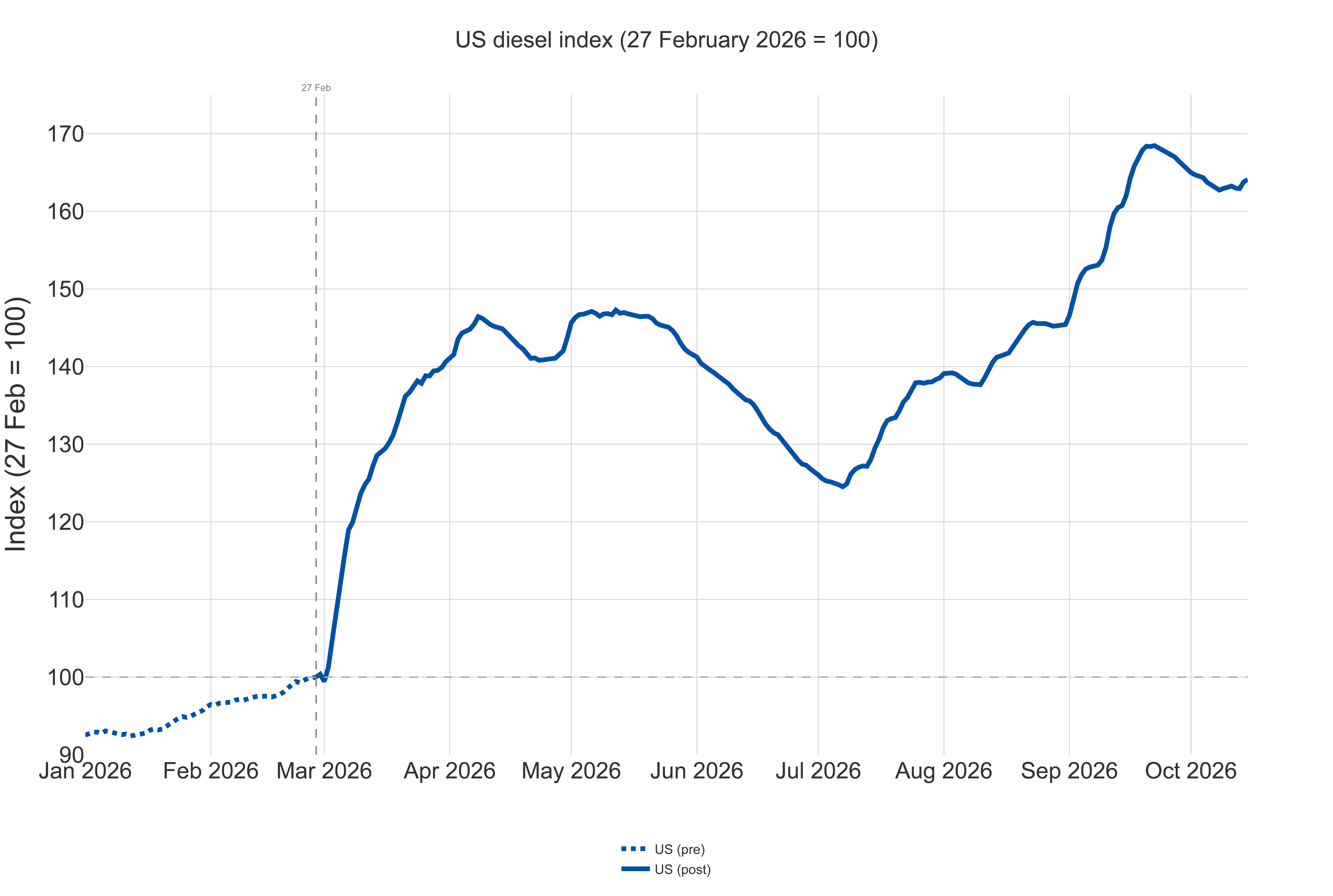
In the US, retail diesel is 64% above its February level, according to IRU data, at USD 1.68 per litre, as low fuel taxes pass wholesale price movements through to the pump almost in full. The EIA’s on-highway average passed USD 6 per gallon in September for the first time, peaked at USD 6.53 per gallon in the week of 21 September and stood at USD 6.18 on 12 October.
The effect on freight is visible: the tonnage index of IRU member the American Trucking Associations fell 1.6% year on year in August and 4.3% since March, and the IEA says US road freight, “the main source of diesel demand”, “has already weakened considerably”.
On 5 October, an executive order allowed trucks to run on red-dyed diesel, normally reserved for off-road use, and deferred the federal diesel excise of USD 0.24 per gallon until the end of the year. The IRS confirmed on 14 October that no federal penalty will apply to dyed diesel used on highways from 1 October to 31 December.
An overview of national measures compensating for higher diesel prices are available here.
What to watch in the coming month
The IEA’s arithmetic for the rest of the year is tight but not catastrophic. Refinery runs should recover from a seasonal low of 81.3 million barrels a day in October to 84.6 million in December, which “should almost keep pace” with demand. Inventory draws are nevertheless expected to accelerate in October, when demand rises seasonally and maintenance peaks.
On the cost side, the IEA warns that delivered diesel prices in Europe “could rise again in the coming weeks” as product tanker rates climb and widen the gap between prices at the exporting port and prices at the importing one.
Winter adds pressure on diesel as well. Heating oil deliveries in Germany and France were down about 50% year on year in August as households deferred purchases; those tanks will be filled in the fourth quarter, in competition with trucks for the same middle distillate.
Beyond the winter, the IEA now expects the gasoil market to return to surplus in the first quarter of 2027, but only enough to lift stocks in line with the usual seasonal pattern, not to repair the deficit built up in 2026. In its words, the gasoil balance “will remain tight well into 2027” and depends on a recovery of product supply from the Middle East; replenishing inventories is unlikely before the second half of 2027.
The IEA names the alternative: “failing this, further demand reductions and the heavy economic costs these will entail may be needed to balance markets”. Vitol’s chief executive puts it more bluntly: Middle East flows must continue to “keep things in balance as we go through the winter” because “there aren’t any more inventories to drain in the west”.
For operators, the conclusion of September stands and the horizon has lengthened. A return to pre-war diesel prices is unlikely before the second half of 2027, and most national measures run only to 31 October or 31 December. The two levers that can still move supply this winter, the diesel-first emergency stock releases and the reopening of Middle East product exports, are both in the hands of governments. Tax cuts and waivers protect operators’ cash flow; they do not add a barrel. Securing diesel supply and preserving cash flow remain two separate problems.
IRU fuel prices: Get daily updates for EU countries and weekly updates for 40+ countries, with a one-week forecast to help you plan confidently.
IRU members, strategic partners an Intelligence subscribers already have full access to the IRU fuel prices service.