
As of 2 April 2026, the energy shortage is worsening across multiple fronts, with diesel bearing the heaviest impact, forcing governments to take action. Here is the latest overview for the road transport sector.
Oil markets experienced significant volatility on 31 March and 1 April, pulling Brent crude back from its USD 120 a barrel towards the USD 106 a barrel mark.
However, the closure of the Strait of Hormuz continues to limit the supply, as traffic collapsed from roughly 138 vessels per day before the war to only 20 vessels since 28 March, as reported by ship tracking data.
The IEA has warned that “April will be much worse than March” for oil supply. Analysts at Société Générale said prolonged disruption could push prices as high as USD 150 a barrel.
Pump prices
Prices have increased in all regions since the war began, but this week saw the first signs of divergence between regions benefiting from diplomatic hopes and those still absorbing the supply shock.
In the US, diesel prices are now 41% higher than at the start of the war. As a net exporter of oil, the US is somewhat insulated from global supply disruptions, yet domestic prices remain closely tied to global crude benchmarks, meaning American operators are facing substantial cost increases.
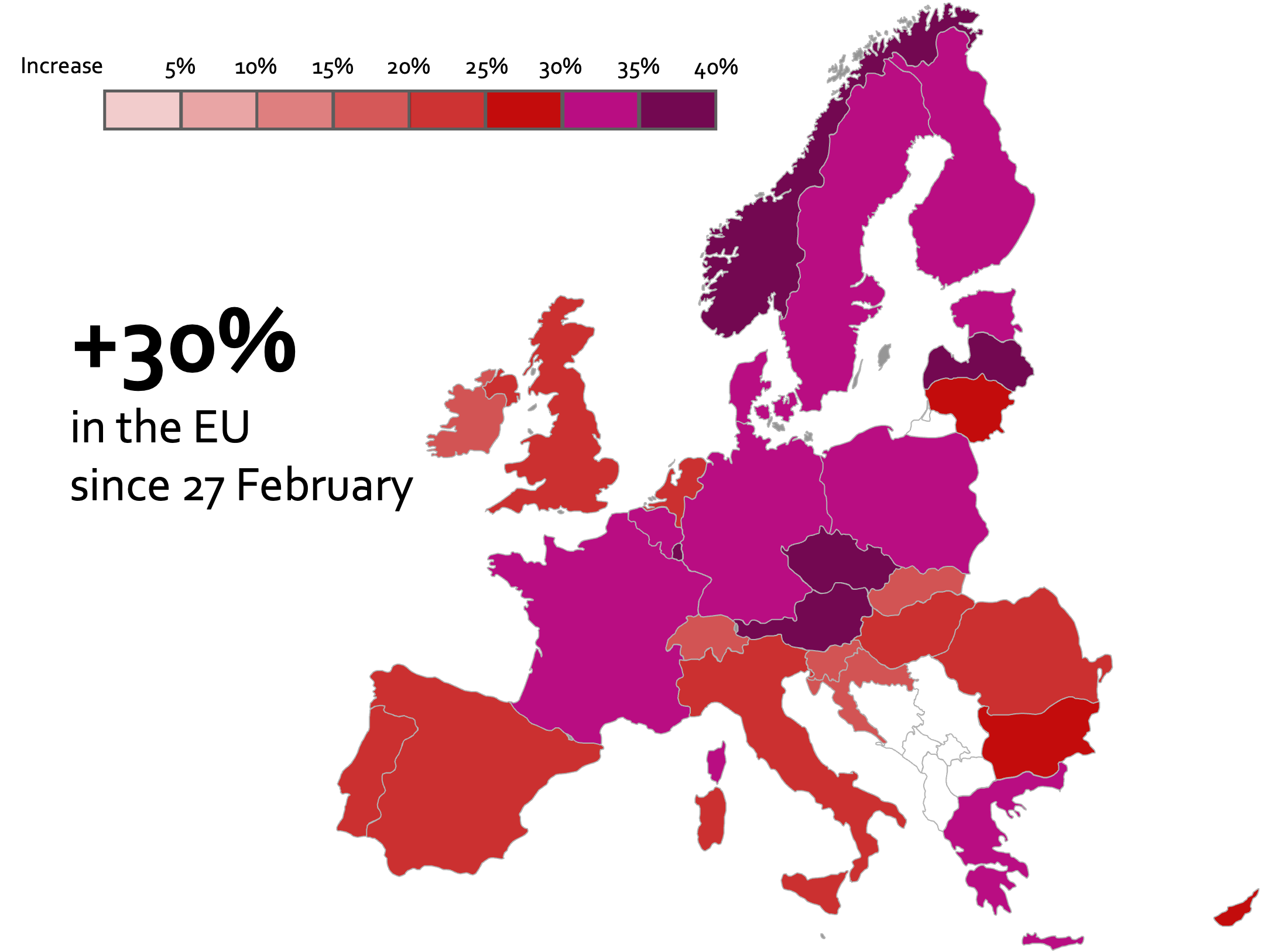
In the EU, the average diesel price stood at EUR 2.1 per litre as of 1 April, a 30% increase since the beginning of the war.
The highest increases were recorded in Austria (+43%), Luxembourg (+37%) and Estonia (+35%).
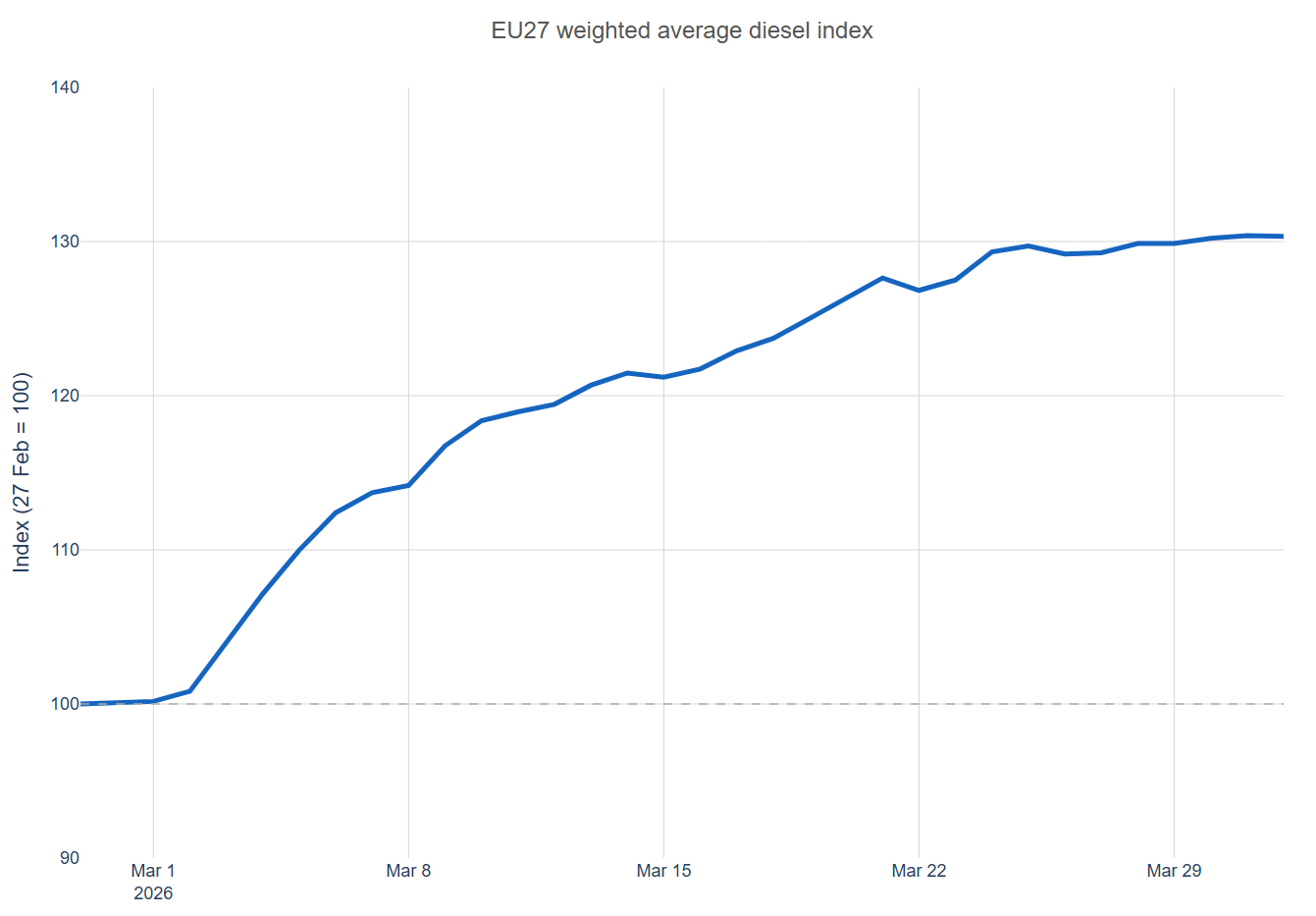
Germany, the EU's largest trucking market, is at EUR 2.32 per litre (+33%), with operators now facing over EUR 1,200 per month in additional diesel costs per truck, according to Transport & Environment. Belgium jumped to EUR 2.29 per litre (+34%), now matching Germany's pace.
The Netherlands continues to lead in absolute price at EUR 2.50 per litre.
Malta is the only country with no increase in fuel prices, thanks to its administered pricing.
Ireland recorded one of the lowest diesel price increases in the EU at 17%, largely attributable to its 20 cent per litre excise duty cut as part of a EUR 250 million emergency package, the largest single fuel tax intervention in the EU in response to the war in Iran.
AdBlue supply remains a growing concern. The global urea price reached around USD 684 per tonne on 1 April, up 93% since the conflict started. IRU member BGL has warned of up to 170% AdBlue price increases and potential shortages. The risk stems from the same root cause as 2022: Middle East conflict disrupting natural gas supply chains that feed urea production. Without AdBlue, Euro 6 trucks cannot legally operate. The shortage would translate directly into constrained road freight capacity and surging spot rates.
In China, average diesel prices have risen by 25% since the war started, approaching, but still below, the EU weighted average of 29%, and lower than the US increase of 41%.
China banned the export of diesel, gasoline and jet fuel in early March, followed by a separate price cap on 23 March that roughly halved the rate of price increases passed on to consumers. However, the cap has only moderated rather than contained the rise. Prices continue to climb.
In India, diesel prices have risen by just 5%, the lowest among major economies. On 27 March, India removed the central excise duty on diesel entirely and imposed export taxes on diesel and jet fuel to lock supply into the domestic market. This, combined with other dynamics, means India’s pump prices have been substantially contained.
In Brazil, prices continue to rise, up by 24% this week. The government's 12 March package – zeroing PIS/Cofins taxes on diesel, creating a BRL 0.32 per litre subsidy, and raising export taxes – was initially undermined when Petrobras raised diesel prices by BRL 0.38 per litre. However, the situation has since shifted significantly as Petrobras is now pricing diesel at the refinery gate 63% below import levels.
In Türkiye, price increases have stalled at +28%, held in place by the government’s ÖTV sliding scale mechanism, activated on 5 March, which automatically reduces the Special Consumption Tax by up to 75% of any refinery price increase, absorbing most of the shock before it reaches the pump.
Brent price dynamics
Brent was at USD 109 on 2 April, up 49% from the pre-war baseline of USD 73 on 27 February. Week-on-week, Brent was broadly flat (-0.4%), as diplomatic signals pulled prices down while the physical supply crunch pushed them back up.
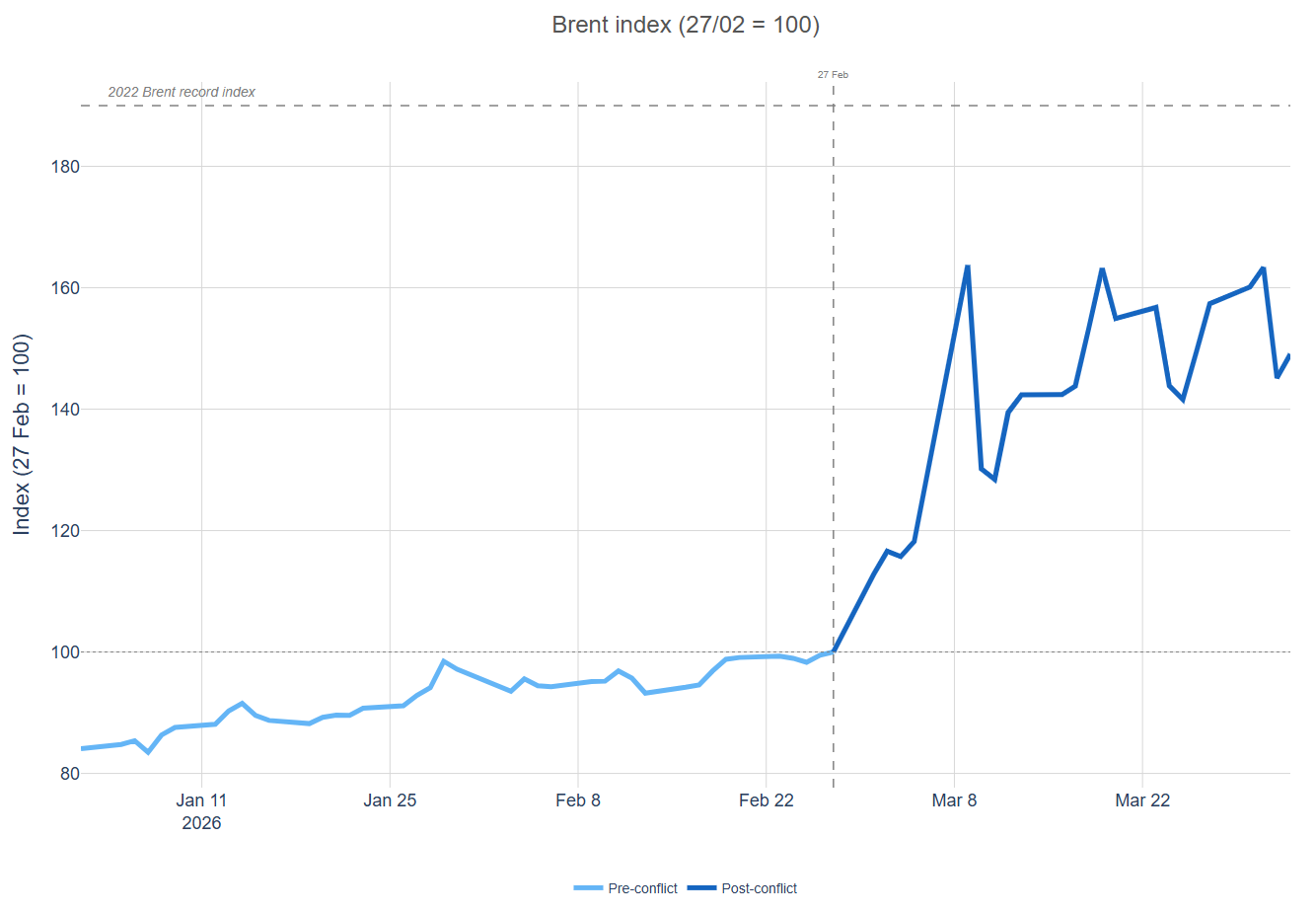
The headline move this week was the sharp sell-off following the 31 March communiqué: Brent spiked to an intraday high of USD 119 on 31 March – just short of the post-war record of USD 119.5 set on 9 March – before falling to USD 106 on 1 April as markets priced in the provisional maritime security agreement. The recovery towards USD 108 on 2 April shows that the market is not yet pricing in a meaningful reopening of the strait.
March was the most volatile month for oil since 2022, with Brent trading in the USD 78–120 range and daily swings of over USD 14 (23 March alone saw a USD 14 intraday drop). The average Brent close in March was USD 99, 37% above the pre-war level.
Natural gas price dynamics
Dutch TTF closed at EUR 49.35 per MWh on 2 April, up 54% from the pre-war level of EUR 31.96. This represents a significant pullback from the post-war peak of EUR 61.85 per MWh (19 March). TTF fell 11% week-on-week, driven by the ceasefire signals and warmer spring weather reducing heating demand.
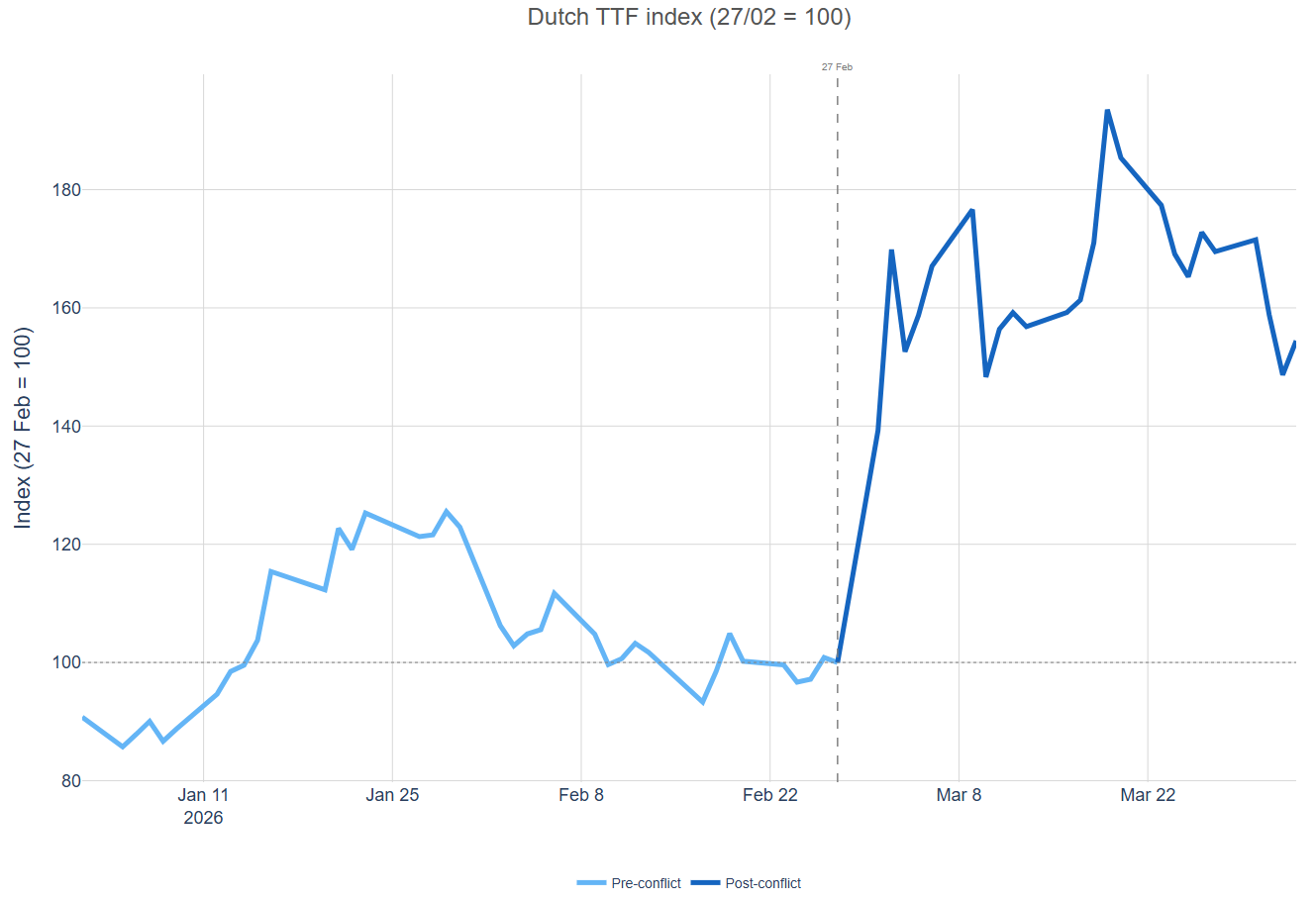
The decline does not resolve the underlying supply problem. EU gas storage stands at just 27.7% (GIE AGSI, 1 April), the lowest end-of-winter level since 2022. Net withdrawals continue, with some markets critically depleted. The Netherlands is at just 4.7% and Germany at 22%.
Qatar's South Pars gas field, a major global LNG source, was attacked in early March, and LNG flows through the Strait of Hormuz remain disrupted. Europe's TTF price has risen by 54% since the war started, even more steeply than crude (+49%) when measured from the same baseline.
IRU fuel prices: Get daily updates for EU countries and weekly updates for 40+ countries, with a one-week forecast to help you plan confidently.