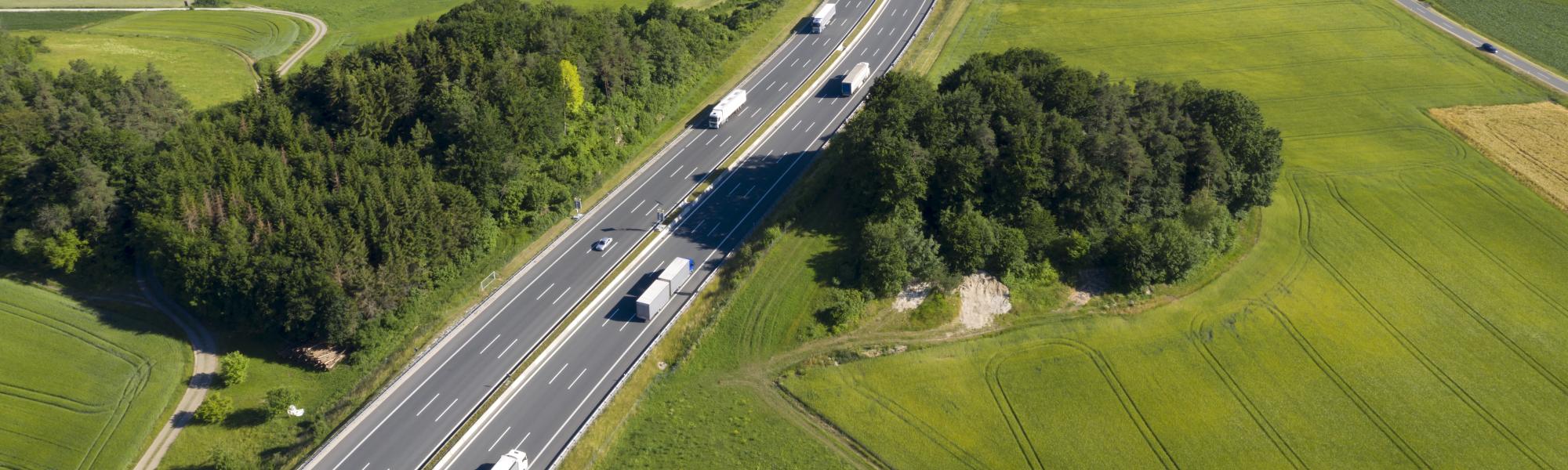
IRU called for faster grid connections, affordable energy, accessible financing and fit-for-purpose regulation at two major Brussels policy events, as the EU negotiates its grids package and prepares to review the Alternative Fuels Infrastructure Regulation (AFIR).
Europe’s clean industrial transition depends on making decarbonisation economically viable for businesses.
For commercial road transport, this means reliable grid access, affordable electricity and financing that enables operators to invest in zero-emission fleets.
IRU brought these priorities to Friends of Europe’s Energy and Climate Summit and Brussels Climate Week.
Energy and Climate Summit
Friends of Europe’s annual Energy and Climate Summit – co-organised by IRU alongside leading technology, energy and industrial companies – brought together policymakers, business leaders, financial institutions and civil society to address the strategic challenges shaping Europe’s energy transition across the entire economy.
Discussions covered the infrastructure and investment needed to accelerate decarbonisation across sectors while keeping European industry competitive.
IRU EU Director Raluca Marian brought road transport into the big-picture debate on Europe’s rising electricity demand, driven by artificial intelligence and the electrification of other sectors.
She spoke on a high-level panel with representatives from the European Parliament, the European Commission, the European Investment Bank and Spanish grid operator Redeia. The panel addressed the infrastructure and investment needed to make Europe’s energy transition work for road transport.
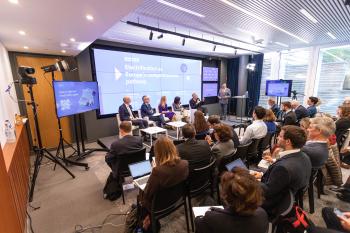
Raluca Marian highlighted the gap between Europe’s electrification ambitions and the conditions transport operators face.
In some EU countries, operators are ready to electrify their depots but cannot secure sufficient grid capacity or timely connections. High electricity costs further weaken the business case, particularly for small and medium-sized operators working on very thin margins.
IRU called for an “AFIR for grids” to establish clear expectations for member states on grid capacity, permitting and connection timelines.
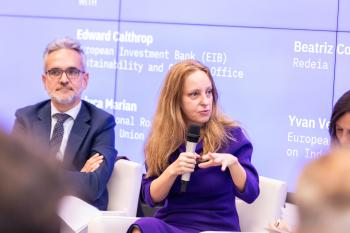
“Our operators work across Europe, but the conditions for electrification vary from one country to another,” said Raluca Marian. “For example, in France, which is a favourable case, connections can take eight months, while in the Netherlands, they can take years, if capacity is available at all.”
“An ‘AFIR for grids’ could help address these barriers by setting clear expectations for grid capacity, faster permitting and connection timelines,” she added. “Together with affordable energy, this would give operators greater certainty to invest, accelerate road transport decarbonisation and protect Europe’s competitiveness.”
European Commissioner for Energy and Housing Dan Jørgensen also recognised the importance of affordable energy at the Summit, highlighting its role in making Europe’s clean industrial transition economically viable.
Brussels Climate Week
Supported by the City of Brussels, the inaugural Brussels Climate Week brought an established international climate forum format from New York to the heart of Europe for the first time.
Over four conference days, senior EU institutional leaders, national ministers, Members of the European Parliament, industry representatives and financial leaders discussed how to deliver climate action, energy security and industrial competitiveness together, with a focus on technological innovation and the transition to a more sustainable economy.
Brussels Climate Week provided another platform to address the practical conditions needed to decarbonise commercial road transport.
On Industry Day, IRU co-organised the panel “From targets to reality: Unlocking a competitive transition for commercial road transport”, convening representatives of the European Parliament, European Commission and charging industry.
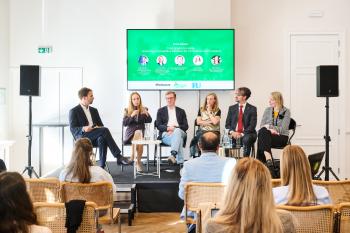
The exchange focused on how the EU can accelerate heavy-duty road transport decarbonisation while ensuring that infrastructure and regulatory requirements reflect commercial operating conditions.
IRU identified three priorities: recognising semi-public depot charging under the AFIR review; maintaining a range of decarbonisation solutions for operations where full electrification is not yet feasible; and reviewing vehicle weight and dimension rules to address the payload constraints of zero-emission trucks.
Participants also highlighted the complementary roles of public charging infrastructure and depot charging. Access to financing remains essential to help operators meet the upfront costs of fleet renewal and charging infrastructure.
Raluca Marian stressed that the transition must reflect the operational and economic realities of commercial road transport. Recognising semi-public depot charging, preserving suitable decarbonisation options and addressing payload constraints can help reduce emissions while maintaining the competitiveness of transport businesses.
Aligning EU policies with operator realities
The EU’s grids package and the forthcoming AFIR review offer an opportunity to create the conditions for investment in zero-emission fleets. This means accelerating grid connections and securing sufficient capacity, while ensuring charging infrastructure is available where trucks operate and park, including at depots, and reflects the diversity of commercial transport operations.
Together with affordable electricity and accessible financing, these measures would give operators greater certainty to invest in zero-emission vehicles, turning EU climate objectives into practical progress on the ground.