Decarbonisation is a decades-long journey. But CEVA Logistics is quick to remind us that the road to net-zero is a daily endeavour – and that a host of solutions are already at our disposal.
IRU member CEVA Logistics is heading full speed towards carbon neutrality, helping bring the industry forward with it.
We asked Pierre-Alain Saclier, the company’s Vice President of Global Consumer & Retail, how it is driving decarbonisation today.
What does decarbonisation mean in practice?
Decarbonising means being agile, combining technologies and solutions already available to cut carbon emissions.
We are seeing consistent progress towards low-emission vehicles. Biofuels are developing more rapidly, as supply is easier to scale up and these fuels can be used with current vehicles.
For example, we have built a full HVO network in the UK with dedicated infrastructure and tanks across 18 sites, representing around 6 million litres per year. The fuel used is ISCC certified, palm oil free, and enables up to a 90% reduction in CO₂ emissions on a well-to-wheel basis.
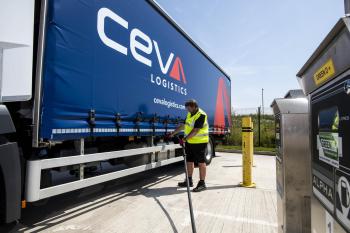
Globally, we have over 870 HVO-powered trucks.
In parallel, we have developed a fleet with a mix of different electric vehicles suited for intra-city deliveries and long-distance transport. Recent developments are making electric vehicles increasingly operational, especially for short distances. We now have 548 battery electric trucks and vans, saving around 15,000 tonnes of CO₂e per year, and plan to have over 650 by 2026.
In total, our fleet has 1,591 low-carbon vehicles, a 38% increase compared to 2024. We plan to have 1,750 low-carbon vehicles in 2026, strategically replacing older models with more efficient alternatives during each renewal cycle.
Hydrogen, on the other hand, is still in the pilot phase. More development is needed to make it cost-competitive and operational.
Multimodal transport is also an option that needs to be considered when distances and network conditions allow.
How can we accelerate decarbonisation?
It starts by involving our customers, presenting the different options available and trying to include sustainability in each transport operation. Every client might not be fully aware of all the solutions and technologies already on the table.
Then, we must replicate all workable and efficient solutions across more operations.
Decarbonisation is a daily endeavour, a series of cumulative small steps to optimise operations, rather than a big shift that brings operational risks and raises costs.
Any new initiatives?
In 2025, we launched a "mass balance" service in Europe that allows our customers to reduce their shipping emissions by up to 80% through funding support from us for the use of biofuels.
What’s the role of digitalisation?
Digitalisation plays a significant role in decarbonisation through efficiency gains.
We have several digital tools:
- An AI-driven route planner for first- and last-mile delivery in the US. It optimises delivery routes by reducing the distance or frequency, particularly for network or dedicated customer routes.
- The digital Linehaul Scheduler tool already used in the US is now being deployed in Europe. It streamlines routes between warehouses, increases load rates, and reduces travel distances.
- A telematics tool to better monitor environmental indicators and support the identification of routes that could be served with electric vehicles.
How do you track decarbonisation?
CEVA measures and publishes year-on-year performance overviews to ensure that the path towards carbon neutrality is on track.
We also monitor energy costs as part of our reduction efforts to offer our customers compensation options for operations that cannot yet be decarbonised.
For example, for a customer in the luxury sector, we offer our CEVA FORPLANET Mass Balance solution for eight lanes (around 300 shipments), cutting CO2 emissions by 422 tonnes for a one-year transport contract.
Together with our parent company, the CMA CGM Group, we aim to reach net-zero by 2050 across all activities through a staged decarbonisation strategy.
Is decarbonisation often oversimplified?
One oversimplification is that operators simply need to switch from one truck to another to reduce their CO2 emissions.
Decarbonisation is more complex than that. The range of options is much wider. Everything – from efficiency measures to the electricity source on a given route – must be considered.
Waiting for asset prices to drop is also very common. We already have solutions that are operationally feasible and economically viable. This is something we tell our customers every day.
It is a daily discussion to present all the dynamics that could bring us closer to carbon neutrality: freight optimisation, flow consolidation, multimodal operations, etc. All these solutions must be considered.
About CEVA
CEVA Logistics, a world leader in third-party logistics, provides global supply chain solutions to connect people, products and providers all around the world.
Headquartered in Marseille, France, CEVA Logistics offers a broad range of end-to-end, customised solutions in contract logistics and air, ocean, ground and finished vehicle transport in 170 countries worldwide thanks to its approximately 110,000 employees across more than 1,700 facilities.
With 2025 revenue of USD 18.3 billion, CEVA Logistics is part of the CMA CGM Group, a global player in sea, land, air and logistics solutions.