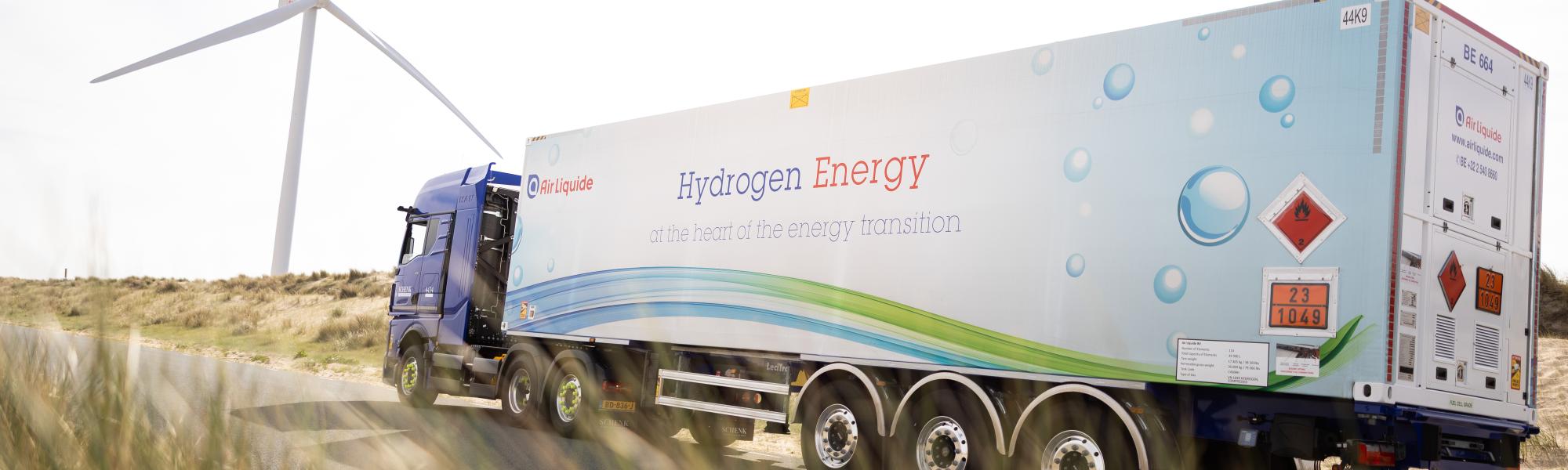
Heavy-duty hydrogen transport has reached a pivotal stage. As Erwin Penfornis, Air Liquide’s Vice-President of Hydrogen Energy World Business Line, emphasises, the solutions already exist and are fully industrialised. The challenge now is creating the right economic conditions and deploying vehicles, fuel and infrastructure in unison to trigger full market activation.
Hydrogen works as a fuel for heavy-duty vehicles. Now the focus is on economic viability and infrastructure readiness.
IRU member Air Liquide approaches this transition backed by over 60 years of expertise across the hydrogen value chain and 15 years dedicated to hydrogen mobility. Today, the company operates across the full ecosystem, from renewable and low-carbon hydrogen production through large-scale electrolysis to liquefaction, supply and end-use applications.
To overcome historical bottlenecks, Air Liquide has joined forces with major industrial partners – including Daimler Truck, Volvo Group, and IRU member TotalEnergies – to accelerate the European rollout of heavy-duty hydrogen mobility by 2030. Rather than attempting a scattered, continent-wide deployment, the industry is concentrating vehicles and infrastructure along designated anchor industrial hubs and connecting corridors where favourable conditions already exist.
Germany currently serves as a prime example of this synchronised strategy. The country combines targeted incentives for clean vehicles with policy frameworks designed to help operators achieve total cost of ownership parity with diesel.
Reaching a retail hydrogen price below EUR 8 per kilogram remains a vital target for commercial viability, a threshold that is becoming increasingly achievable as supply chains mature and support mechanisms such as RED III credits and GHG quotas take effect.
Scaling infrastructure and advanced logistics
Bringing costs down further requires a massive scale-up across the entire value chain, driven by higher truck volumes and greater hydrogen refuelling network utilisation.
To optimise distribution over longer distances, the industry is increasingly pointing to liquid hydrogen as a strategic long-term solution. By significantly increasing energy density per load, liquid hydrogen can fundamentally improve supply economics.
Infrastructure deployment is accelerating in tandem to meet this demand. TEAL Mobility, an Air Liquide and TotalEnergies joint venture, is notably building high-capacity station networks engineered specifically for heavy trucks. The aim is to deliver multi-tonne daily volumes and rapid, consecutive refuelling, offering long-haul fleets the quick turnarounds required for intensive logistics.
Two technologies, one decarbonisation goal
Hydrogen is not a competitor to battery-electric technology; rather, these decarbonised drive systems are complementary, serving distinct operating profiles. Battery-electric vehicles are already proving effective for many regional routes.
However, hydrogen becomes essential for the use cases responsible for the highest CO₂ emissions – specifically heavy-duty transport where heavy payloads, intensive usage, long ranges, or electricity grid congestion, such as in the Netherlands, present operational challenges.
Global precedents highlight how both technologies can thrive together. In China, around 40,000 hydrogen trucks are already operating alongside rapid battery adoption. In Europe, initiatives like the Paris hydrogen taxi ecosystem (HysetCo) demonstrate what happens when vehicle fleets and refuelling stations expand in tandem.
Air Liquide also approaches this transition as a major shipper in its own right. Operating thousands of transport movements to deliver industrial gases, the company has begun deploying hydrogen trucks into its own logistics fleet in the Netherlands. This first-hand operational experience confirms that vehicle manufacturers, energy suppliers, and transport operators must build the ecosystem together.
With key technologies and strategic partnerships now established, the priority through 2030 is transforming readiness into deployment at scale.
About Air Liquide
A world leader in gases, technologies and services for industry and healthcare, Air Liquide acts as the backbone of numerous economic sectors, serving 4.3 million customers and patients across 59 countries with approximately 65,000 employees.
With over 60 years of expertise, Air Liquide views hydrogen as a key solution in the energy transition to decarbonise industry and mobility, fully in line with its ambition to achieve carbon neutrality by 2050.