
Seven in ten operators say customers won’t pay the extra cost of greener transport, according to IRU and Trimble’s 2026 Green Compact survey.
A new survey of road freight operators shows that, while they are cutting emissions, cost is now their biggest obstacle to going further, compared to last year’s survey, in which cost ranked second to infrastructure.
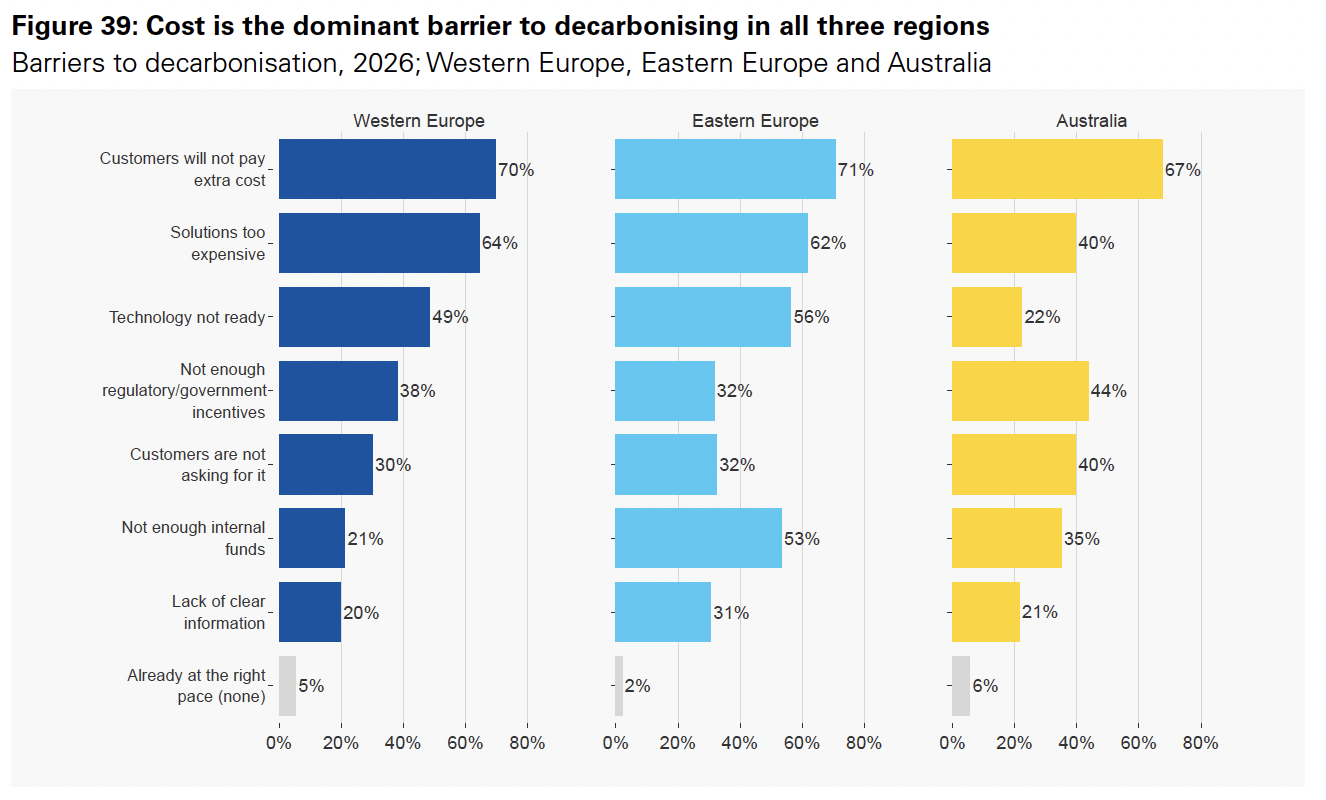
Moreover, around seven in ten operators in Western Europe (70%), Eastern Europe (71%) and Australia (67%) say their customers are unwilling to pay the additional cost of decarbonisation.
IRU Secretary General Habib Turki said, “The next phase of decarbonisation requires much greater investment. Operators cannot carry that cost alone, particularly when their customers are unwilling or unable to pay more for greener transport.”
Vehicle prices overtake infrastructure
Together, expensive solutions and unwilling customers form a cost wall. The price of decarbonising is high, but operators have no reliable way to pass it on. Solutions are seen as too expensive by 64% of Western European operators, 62% in Eastern Europe and 40% in Australia.
The shift is clearest in alternative fuels. Last year, the lack of charging and refuelling infrastructure was the leading obstacle. In 2026, vehicle prices have become the biggest barrier in both European regions. In Western Europe, 66% of operators cite vehicle prices, up from 49% in 2025. In Eastern Europe, the figure has risen from 52% to 78%.
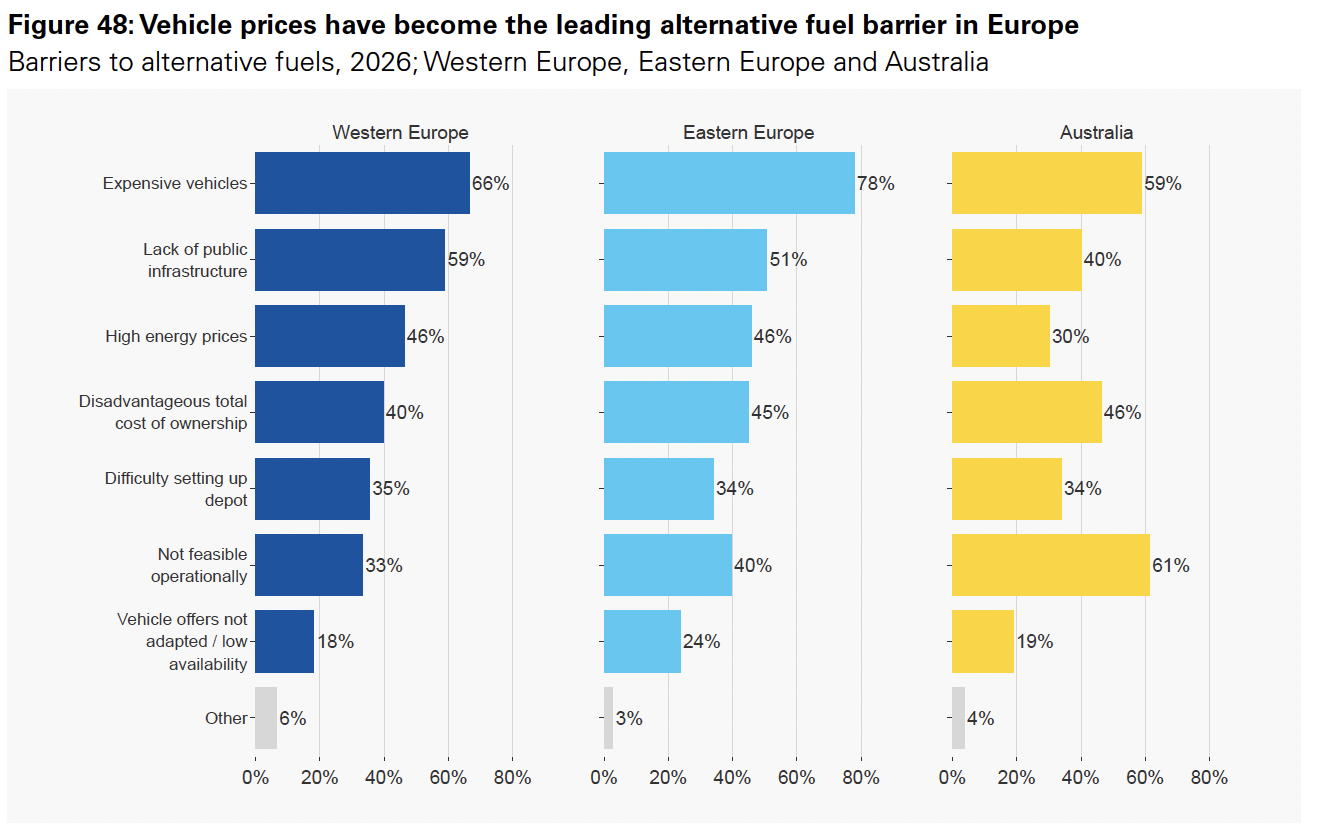
The gap is large. An electric truck costs two to three times as much as its diesel equivalent, far more than operators’ thin margins can absorb.
Action comes before commitment
Nine in ten Western European operators (90%) take at least one measure to cut emissions, as do 87% in Eastern Europe and 55% in Australia.
They start with measures that pay for themselves: routing optimisation (53% in Western Europe, 62% in Eastern Europe) and eco-driving training (42% in both).
But formal commitment lags. Targets have been set by 41% of Western European operators, 31% in Eastern Europe and 11% in Australia, and only 43%, 23% and 6%, respectively, calculate their CO₂ emissions.
Money moves operators more than mandates
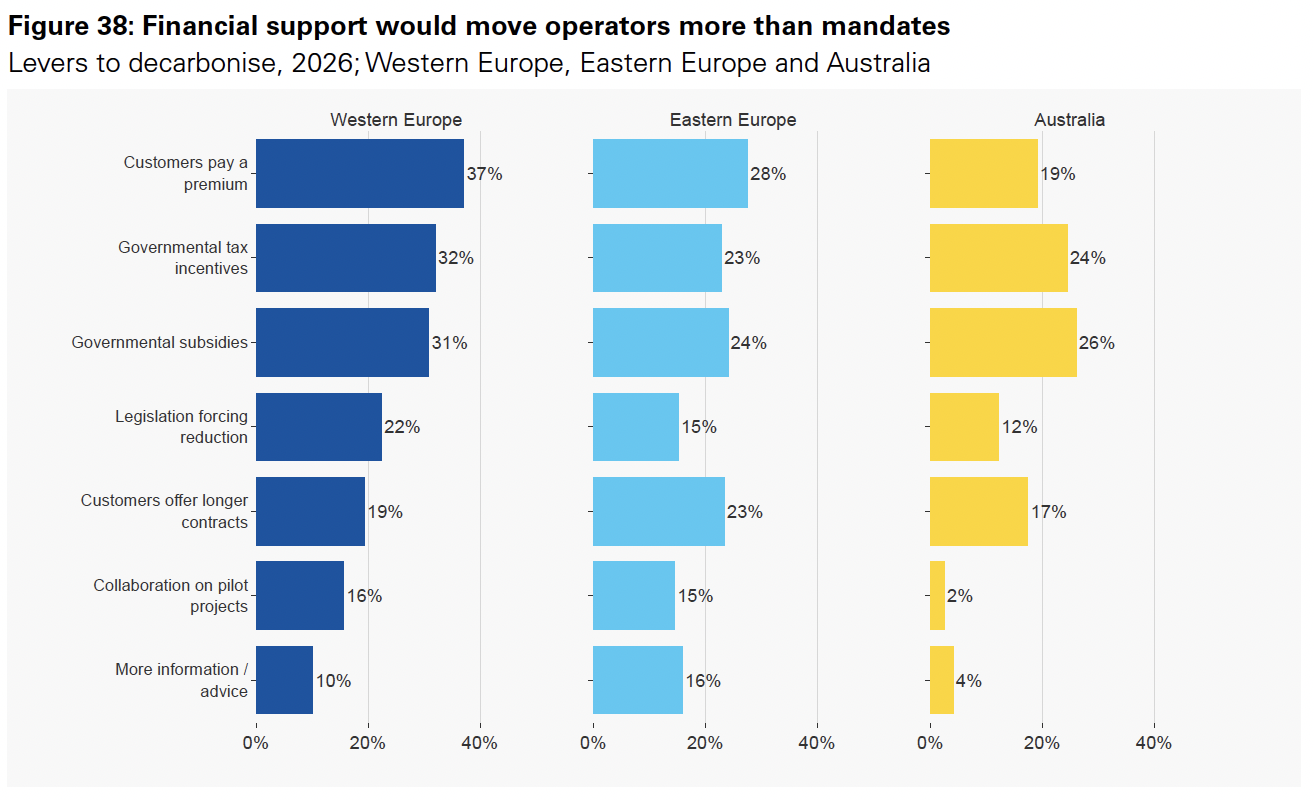
In Western Europe, 37% of operators say a customer price premium would drive emissions cuts to a very large extent, ahead of tax incentives (32%) and subsidies (31%). Only 22% cite legislation as a driving force.
In Australia, subsidies lead (26%), while Eastern European operators value longer customer contracts (23%) alongside premiums (28%).9
“Regulation can set the direction, but it cannot deliver the transition on its own,” said Habib Turki. “We need solutions that work in the real world such as affordable vehicles, accessible energy and infrastructure, and financial incentives that reflect the realities of running a transport business.”
Fuel choices follow the path of least resistance
Around 41% of Western European operators already use alternative fuels, against 14% in Eastern Europe and 7% in Australia.
Renewable diesel (HVO), which works with existing engines, leads in every region. In Western Europe, its use is expected to rise from 29% today to 54% within five years.
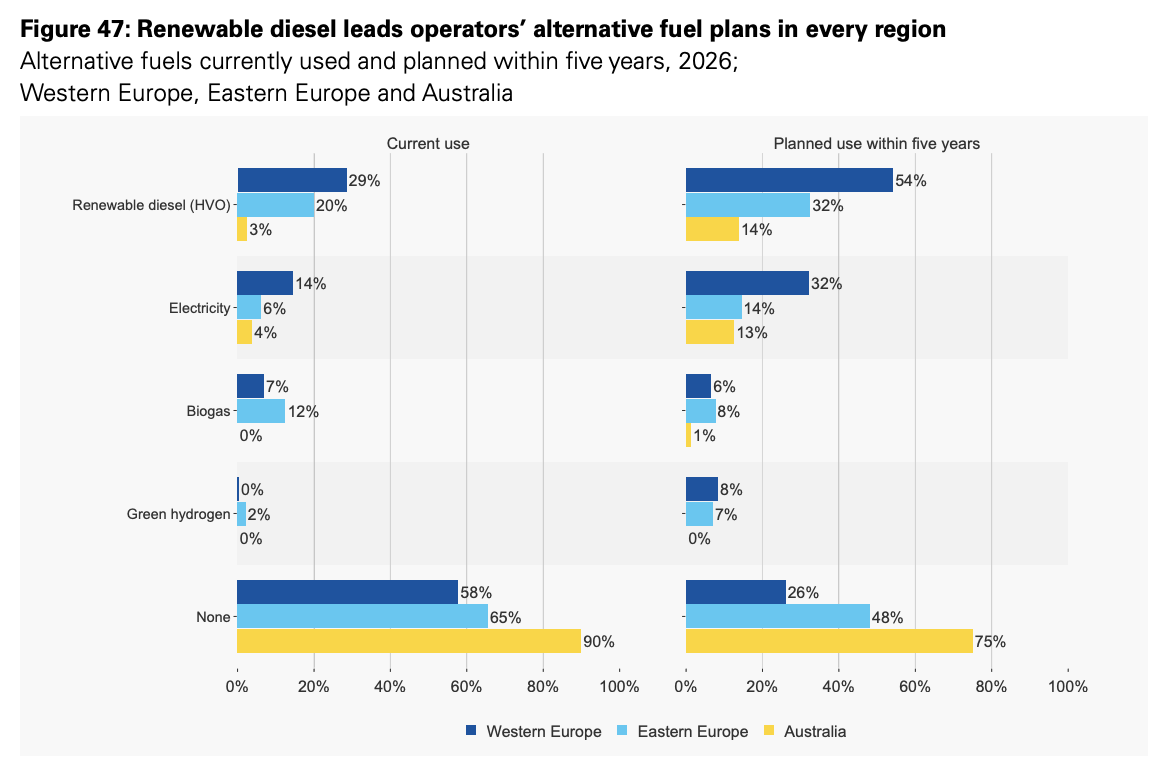
Battery-electric investment is planned by 29% of Western European operators, 17% in Eastern Europe and 10% in Australia, and it is concentrated where it fits best. In Western Europe, 87% of operators with turnover above EUR 100 million plan to invest, against 26% of smaller firms, and 40% of regional operators plan to invest against 17% of long-haul operators. In a sector dominated by SMEs, the divide is capital, not will.
“Decarbonisation will move faster when it makes commercial sense for operators of all sizes,” said Habib Turki.
Globally, public policy is diverging
Beyond the operator survey, the new report also compares Brazil, China, the EU, India and the US, demonstrating how regulation is diverging.
For example, China’s mix of tighter standards and strong incentives took new-energy vehicles to roughly 29% of new heavy-truck sales in 2025. The EU has the most complete framework, but operators struggle to follow it: only around one in eight say they understand a given EU policy well.
Incentives also vary widely, with governments using two approaches – push and pull – neither of which closes the gap on its own.
Push measures raise the cost of diesel. For example, ETS2, the EU’s new emissions trading system, will price road fuel emissions at around EUR 60 per tonne of CO₂ starting in 2028, adding an estimated 5.5% to the total cost of ownership of a long-haul truck in France. CO₂-differentiated tolls are also in place or being introduced in 11 EU countries.
In Germany, higher tolls have increased costs for a Euro VI articulated truck by 83%, equivalent to around 10% of its total cost of ownership. This brings diesel trucks closer to cost parity with electric trucks, which remain exempt from tolls until 2031.
Pull measures lower the cost of zero-emission vehicles. Purchase incentives exist in many EU countries but are often capped, difficult to apply for, and available only for short periods, making them poorly suited to multi-year fleet renewal plans. Toll exemptions vary widely, from Germany’s full exemption to reduced rates elsewhere. Even so, 38% of Western European operators and 44% of Australian operators still say government incentives are insufficient.
Although slipping to second place in this year’s survey, energy supply and grid capacity also remain major challenges.
A fully electric EU truck fleet would require electricity equivalent to around a fifth of the combined electricity available in Germany and Poland, according to IRU estimates. Europe currently has just 1,225 public truck-capable charging stations, compared with an estimated need for 50,000 high-power charging points. Most charging will take place at depots, where securing grid capacity typically takes one to two years.
More than 1,000 transport operators from across 36 countries participated in the survey.