
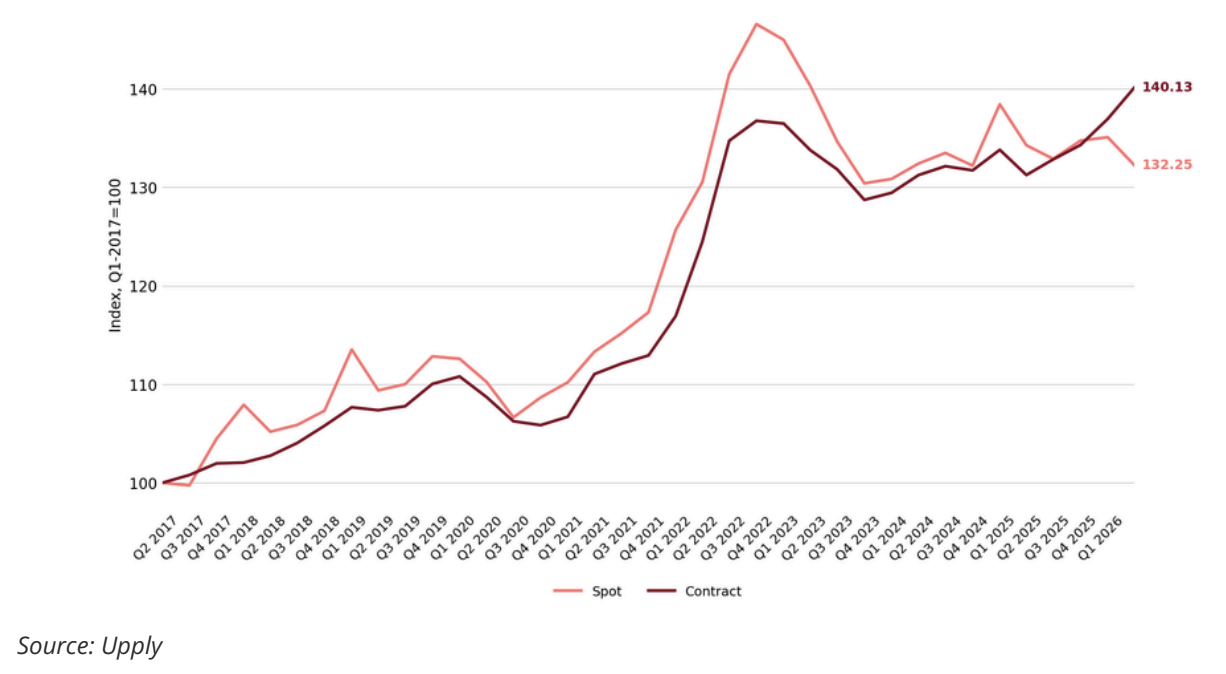
The IRU x Upply x Ti report on European road freight rates in Q1 2026 reveals a divergence between contract and spot markets. Contract rates reached 140.1 index points, a solid 3.2-point increase quarter on quarter (q-o-q) and an 8.9-point increase year on year (y-o-y). Meanwhile, spot rates edged down slightly to 132.3 index points, falling by 2.8 points q-o-q and ending the period 2.0 points lower y-o-y.
- The Eurozone manufacturing Purchasing Managers' Index (PMI) reached 51.6 in March
- New truck registrations fell by 6% y-o-y in 2025, according to ACEA
- 12.1% of driver positions were unfilled in the EU in 2025, according to preliminary IRU driver shortage survey results
- EU diesel prices rose from an average of EUR 1.56 per litre at the end of Q4 2025 to EUR 1.96 per litre at the end of Q1 2026 – a 26% increase
- Conflict in the Middle East is threatening AdBlue supply
- Poland had the largest EU toll increase in Q1 2026, rising by 33% for a standard EURO VI tractor and semi-trailer combination (40% y-o-y increase)
- The outlook for rates across Europe in 2026 is modest upward pressure, driven by fuel price increases and moderate demand recovery
- The Road Freight Sentiment Index for Q1 stood at 16.9, up by 6.2 points from Q4 2025, indicating expectations for European road freight rates to rise over the next three months
The European spot rate index declined at the start of the year, reflecting the typical Q1 post-peak demand pattern. In Q1, European consumers remained cautious, as cost pressures dampened household spending across the EU. These factors have led to weaker spot rates, though rising fuel costs due to the war in Iran are likely to reverse this trend.
In contrast, contract rates have risen steadily over the past three quarters. The Eurozone manufacturing PMI reached 51.6 in March, indicating expansion and the strongest reading since June 2022, with output at a seven-month high and new orders stabilising. Industrial production has long been a key driver of contract rates, with higher manufacturing volumes and previously optimistic business indicators pushing demand for contracts higher.
Ti Head of Commercial Development Michael Clover said, "The decline in spot rates in Q1 is already a historical trend, as rising diesel prices push up freight rates and we now expect spot rates to rise sharply. Contract rates were already rising steadily, but with fuel prices increasing we expect to see this trend continue and strengthen. The real question for the medium term, if the war in the Middle East continues, is how the upward pressure on freight rates from high fuel costs will balance against lower volumes as the economic situation worsens.”
EU diesel prices rose from an average of EUR 1.56 per litre at the end of Q4 2025 to EUR 1.96 per litre at the end of Q1 2026, a 26% increase, as the closure of the Strait of Hormuz pushed Brent above USD 100 a barrel. French and German diesel prices drove the EU average higher, with increases of 27% and 35%, respectively, between December and March.
While the European Commission is looking for a solution to this energy crisis, EU countries have begun deploying measures to partially absorb the increase. These include capping prices, as in Slovenia and Croatia, reducing excise duties, as in Ireland and Italy, and reducing VAT rates to ease cash flow, as in Spain. Price discrepancies of up to EUR 1 per litre between EU countries have encouraged fuel tourism, putting pressure on fuel supply in countries with cheaper diesel.
Looking at Q2, prices are still climbing, but at different paces depending on the national measures taken. However, the EU average for April is 10% higher than in March. There are also questions about the availability of diesel. Air transport is struggling to secure jet fuel for the coming months. EU refineries may want to produce more jet fuel at the expense of diesel.
As for AdBlue – a mandatory additive for diesel trucks made from urea that is mainly produced in the Middle East – supply could be put at risk if the crisis continues.
IRU Senior Director for Strategy and Development Vincent Erard added, “Fuel price volatility, compounded by the war in Iran and geopolitical disruption, has laid bare our industry's fragile operating conditions. European governments have put in place emergency measures. But uncoordinated action can distort markets, leaving operators exposed where national room for manoeuvre is limited. The effects go beyond today's margins, hitting fleet investment, capacity and supply chain resilience. Transport is not a buffer to be squeezed when energy markets falter; it’s a strategic resource that needs stable, predictable and forward-looking conditions. We need targeted and proportionate support, nationally and regionally, to continue delivering our essential services to citizens and businesses.”
Market outlook
Fuel is expected to be the dominant driver of road freight rate changes in Q2 and beyond.
EU average diesel prices have risen sharply, up by 31% in March alone. Even if demand softens, operators will be unable to absorb costs of this magnitude without passing them through to rates, meaning upward pressure on both spot and contract rates is likely to persist through at least H1 2026, regardless of the demand picture.
The IRU x Upply x Ti European Road Freight Sentiment Index rose by 6.2 index points to 16.9 in Q1 2026. This indicates that expectations for European road freight rates to rise in the next three months have strengthened, notably at the start of the year, with overall sentiment firmly leaning towards a further increase in rates.
Upply Chief Executive Officer Thomas Larrieu commented, “The Q1 picture reveals a market entering a new phase where cost pressures are overtaking demand as the primary driver behind rate movements. The resulting contract-spot divergence reflects two pricing logics responding to the same shock at different speeds. As fuel prices surge, the key question is how quickly and how evenly these costs will be absorbed and passed through into rates across corridors, markets and contract structures in Europe in the months ahead.”