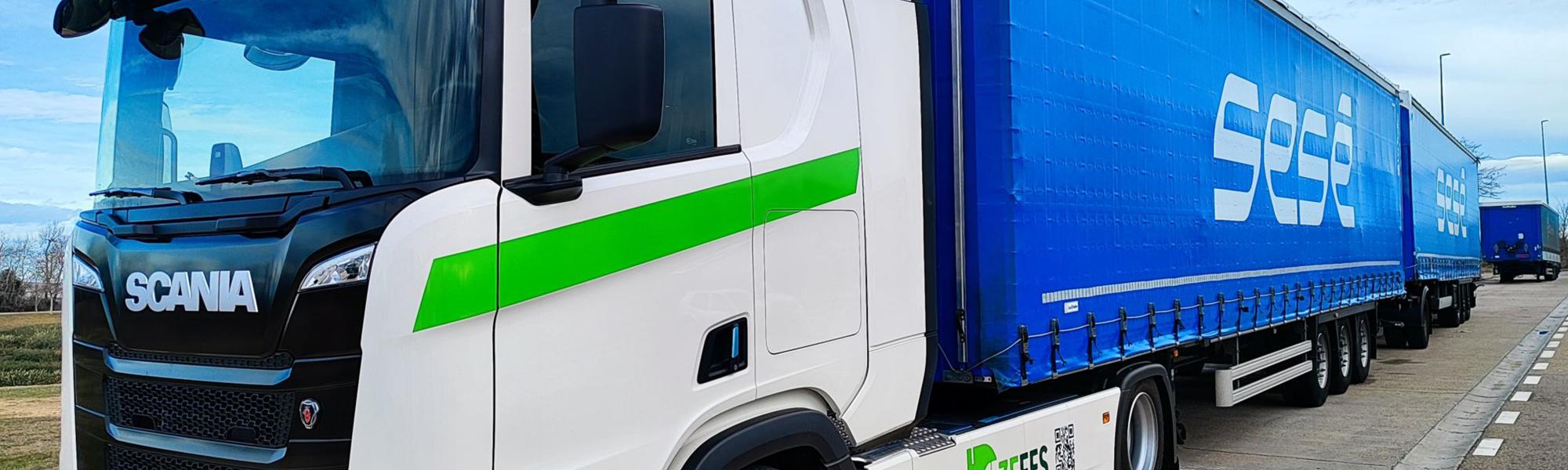
The electric duo-trailer will first travel a 90km route twice a day. In a second phase, it will run an intermodal route between Spain and Germany. The long-term ambition is to promote cross-border operations with electric vehicles and encourage regulatory changes that normalise the use of duo-trailers.
IRU members Sesé and Scania are running an electric duo-trailer trial in Spain, as part of ZEFES, an EU-funded project on innovation in zero-emission vehicles.
During the first phase, the electric duo-trailer will operate on one of Sesé’s regular Spanish routes, covering 90km between Martorell and Maçanet.
The trial aims to demonstrate the operational efficiency of duo-trailers, which can halve the number of journeys needed to transport the same load, as well as their compatibility with alternative fuel vehicles.
This combination can significantly reduce carbon emissions. Sesé’s previous experience using duo-trailers reduced CO₂ emissions by up to 30% on a single load. These reductions can reach up to 90% when combined with alternative fuel vehicles.
ZEFES will assess vehicle performance and emissions reductions, as well as the suitability of existing charging infrastructure and the requirements for scaling up this type of operation in the future.
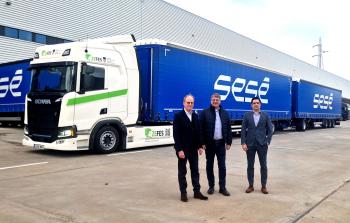
“The path towards more sustainable road transport involves developing solutions that do not compromise operational capacity,” said Sesé Head of Institutional Relations & Sustainability Héctor Cebrián. “Combining efficient alternatives, such as duo-trailers, with a wide range of available energy sources offers companies different ways to advance their decarbonisation goals without losing competitiveness.”
“To achieve this, key elements include both the impetus of the private sector and initiatives like the one we are presenting today, as well as a legislative framework that promotes technological neutrality,” he added.
In parallel, ZEFES is examining the expansion of electric tractor units to cross-border operations to boost their adoption at EU level. It also continues to promote a review of the EU regulatory framework to facilitate the use of duo-trailers across the continent and thereby strengthen the competitiveness of supply chains.
In the second phase, the test will extend to an intermodal route between Spain and Germany. It will regularly use the Megawatt Charging System in Vilamalla, near the Spanish border.
“We are demonstrating that the electrification of heavy-duty transport is not a vision of the future, but a reality already operating on demanding routes like this one,” said Scania Ibérica Head of Sustainability Alex Neri. “Our goal is to support customers like Sesé at every step of their decarbonisation process, integrating electric solutions that maintain the competitiveness of their operations.”
“This electric duo-trailer is an important step towards the implementation of zero-emission heavy goods vehicles in logistics operations,” said ZEFES Technical Coordinator Ben Kraaijenhagen. “It demonstrates the operational capabilities of zero-emission HDVs and encourages companies in the logistics and energy sectors to invest in energy infrastructure that accelerates the path towards zero-emission transport.”
This article was first published by Sesé.
About ZEFES
By demonstrating real-world applications of battery electric vehicles and fuel cell electric vehicles across the EU, ZEFES is a catalyst for the decarbonisation of long-haul freight transport.
IRU has been involved in the project from the very beginning, focused on identifying business needs by engaging with operators and other industry stakeholders.