Why more women?
The industry is facing a structural shortage of drivers. This poses a major threat to mobility networks and supply chains across the globe. But the shortage is not only about too few workers; it also reflects the sector’s difficulty in attracting young people and women, two of the largest untapped talent pools in today’s labour market.
Bringing more women into the profession is not simply a matter of filling empty seats.
A driver profession that reflects the diversity of the wider workforce is a stronger, more resilient one. It draws on a broader pool of skills and perspectives, strengthens safety culture, and is better equipped to serve an increasingly diverse customer base.
Yet women remain a small minority behind the wheel.
In Brazil, women account for around 4% of truck drivers – one of the highest shares among the markets surveyed worldwide. In Canada, the figure is similar. This points to a pattern seen across most markets: the profession has yet to open its doors fully to half of its potential workforce.
Safety concerns remain a major barrier keeping women out of the profession, from overnight stops at isolated truck stops to the lack of female driver trainers who can support and encourage women to join and stay.
The two challenges reinforce each other: more female trainers are needed to bring in more female drivers, but more female drivers are needed to develop more female trainers. Breaking this cycle will require deliberate, sustained action.
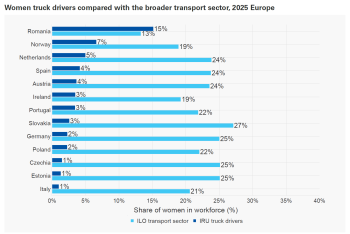
But the focus should not be limited to driver roles. To really drive change, the participation of women must be increased across the sector, including in senior and managerial roles.
How can this be achieved?
The Charter for Women in Road Transport is accompanied by an implementation toolkit and a checklist for both SMEs and large transport companies to drive change.
Implementation toolkit
Concrete recommendations to attract and retain women in road transport
Principle 1 - Recruit neutrally

The aim is to create a recruitment approach that naturally attracts and considers qualified women alongside all candidates. Through descriptive texts about the role and workplace, companies present themselves and the type of person they are seeking. Studies show that subtle biases in wording can influence who applies. Descriptions must appeal broadly rather than inadvertently discourage women from applying.
Employers should invite everyone involved in hiring to embrace a recruitment process that is free from bias and discrimination. This means reviewing each stage – from drafting job postings and marketing them to interviewing candidates – to remove any criteria or phrasing tied to pregnancy, maternity, age, marital status, appearance, or other personal traits that have no bearing on job performance.
More
Quick wins
- Adopt fair, inclusive recruitment and selection practices that remove barriers for women at every stage. This includes crafting gender-neutral job descriptions, conducting interviews that focus on skills rather than stereotypes. Anonymising CVs can depict a positive push to proactively reach out to qualified women candidates, minimising unconscious biases related to gender, ethnicity or age and creating a more equitable hiring process.
- Job advertisements should explicitly mention any available flexible work arrangements (e.g. adjustable work hours, remote work opportunities, part-time roles), supportive work-life balance measures, and parental leave policies that can improve the attractiveness of the profession to women.
- When equally qualified candidates apply, organisations are encouraged to give preference to women in order to correct structural imbalances in traditionally male-dominated areas of road transport. To reinforce this commitment and provide mutual support, it is recommended to onboard at least two women simultaneously, a practice demonstrated by some IRU members to enhance their sense of belonging and improve long-term retention. Such an approach, sometimes referred to as affirmative action, remains firmly merit-based. It is employed only when candidates' qualifications and experience are demonstrably equivalent and is best implemented in the final stage of recruitment to address deep-rooted barriers and foster a more diverse workforce.
- Actively showcase women as role models by featuring their achievements in company communications, events or speaker series, and mentorship programmes.
- Organise, where appropriate, events to present company jobs to young women and girls and also engage parents, as they often influence their children’s professional choices.
- Establish dedicated social and networking events for women – such as informal "women in transport networking" or after-work meetups – can significantly boost women's retention.
Taking it further
- Offer regular, targeted training for all managers, recruiters and colleagues – especially those who will work closely with new hires from minority groups, covering gender bias awareness, proactive diversity management, respectful communication and inclusive hiring practices.
- Put in place return-to-work and mentorship programmes to help women re-enter the industry and advance their careers smoothly. Additionally, by including an optional gender question in standard exit-survey processes, employers can analyse departures through a gender lens. This helps identify any disparities and inform targeted improvements without singling out women for separate interviews.
- Run outreach campaigns promoting the industry's positive impact on society.
Principle 2 - Empower career development

Employers recognise that ongoing training and reskilling are vital to fostering gender balance and enabling women’s career progression throughout the sector. Equal access to learning opportunities – whether when new infrastructure is introduced, technology transforms roles, or employees take career breaks – helps retain skilled women and opens pathways to leadership.
More
Quick wins
- Ensure that women returning from maternity leave or other breaks retain their accrued status and easily access refresher courses to update their skills, when needed.
- Anchor re-entry to existing training obligations where they exist, aligning its timing with the employee’s return from leave so it doubles as their re-entry refresher, rather than commissioning a separate programme. Where no such scheme applies, hold a short, informal skills check-in instead, covering any changes to vehicles, routes, regulations, or procedures during the absence.
Taking it further
- Ensure that all workers – regardless of gender, age or background – have the same opportunities to enter, validate and advance through vocational and technical training where needed.
- Include a mandatory gender-awareness and unconscious-bias segment in every training programme, with dedicated sessions for senior leaders. These modules should challenge stereotypes, spur discussions, and build an inclusive culture. Every training should address gender specific needs where necessary to ensure that both genders have equal access to learning.
- When possible, offer paid apprenticeships, on-the-job training and "positive-action" skill-building workshops specifically aimed at women technicians.
- Establish mentor/buddy networks to reinforce formal training, share career guidance and expand professional connections.
- Offer targeted leadership and mentorship initiatives – such as intensive leadership bootcamps, peer-mentoring circles and senior-sponsor partnerships – that equip women with the strategic skills, organisational insights and professional networks needed to progress into higher-level, better-paid roles, while addressing structural barriers to advancement.
- Maintain gender-balanced representation on training committees.
- Share successful case studies and/or courses to inspire wider adoption across the industry.
Principle 3 - Align pay

Pay women and men equally based on their role, experience and skills, consistent with the principles of the International Labour Organization Equal Remuneration Convention. Support this with transparent remuneration policies and procedures.
More
Quick wins
- Employers should not discriminate based on gender when it comes to remuneration, salary increases and bonuses. Therefore, employers should:
- Reassess their remuneration policy and include anti-discrimination and equality aspects in the assessment.
- Assess and compare the value of work on objective criteria such as educational, professional qualifications and required training, the skills and responsibilities inherent to the position, the nature and complexity of the work, and externally sourced benchmark data for comparable roles, undertaken and the nature of tasks involved to prevent or identify and tackle possible pay discrimination based on gender-biased pay scales.
- Employers should reduce the impact of maternity and paternity leaves on the variable part of the salary.
- Employers could reduce the impact of the attendance/presence criterion in the calculation of the annual or performance-based "bonuses"/variable parts of salaries.
- Employers should make available to employees the rules and criteria (e.g. national laws, collective agreements, and sectoral or company rules) used to determine the variable components of remunerations, such as payments in kind and bonuses. In case of discrimination, all these measures improve the prospects for successful employees' claims. This transparency would help companies to avoid discriminating in pay.
- Employers should enable employees to obtain information on the pay levels applicable to their category of workers (e.g. professions), for the same work or work of equal value, broken down by gender.
- Employers should make available means of redress/complaint to employees.
- Employers could inform employees how to challenge a situation if they fear that there has been discrimination (e.g. responsible person/department).
- Employers should disclose salary ranges in job postings or upon request, so pay isn't set through opaque individual negotiation.
Taking it further
- Embed equal-pay and non-discrimination principles in all people-management training.
- This could be done by including modules on the legal and business case for pay equity, and on how implicit bias can skew recruitment, performance reviews and promotion decisions.
- Ensure HR professionals, recruiters and line managers complete this training regularly (e.g. annually), with refresher sessions whenever policies or pay frameworks are updated.
- Introduce structured, merit-based decision frameworks, defining clear, role-specific selection and evaluation criteria (skills, experience, competencies) in advance of any recruitment, promotion or salary-review exercise.
- Use standardised scorecards, blinding CV screening and/or automated recommendation tools to generate "short-lists" or pay proposals strictly on those criteria can help minimise ad-hoc manager judgments.
- Audit decisions periodically (e.g. quarterly) to check that outcomes align with the pre-set criteria and to identify any unexplained disparities.
- Complement training with targeted awareness campaigns.
- Run periodic internal communications (posters, intranet features, lunch-and-learn sessions) to keep equal-pay goals and inclusive leadership top of mind.
- Share anonymised case studies showing how structured processes have mitigated bias and improved diversity outcomes.
Principle 4 - Work-life balance

Achieving a healthy balance between professional responsibilities and personal life is essential to attract and retain women. Plus, it benefits all employees.
Employers are invited to accommodate family needs and support long-term career engagement by offering flexible working arrangements.
More
Quick wins
- Frame childcare and family support as a universal benefit, not limited to parents of very young children, recognising that caregiving needs evolve over time and may include care for older children or other dependents.
- Involve employees in planning flexible schedules and workload adjustments to address their personal needs, ensuring their availability to every employee and across all roles, where possible.
Taking it further
- Where feasible, provide on-site or nearby childcare facilities, or offer subsidies or reimbursements for childcare expenses. These benefits should be available to all employees – regardless of gender – to promote shared caregiving responsibilities.
- Put in place shift-scheduling options, job-sharing schemes, part-time roles, and reduced-hour contracts to accommodate individual preferences.
- Offer inclusive parental-leave packages, including maternity, paternity, shared parental, and carers' leave, and negotiating additional family-related provisions as appropriate to your national context is highly recommended. Flexible options, such as phased returns or extended unpaid leave, can be valuable additions.
- Establish formal career-break or re-entry programmes to support employees returning to work after extended leave.
- Leverage social-dialogue forums to advocate for work–life balance improvements and align them with customer expectations.
Principle 5 - Address conflicts

A culture of respect is key to everyone's health, morale and effectiveness at work. Inappropriate behaviour, sexual harassment, and sexist behaviour undermine individual dignity, lower engagement, and lead to higher absenteeism and turnover. Even in the strongest teams, disagreements can arise. What matters most is how they are handled.
Employers are strongly recommended to invite all employees to treat one another with kindness and professionalism, making it clear that any form of discrimination or bullying will not be tolerated. Open dialogue, regular briefings and training on respectful conduct, and a zero-tolerance attitude towards inappropriate behaviour experienced by others will help ensure that everyone can thrive in a supportive work environment. This culture of respect must be backed by a transparent, well-communicated process for raising concerns – especially around harassment or bullying – so that every issue is taken seriously and addressed promptly. Left unaddressed, workplace conflicts erode team cohesion, lower productivity, and can ultimately drive valued employees away, damaging both morale and organisational reputation.
Employers should therefore foster an atmosphere where people feel safe to voice problems, confident that they will be heard impartially, and assured that fair solutions will be sought for the benefit of individuals and the company alike.
More
Quick wins
- Require people in leadership roles to always model respectful behaviour.
- Provide multiple reporting options (e.g. hotline, email, trusted HR contacts) where possible. Employers should respond swiftly and fairly to incidents, investigating every report with urgency and impartiality.
- Commit to confidentiality and protection against retaliation for anyone who comes forward. Creating safe spaces for employees to share experiences builds a supportive community and reinforces an inclusive culture.
Taking it further
- Adopt a clear, enforceable anti-harassment policy.
- Define unacceptable conduct (e.g. unwanted advances, demeaning jokes, sexist remarks) in concrete terms.
- Explain that certain behaviours may violate national or regional laws.
- Affirm zero tolerance: all incidents will be reported, investigated and, where warranted, disciplined.
- Detail progressive disciplinary steps – ranging from warnings to termination – to ensure consistency and fairness.
- Communicate the policy widely (staff handbooks, intranet, posters) and, where appropriate, share its existence with customers and partners to demonstrate your commitment.
- Train managers to recognise, address, and resolve complaints promptly and impartially to prevent inappropriate behaviour, sexual harassment and sexist behaviour.
- Offer support services – such as counselling or legal advice – to anyone affected.
- In light of an incident, employers should adopt interim measures (e.g. temporary reassignments) to ensure the safety and comfort of those involved, as well as follow through with appropriate corrective actions and communicate outcomes to relevant parties.
- Collect data on reported incidents, investigation timelines and resolutions. It is a good practice to publicise aggregate results and improvements to maintain transparency and trust, as well as regularly assess the effectiveness of policies and procedures through surveys, focus groups or audits.
- Hold training sessions or workshops for all employees on identifying and preventing harassment and discrimination that include specific modules on bystander intervention and unconscious bias.
- Codify in writing that any form of sexual harassment or sexist behaviour will result in disciplinary action up to and including dismissal. This can be done by embedding it in the company's values, performance evaluations, and/or leadership objectives.
Principle 6 - Champion safe, secure and dignified working environments, ensuring access to appropriate parking, sanitation and facilities

Rest facilities at stops and terminal stations
Despite women comprising over 50% of public transport users, they remain under-represented – and often underserved – in urban transport workforces. Gender stereotypes, non-inclusive recruitment practices, ill-fitting equipment, and a lack of private facilities and safety measures create significant barriers to women entering, staying and advancing in the sector. Employers and urban transport authorities are therefore urged to adopt proactive, gender-responsive policies across recruitment, workplace design, training and facilities.
This includes ensuring all job materials and outreach campaigns feature women in diverse roles, providing ergonomically designed uniforms, tools and vehicles; guaranteeing secure, private rest and sanitation areas on route and at depots; implementing clear anti-harassment protocols and safety audits; and offering flexible work arrangements alongside mentoring and career-development programmes.
Safe and secure truck parking areas
Across most major transport corridors – whether in scheduled or unscheduled passenger services – truly convenient, gender-sensitive rest facilities at terminal stops and stations, together with secure parking areas, remain painfully scarce.
This is not a regional problem. Surveys from Europe, North America and beyond consistently find that a majority of women drivers report having faced unsafe situations at overnight parking areas. Rest and parking facilities frequently lack appropriate amenities, such as toilets, showers, adequate lighting, clean restrooms, and basic rest and dining options. Too often, gender-specific needs are overlooked, creating additional safety and inclusivity barriers that persist across different regulatory and cultural contexts.
Employers are strongly encouraged to recognise and respond to these gender-specific needs, whether by providing such facilities themselves or by inviting relevant external service providers – municipalities, parking operators, and similar stakeholders – to offer them. This is not merely a matter of convenience; it is a contribution to road safety and long-term workforce stability. To improve fatigue-fighting, high-quality rest facilities are essential anywhere a driver operates.
More
Quick wins
- Supply personal protective equipment (PPE) in a wide range of sizes and designs that fit all body types, ensuring safety and comfort for everyone.
- Have sanitary facilities in buildings that support standards for privacy and security, considering men and women perspectives.
- Maintain clear reporting channels for any incident and respond swiftly with support and corrective action.
Taking it further
- Conduct health and safety risk assessments from a gender perspective, analyse the results and adopt necessary measures.
- Organise mixed-gender teams for high-risk night shifts or areas to improve security and occupational safety.
- Pilot reserved, well-lit parking zones close to terminals for women (including pregnant employees) working late or overnight.
- Map routes and depots to pinpoint violence hotspots; survey women staff for firsthand risk reports.
- Provide all employees – especially women – with security training and raise awareness internally and with the public of staff safety concerns.
- Extend medical check-ups and occupational health services to account for gender differences in health behaviours, symptom progression and treatment responses.
- Adopt risk assessments for pregnant women and suitable alternative duties during pregnancy.
- Ensure women drivers (taxis, buses, trucks) have secure access points, communication devices, and emergency protocols, particularly during late hours. This should go beyond standard H&S measures.
- Maintain clear reporting channels for any incident and respond swiftly with support and corrective action.
Rest facilities at stops and terminal stations
Quick wins
- Use imagery, language and role models in all communications that showcase women in driving, technical and leadership roles.
Taking it further
- Provide properly fitted PPE and vehicle controls that have been assessed via body mapping studies.
- Publish clear, confidential reporting channels for gender based harassment, plus rapid-response investigation teams.
- Train all staff, including managers, on violence prevention and de-escalation techniques; install panic buttons/radios in vehicles.
Safe and secure truck parking areas
Quick wins
- Mark and reserve a cluster of bays closest to the security office and restrooms for women drivers.
Taking it further
- Ensure that all walkways between trucks, restrooms, dining and security posts are brightly lit, and covered by cameras.
- Provide lockable, women-only restroom blocks stocked with sanitary supplies, mirrors, seating, and charging points.
- Create separate "quiet rooms" or lounges where drivers can rest, nap, or de-stress, with gender-neutral and women-only options.
- Use visible signage ("Women's Safe Zone") and ensure real-time monitoring (e.g. app alerts when spots free up).
- Station trained security staff (men and women) on patrol, with regular foot-and-vehicle rounds of all lots.
- Make a "late-shift safety buddy" available to drivers who wish for company when walking to their vehicle after hours for safety reasons.
- Place QR-code stickers in women's restrooms and lounges inviting anonymous suggestions on safety and amenities.
- Integrate feedback channels with your HR or facilities team for rapid follow-up and visible "you said/we did" updates.
- Host periodic focus groups with women driver associations to co-design improvements before rolling them out widely.
- Sponsor mentoring or "ride-along" days where prospective women drivers visit well-equipped parking facilities.
- Require all carrier partners to use only safe and secure truck parking areas that meet your gender-inclusive benchmarks or provide higher pay/pass-through fees when they do.
- Run referral bonuses when existing women drivers recommend a colleague who signs with you, tied to their use of these facilities.
- Ensure scheduling staff are aware of women drivers' preferences and always route them to equipped safe and secure truck parking areas.
- Incorporate secure parking area safety training into drivers' onboarding curriculum.
Charter for Women in Road Transport
The commercial road transport industry is committed to improving its efficiency, attractiveness and professionalism – notably in responding to challenges in workforce and skills shortages.
A key pillar of this effort is increasing women’s participation in mobility and logistics – as employees, drivers and managers – by promoting career opportunities and addressing the practical, social and cultural barriers that prevent women from entering and thriving in the industry.
IRU’s Charter for Women in Road Transport lays out core principles to open road transport to more women by providing opportunities across the industry.
The charter invites companies of all sizes to embrace its principles, evolve their culture and set clear targets – with the ultimate aspiration of reaching gender parity.
Inclusive strategy
Put in place a supportive, inclusive company strategy covering recruitment, training, anti-harassment, and conflict management to increase the number of women.
Set clear targets
Formulate longer-term targets and specific short-term objectives to attract and retain women, adapting policies, behaviours and incentives.
Appoint a champion
Large companies can appoint a dedicated staff member to take responsibility for implementing the policy and leading the process of change.
Review & improve
Carry out regular reviews of actions undertaken and take corrective measures to implement short-term and long-term goals.
Why more women?
The industry is facing a structural shortage of drivers. This poses a major threat to mobility networks and supply chains across the globe. But the shortage is not only about too few workers; it also reflects the sector’s difficulty in attracting young people and women, two of the largest untapped talent pools in today’s labour market.
Bringing more women into the profession is not simply a matter of filling empty seats.
A driver profession that reflects the diversity of the wider workforce is a stronger, more resilient one. It draws on a broader pool of skills and perspectives, strengthens safety culture, and is better equipped to serve an increasingly diverse customer base.
Yet women remain a small minority behind the wheel.
In Brazil, women account for around 4% of truck drivers – one of the highest shares among the markets surveyed worldwide. In Canada, the figure is similar. This points to a pattern seen across most markets: the profession has yet to open its doors fully to half of its potential workforce.
Safety concerns remain a major barrier keeping women out of the profession, from overnight stops at isolated truck stops to the lack of female driver trainers who can support and encourage women to join and stay.
The two challenges reinforce each other: more female trainers are needed to bring in more female drivers, but more female drivers are needed to develop more female trainers. Breaking this cycle will require deliberate, sustained action.
But the focus should not be limited to driver roles. To really drive change, the participation of women must be increased across the sector, including in senior and managerial roles.
How can this be achieved?
The Charter for Women in Road Transport is accompanied by an implementation toolkit and a checklist for both SMEs and large transport companies to drive change.
Implementation toolkit
Concrete recommendations to attract and retain women in road transport
Principle 1 - Recruit neutrally
The aim is to create a recruitment approach that naturally attracts and considers qualified women alongside all candidates. Through descriptive texts about the role and workplace, companies present themselves and the type of person they are seeking. Studies show that subtle biases in wording can influence who applies. Descriptions must appeal broadly rather than inadvertently discourage women from applying.
Employers should invite everyone involved in hiring to embrace a recruitment process that is free from bias and discrimination. This means reviewing each stage – from drafting job postings and marketing them to interviewing candidates – to remove any criteria or phrasing tied to pregnancy, maternity, age, marital status, appearance, or other personal traits that have no bearing on job performance.
Quick wins
Taking it further
Principle 2 - Empower career development
Employers recognise that ongoing training and reskilling are vital to fostering gender balance and enabling women’s career progression throughout the sector. Equal access to learning opportunities – whether when new infrastructure is introduced, technology transforms roles, or employees take career breaks – helps retain skilled women and opens pathways to leadership.
Quick wins
Taking it further
Principle 3 - Align pay
Pay women and men equally based on their role, experience and skills, consistent with the principles of the International Labour Organization Equal Remuneration Convention. Support this with transparent remuneration policies and procedures.
Quick wins
Taking it further
Principle 4 - Work-life balance
Achieving a healthy balance between professional responsibilities and personal life is essential to attract and retain women. Plus, it benefits all employees.
Employers are invited to accommodate family needs and support long-term career engagement by offering flexible working arrangements.
Quick wins
Taking it further
Principle 5 - Address conflicts
A culture of respect is key to everyone's health, morale and effectiveness at work. Inappropriate behaviour, sexual harassment, and sexist behaviour undermine individual dignity, lower engagement, and lead to higher absenteeism and turnover. Even in the strongest teams, disagreements can arise. What matters most is how they are handled.
Employers are strongly recommended to invite all employees to treat one another with kindness and professionalism, making it clear that any form of discrimination or bullying will not be tolerated. Open dialogue, regular briefings and training on respectful conduct, and a zero-tolerance attitude towards inappropriate behaviour experienced by others will help ensure that everyone can thrive in a supportive work environment. This culture of respect must be backed by a transparent, well-communicated process for raising concerns – especially around harassment or bullying – so that every issue is taken seriously and addressed promptly. Left unaddressed, workplace conflicts erode team cohesion, lower productivity, and can ultimately drive valued employees away, damaging both morale and organisational reputation.
Employers should therefore foster an atmosphere where people feel safe to voice problems, confident that they will be heard impartially, and assured that fair solutions will be sought for the benefit of individuals and the company alike.
Quick wins
Taking it further
Principle 6 - Champion safe, secure and dignified working environments, ensuring access to appropriate parking, sanitation and facilities
Rest facilities at stops and terminal stations
Despite women comprising over 50% of public transport users, they remain under-represented – and often underserved – in urban transport workforces. Gender stereotypes, non-inclusive recruitment practices, ill-fitting equipment, and a lack of private facilities and safety measures create significant barriers to women entering, staying and advancing in the sector. Employers and urban transport authorities are therefore urged to adopt proactive, gender-responsive policies across recruitment, workplace design, training and facilities.
This includes ensuring all job materials and outreach campaigns feature women in diverse roles, providing ergonomically designed uniforms, tools and vehicles; guaranteeing secure, private rest and sanitation areas on route and at depots; implementing clear anti-harassment protocols and safety audits; and offering flexible work arrangements alongside mentoring and career-development programmes.
Safe and secure truck parking areas
Across most major transport corridors – whether in scheduled or unscheduled passenger services – truly convenient, gender-sensitive rest facilities at terminal stops and stations, together with secure parking areas, remain painfully scarce.
This is not a regional problem. Surveys from Europe, North America and beyond consistently find that a majority of women drivers report having faced unsafe situations at overnight parking areas. Rest and parking facilities frequently lack appropriate amenities, such as toilets, showers, adequate lighting, clean restrooms, and basic rest and dining options. Too often, gender-specific needs are overlooked, creating additional safety and inclusivity barriers that persist across different regulatory and cultural contexts.
Employers are strongly encouraged to recognise and respond to these gender-specific needs, whether by providing such facilities themselves or by inviting relevant external service providers – municipalities, parking operators, and similar stakeholders – to offer them. This is not merely a matter of convenience; it is a contribution to road safety and long-term workforce stability. To improve fatigue-fighting, high-quality rest facilities are essential anywhere a driver operates.
Quick wins
Taking it further
Rest facilities at stops and terminal stations
Quick wins
Taking it further
Safe and secure truck parking areas
Quick wins
Taking it further
Sign the charter
Show your engagement and sign the charter
Related content
Related documents
Contact us
Do you have a question? Would you like advisory services on how your company can attract and retain more women? A best practice to stand out your company? Contact us directly.
Related news
Geneva
Diesel: all indicators turning red
Geneva
IRU and UNECE eye stronger cooperation on international road transport
Geneva
Trucks make transport corridors work: IRU at key UN working party
Seoul
AI and new technologies are reshaping road transport, but people remain key
Brussels
Vehicle data, AI and operational challenges take centre stage at IRU event
Islamabad
Legal mobility pathways key to mitigating driver shortage
Brussels
IRU brings OEMs and operators together to advance vehicle data access
Brussels
Closing road transport’s gender gap: What can you do?
Brussels
eCMR interoperability in focus at IRU innovation roundtable
Online
A seat at the wheel: IRU champions women in coach travel at UN event